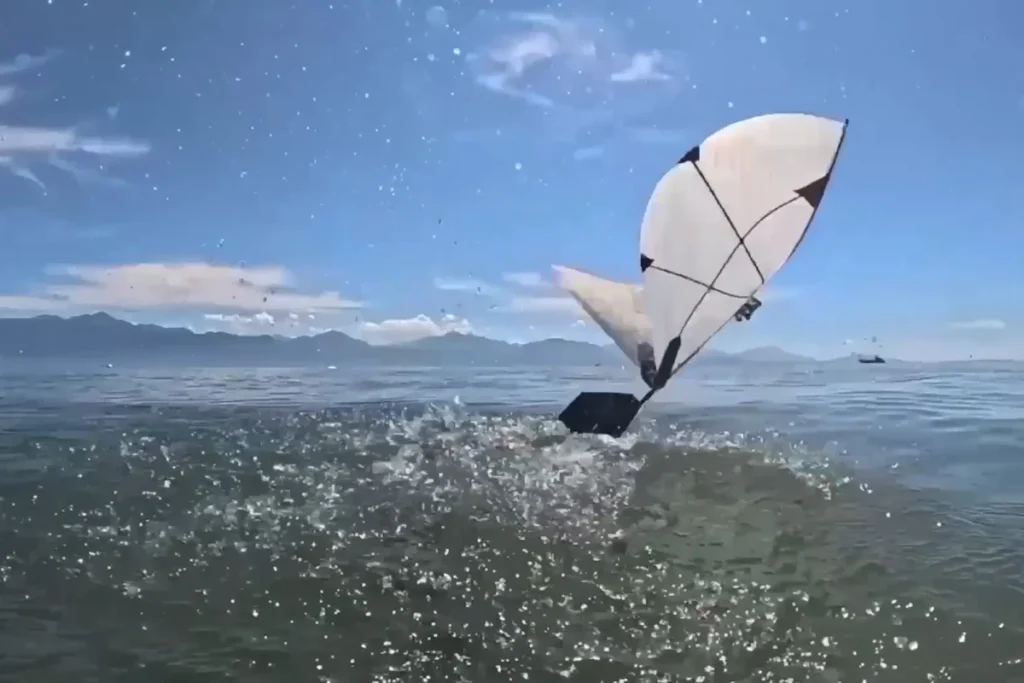
A revolutionary robot capable of seamless transition between flight and underwater propulsion, drawing direct inspiration from the natural world’s most versatile avian species, has been developed by a collaborative team of engineers from the Massachusetts Institute of Technology (MIT) and EPFL in Lausanne, Switzerland. This pioneering "flapping-wing aerial-aquatic vehicle" (FAAV) represents a significant leap in robotic design, promising to transform fields from oceanography to environmental monitoring by offering an unprecedented ability to traverse both air and water with a single, agile platform.
The natural world is replete with wonders, none perhaps as captivating as the approximately 100 species of birds that defy conventional boundaries, mastering both the skies and the depths. Loons, gulls, puffins, cormorants, and petrels are prime examples of these dual-medium aviators. These birds execute spectacular dives, plunging into the aquatic realm to hunt prey with remarkable agility, only to burst forth from the surface, ascending into the air to continue their journey. Their inherent ability to adapt their locomotion to vastly different physical environments—air being approximately 1,000 times less dense and viscous than water—has long fascinated scientists and engineers alike. It is this extraordinary biological adaptability that served as the core inspiration for the FAAV, a sub-300-gram marvel designed not only to mimic these behaviors but also to unlock new avenues for scientific research and practical applications.
The Avian Blueprint: Masters of Two Realms
To fully appreciate the FAAV’s innovation, one must first delve into the biomechanical marvels that inspired it. Diving birds possess a unique suite of adaptations that enable their bimodal existence. Their wings, while primarily designed for aerial flight, are often shorter and stiffer than those of terrestrial birds, allowing them to act as hydrofoils or propellers underwater. For instance, puffins utilize a "wing-propelled diving" technique, essentially "flying" through water with the same flapping motion used in the air, albeit at a reduced frequency and with greater force. Their bodies are streamlined to reduce drag, and their feathers are densely packed and coated with oil from a preen gland, providing insulation and waterproofing essential for maintaining buoyancy control and preventing hypothermia. Some species, like loons, even possess denser bones than typical flying birds, aiding in their ability to dive deep.
The transition itself is a complex dance between physics and physiology. To take off from water, birds like ducks often paddle vigorously with their webbed feet while simultaneously flapping their wings, generating the necessary thrust and lift to overcome the water’s surface tension and density. Once airborne, their physiology shifts, with respiratory and circulatory systems optimized for sustained flight. Underwater, they can hold their breath for extended periods, and their vision adapts to the different refractive index of water. This intricate interplay of form and function highlights the monumental engineering challenge of creating a robotic system that can seamlessly replicate such diverse mechanical demands.
Genesis of the FAAV: Bridging Air and Water
The development of the FAAV is rooted in the burgeoning field of bio-inspired robotics, where engineers look to nature’s millions of years of evolutionary design for solutions to complex problems. The collaboration between MIT, a global leader in robotics and artificial intelligence, and EPFL, renowned for its contributions to engineering and innovation, brought together diverse expertise to tackle the formidable challenge of aerial-aquatic locomotion.
At the heart of this endeavor is MIT’s AURA Lab, led by Assistant Professor Raphael Zufferey, the lead author of the new study published in the journal Science. The AURA Lab’s mission revolves around engineering small, unobtrusive aerial and aquatic vehicles designed to explore and monitor the health of oceans and waterways. This ethos perfectly aligned with the vision for the FAAV: a robot capable of reaching previously inaccessible areas and collecting data with minimal environmental impact. The team recognized that while the physical properties of air and water are dramatically different – water being significantly denser and more viscous – nature had already provided elegant solutions for traversing both. The key was to understand and translate these biological principles into a robust robotic design.
The research journey began with an extensive review of scientific literature on diving birds. Researchers meticulously gathered data on species such as puffins, petrels, and kingfishers, analyzing their wing flapping frequencies in both air and water, wing dimensions, and takeoff strategies. They observed that smaller birds typically flap their wings around 10 times per second in air but reduce this to about four times per second when swimming. Larger birds exhibit slightly lower frequencies due to their greater wingspans. These critical observations provided the foundational biomechanical parameters for the FAAV’s design.
Anatomy of an Aerial-Aquatic Robot: Engineered for Versatility
The FAAV itself is a testament to minimalist yet highly functional design. Weighing less than 300 grams (approximately half a pound), its lightweight construction is crucial for both aerial agility and efficient underwater movement. The robot’s core components include:
- Central Body (Fuselage): This houses the FAAV’s vital electronics, a rechargeable battery, and a waterproof electric motor. The motor is the powerhouse, driving a crankshaft mechanism that translates rotational motion into the rhythmic up-and-down flapping of the wings.
- Flexible, Flapping Wings: These are the FAAV’s primary means of propulsion in both mediums. Constructed from thin, yet durable membranes, the wings are coated with hydrophobic nanoparticles. This specialized coating is essential for repelling water, minimizing drag upon exiting the water, and ensuring efficient airflow for flight. The design emphasizes flexibility, allowing the wings to adapt their effective shape and resistance depending on whether the robot is in air or water. The modular design also allows for wings of different sizes (small: 60 cm, medium: 80 cm, large: 100 cm) to be swapped out, enabling researchers to optimize performance for specific tasks or environmental conditions.
- Steerable Tail: This motorized component provides critical control over the robot’s pitch and yaw. By changing its angle, the tail allows the FAAV to dive, ascend, and maintain directional stability in both air and water. Like the wings, the tail is also swappable, offering further customization for experimental optimization.
The ingenuity of the FAAV lies in its ability to leverage the same physical mechanism – flapping wings – for propulsion in two fundamentally different fluid environments. This contrasts sharply with many existing aerial-aquatic robotic concepts that often rely on separate propulsion systems (e.g., propellers for air, impellers for water), adding complexity, weight, and energy inefficiency.
The Rigorous Testing Regime: From Tank to Lake
The development of the FAAV involved a methodical and rigorous testing protocol, moving from controlled laboratory environments to more realistic natural settings. The chronology of experimentation unfolded as follows:
- Initial Water Tank Experiments: The first phase of testing was conducted in a dedicated water tank. This controlled environment allowed engineers to precisely manipulate variables and observe the robot’s behavior without external interference. The robot was submerged approximately half a meter below the surface, and various combinations of wing sizes, flapping frequencies, and tail angles were programmed and tested. High-speed cameras and sensors captured detailed data on thrust, lift, drag, and transition dynamics. This phase was crucial for identifying the fundamental principles governing the robot’s movement and transition.
- Lake Geneva Field Trials: Following successful preliminary tests, the FAAV was deployed in Lake Geneva in Switzerland. This provided a more realistic testing ground, exposing the robot to natural variations in water temperature, clarity, and surface conditions (though still relatively calm compared to open ocean). These trials confirmed the robot’s capabilities in a less controlled environment and validated the findings from the lab.
Across numerous flights and dives, the research team meticulously collected data. Their key findings, which underpin the FAAV’s remarkable capabilities, include:
- Optimal Wing Size for Transition: The experiments revealed that the medium-sized wings (80 cm wide) provided the most reliable and efficient performance for both sustained flight and swimming, as well as the critical transition between the two mediums. This highlights the delicate balance required; wings too small might lack sufficient lift for air or thrust for water, while wings too large could be unwieldy and inefficient.
- Wing Flexibility as a Key Factor: The flexibility of the wing membranes proved to be a critical design element. Flexible wings minimize flapping amplitude in water, reducing drag and increasing propulsion efficiency. Simultaneously, they need to be firm enough to generate adequate lift and maintain structural integrity during aerial flight. This dual requirement for flexibility and firmness is a testament to the bio-inspired design, mimicking how bird wings deform in different mediums.
- Flapping Frequencies Mimicking Nature: The robot demonstrated impressive performance metrics, swimming through water at speeds approaching 1 meter per second when flapping at approximately 5 Hertz (five flaps per second). In the air, it achieved speeds of around 6 meters per second with a similar flapping frequency. These speeds and frequencies closely align with observations of actual diving birds, underscoring the accuracy and effectiveness of the bio-inspired design.
- The Critical Takeoff Angle: Achieving a smooth and successful transition from water to air was found to be highly dependent on the robot’s pitch angle upon breaking the surface. The optimal angle was determined to be 70 degrees – a relatively steep ascent. This specific angle prevents the wingtips from re-entering the water’s surface as the robot flaps upwards, which would otherwise generate unwanted drag and potentially cause the robot to tip back into the water. Any steeper, and the robot risks instability.
- The Absence of "Feet": A Robotic Anomaly: Perhaps one of the most surprising findings was that the FAAV could successfully launch from water into air without requiring any "paddling" maneuver, unlike many diving birds (e.g., puffins and ducks) that use their feet for additional thrust during takeoff. Raphael Zufferey noted, "If you look at birds, most birds need to paddle at the surface to take off. And the question was, do we need the same for robots? And it turns out we don’t." This discovery simplifies the robotic design, demonstrating that in certain engineered systems, a direct translation of all biological mechanisms isn’t always necessary for functional success. The combination of optimized wing size, flapping frequency, and tail pitch proved sufficient to overcome surface tension and achieve aerial launch.
Beyond the Lab: Profound Implications and Applications
The FAAV is more than just a scientific curiosity; it represents a significant technological advancement with far-reaching implications across numerous sectors. Its ability to seamlessly navigate both air and water positions it as a transformative tool for data collection, exploration, and monitoring in environments previously challenging or cost-prohibitive to access.
- Oceanography and Marine Biology: One of the most immediate and impactful applications lies in ocean science. Traditional oceanographic research often relies on large, expensive vessels, or specialized underwater remotely operated vehicles (ROVs) and autonomous underwater vehicles (AUVs). The FAAV could revolutionize this by providing a nimble, cost-effective alternative. Researchers envision deploying these winged robots from boats or shorelines, allowing them to fly rapidly to areas of interest – such as remote icebergs, dynamic port facilities, or even over pods of whales. Upon arrival, the robot could dive to collect water samples, measure parameters like temperature, salinity, oxygen levels, or even identify pollutants, then resurface and fly back to deliver the data. This "dive, sample, fly, return" cycle could be repeated multiple times, offering unprecedented frequency and spatial coverage of data collection at a fraction of the cost and logistical complexity of traditional methods. It could enable monitoring of aquatic regions deemed too dangerous for human-crewed vessels, such as areas with extreme weather, high currents, or proximity to natural hazards like volcanic vents.
- Environmental Monitoring: Beyond deep-sea oceanography, the FAAV holds immense promise for monitoring the health of coastal communities, rivers, and lakes. It could be deployed to assess water quality, track the spread of pollution (e.g., oil spills, harmful algal blooms), monitor aquatic ecosystems for signs of distress, or conduct surveys of biodiversity. Its ability to fly quickly between monitoring points and then dive for precise measurements makes it an ideal platform for dynamic environmental assessments.
- Infrastructure Inspection: The FAAV could also find applications in inspecting critical infrastructure. Ports, offshore wind farms, oil and gas platforms, and underwater pipelines require regular inspection, often involving specialized divers or expensive ROVs. A FAAV could fly to a site, dive to inspect underwater structural integrity or potential damage, and then fly back, offering a safer, faster, and more economical inspection method.
- Search and Rescue & Defense: In emergency scenarios or defense operations, the ability to rapidly deploy a reconnaissance platform that can operate in both air and water could be invaluable. A FAAV could quickly scout coastal areas, river systems, or disaster zones, providing critical intelligence and assisting in search and rescue efforts where terrain is complex and access is difficult.
- Economic and Logistical Advantages: Raphael Zufferey highlights the economic benefits: "Our dream vision is for oceanographers, marine biologists, and members of coastal communities to launch this robot from a boat, or from shore, and it would fly close to the area of interest… It would dive into the water to take a measurement or collect a sample, and fly back to deliver the data at a fraction of the cost of traditional methods. Then it could go back out to dive for more." This economic efficiency, coupled with the ability to collect data with higher frequency (every hour, not just every week), promises to accelerate scientific discovery and improve environmental stewardship.
The Road Ahead: Future Enhancements and Challenges
While the FAAV represents a groundbreaking achievement, the research team is already looking towards future enhancements and addressing remaining challenges. The immediate focus includes:
- Improved Wing Design: Current wings primarily flap up and down. Future iterations aim to enable the wings to turn, offering greater maneuverability and control in both air and water, similar to how birds use their wings for intricate aerial maneuvers.
- Robustness in Turbulent Conditions: Testing the robot’s performance under more challenging environmental conditions is crucial. This includes evaluating its ability to launch from choppy waters and maintain stable flight through windy conditions, which are common in real-world coastal and oceanic environments.
- Enhanced Autonomy and Navigation: Future developments will likely focus on improving the FAAV’s autonomous capabilities, allowing it to plan complex missions, navigate dynamic environments, avoid obstacles, and make intelligent decisions without constant human oversight. This will require integrating advanced sensors, GPS for aerial navigation, and potentially sonar or optical systems for underwater navigation.
- Energy Efficiency and Payload Capacity: For longer missions and the ability to carry more sophisticated sensors or larger samples, improvements in battery technology and overall energy efficiency will be critical. Increasing the payload capacity while maintaining agility will also be an ongoing engineering challenge.
- Swarming Capabilities: Envisioning a future where multiple FAAVs could operate as a synchronized swarm, covering vast areas or performing complex, collaborative data collection tasks, presents another exciting research direction.
The publication of this research in Science marks a pivotal moment in robotics. The FAAV is not merely an engineering feat; it is a tangible manifestation of how nature’s elegant solutions can inspire technological advancements that address some of humanity’s most pressing scientific and environmental challenges. As Raphael Zufferey concludes, "One of the major challenges in ocean science is collecting data both frequently and across many locations, which is something this robot could do in the future. You could send this out not just every week, but every hour. It could fly out at high speeds, dive in fly back, deliver its data, and go back out, multiple times." This innovative aerial-aquatic robot heralds the dawn of a new era for environmental exploration and monitoring, poised to unlock secrets of our planet’s most dynamic and inaccessible realms.
This groundbreaking work was supported, in part, by a Marie Skłodowska-Curie Actions fellowship grant, underscoring the international collaborative spirit behind this significant scientific endeavor.