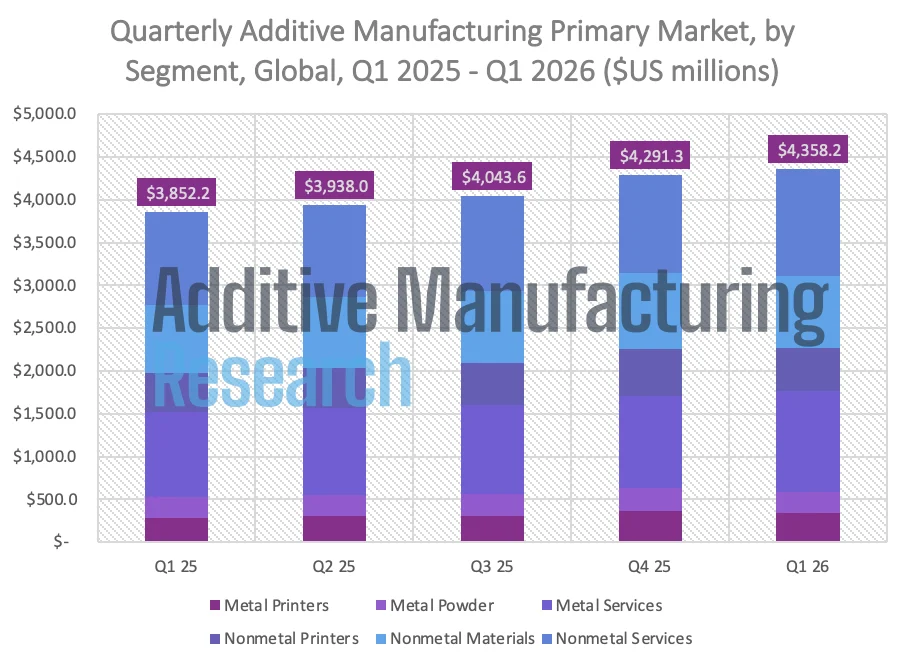
The additive manufacturing (AM) industry has demonstrated a sustained and significant growth trajectory, as highlighted by the latest Q1 2026 market data and forecast reports released by leading industry analyst firm, Additive Manufacturing Research (AMR). These comprehensive reports, which cover ceramic, metal, and polymer 3D printing systems, materials, and services, indicate a robust expansion in market value and a positive outlook for the sector. AMR, a veteran in providing market intelligence for the 3D printing/AM landscape since 2013, has once again provided crucial insights into the industry’s performance.
Key Findings from Q1 2026 Reports
The Q1 2026 reports reveal that the total additive manufacturing market reached an impressive $4.35 billion in the first quarter of 2026. This figure represents a substantial year-over-year growth of 13.1%, building upon a strong sequential market size of $4.29 billion recorded in the fourth quarter of 2025. This sustained upward momentum underscores the increasing adoption and integration of AM technologies across various industries.
Scott Dunham, Executive Vice President at AM Research, commented on the prevailing market conditions, stating, "Q1 2026 mostly continued the growth trend for AM, continuing to ride the train of global supply chain reorganization and government-backed defense and national security initiatives where the traditional means of production may not be able to provide fast enough solutions. Growth is not even across the industry, but it certainly is a growth period, and the first quarter of the year continued on the momentum from the second half of last year."
Dunham’s statement points to two significant drivers fueling this expansion: the ongoing global efforts to reconfigure supply chains and substantial government investments in defense and national security. These sectors are increasingly leveraging AM for its agility, speed, and ability to produce complex parts on demand, often overcoming limitations of conventional manufacturing in critical applications.
Deep Dive into Market Segments
The reports provide a detailed breakdown of market performance across key segments. In Q1 2026, the metal AM market saw a significant increase, reaching $1.76 billion. This marks a considerable rise from the $1.52 billion recorded in the same quarter of the previous year, indicating robust demand for metal 3D printing solutions in aerospace, automotive, medical, and industrial applications.
The polymer AM market also demonstrated strong performance, growing to $2.59 billion in Q1 2026, up from $2.33 billion in Q1 2025. This segment, which often benefits from broader adoption in prototyping, consumer goods, and functional part production, continues to be a cornerstone of the AM industry.
Furthermore, the AM Services market, encompassing outsourced 3D printing operations, design, and post-processing, experienced substantial growth. In Q1 2025, this market was valued at $2.07 billion, and it has now climbed to $2.42 billion by Q1 2026. This growth in services suggests an increasing reliance on specialized AM providers as businesses scale their additive manufacturing efforts and explore new applications.
AM Research’s Comprehensive Analysis
The "3DP/AM Market Insights: Q1 2026" report serves as a distilled and analytical companion to the broader market data and forecast reports. It offers exclusive insights, data visualizations, and expert commentary from AM Research. The firm meticulously tracks the AM market by various crucial parameters, including application sectors, geographical distribution, machine class, printing technology, and individual vendors. This granular approach allows for a nuanced understanding of market dynamics and emerging trends.
The scope of AM Research’s analysis is extensive, encompassing a wide array of leading companies in the "Core Metals" and "Core Polymers" segments. The report’s data draws from the tracking of numerous industry players, including but not limited to 3D Systems, Stratasys, Velo3D, ATLIX, EOS, Nikon SLM Solutions, HP, Nano Dimension (Markforged and Desktop Metal), Formlabs, Carbon, Creality, Bambu Lab, Prodways, Renishaw, Optomec, Colibrium Additive, Farsoon Technologies, Eplus3D, BeAM, and Bright Laser Technologies (BLT). This broad coverage ensures that the market intelligence provided is representative of the entire ecosystem.

Historical Context and Future Outlook
AMR’s "Core Metals" and "Core Polymers" market data offerings are built upon a foundation of nearly a decade of historical quarterly data, providing a valuable long-term perspective on industry evolution. Crucially, these datasets also include ten-year forward forecasts, enabling stakeholders to anticipate future market trends, investment opportunities, and technological advancements.
The quarterly reports on the metal and polymer AM markets are accessible through the AM Research website. They can be acquired as a one-time purchase or through a subscription model, which includes quarterly updates over a one-year term. Sample reports are also available upon request, allowing potential clients to evaluate the depth and quality of the data before committing.
Complementing these core data reports, the "3DP/AM Market Insights: Q1 2026" report is also available as a standalone product or via subscription. This report enhances the understanding of the core data by integrating proprietary charting and graphs with in-depth written analysis. It provides essential context, direction, and strategic insights, making it an invaluable resource for businesses navigating the complexities of the AM landscape.
Drivers of Growth and Industry Implications
The sustained growth in the AM market, as evidenced by the Q1 2026 reports, is indicative of several converging factors. The aforementioned global supply chain recalibration has pushed industries to seek more resilient, localized, and agile manufacturing solutions. AM’s ability to produce complex geometries, reduce material waste, and enable on-demand manufacturing makes it an ideal candidate for this shift.
Government initiatives in defense and national security are another powerful catalyst. The need for rapid prototyping of new equipment, production of specialized parts for critical missions, and the creation of resilient supply chains for defense hardware are driving significant investment in AM technologies. This includes advanced materials, high-performance printing systems, and robust quality assurance processes.
Beyond these macro trends, the ongoing innovation within the AM sector itself continues to fuel adoption. Advancements in material science are leading to new metal alloys, high-performance polymers, and specialized ceramics with enhanced properties. Concurrently, improvements in printer speed, accuracy, and build volume are expanding the range of applications and the economic viability of AM for serial production.
The increasing maturity of the AM ecosystem, with a growing number of service bureaus and established vendors offering comprehensive solutions, also plays a vital role. Businesses can now access AM capabilities more readily, reducing the barriers to entry and accelerating the adoption curve.
Broader Impact and Future Trajectory
The continued expansion of the AM market has far-reaching implications. For manufacturers, it offers opportunities for product innovation, cost optimization, and improved supply chain efficiency. For governments, it represents a strategic advantage in defense and national security, enabling faster development and deployment of advanced capabilities. For the broader economy, it signifies the maturation of a transformative technology with the potential to reshape industries and create new economic opportunities.
The data presented by AM Research suggests that the additive manufacturing industry is not only recovering from past economic fluctuations but is entering a phase of sustained, robust growth. The convergence of technological advancements, strategic industrial shifts, and increasing market acceptance positions AM as a critical component of future manufacturing paradigms. As the industry continues to evolve, detailed market intelligence from firms like AM Research will remain indispensable for stakeholders seeking to capitalize on its immense potential. The upward trajectory observed in Q1 2026 is a strong indicator that the additive manufacturing sector is poised for continued significant expansion in the years to come.