3D bioprinting, a transformative technology that involves creating living tissues by extruding cells suspended within hydrogel-based "bio-inks," has emerged as a cornerstone of bioengineering. Its potential applications span from meticulously replicating human tissues for research and drug testing to ultimately replacing diseased or damaged organs. However, a persistent hurdle in achieving the precision and reproducibility required for these ambitious goals has been the issue of cell sedimentation. This phenomenon, driven by gravity, causes heavier cells to settle at the bottom of the bio-ink reservoir within the printer’s syringe, leading to a cascade of problems that compromise print quality and tissue consistency.
The challenge of cell settling is particularly acute during the extended printing sessions necessary for fabricating larger, more complex tissue constructs. As explained by Ritu Raman, the Eugene Bell Career Development Professor of Tissue Engineering and an assistant professor of mechanical engineering at MIT, "This cell settling, which becomes worse during the long print sessions required to print large tissues, leads to clogged nozzles, uneven cell distribution, and inconsistencies between printed tissues." Current strategies, such as manual stirring of bio-inks prior to printing or the integration of passive mixing mechanisms, have proven insufficient in maintaining the uniform distribution of cells once the printing process commences. These existing solutions often fail to address the dynamic nature of bio-ink extrusion, where continuous movement and pressure can exacerbate the sedimentation issue.
Addressing this fundamental limitation, a team led by Professor Raman has developed an innovative solution: a magnetically actuated mixer, dubbed "MagMix." This novel system actively prevents cell sedimentation within bio-inks during the 3D printing process, paving the way for more reliable and biologically consistent engineered tissues. The findings of this groundbreaking research were published on February 2nd in the journal Device.
The Science Behind MagMix: Overcoming Gravitational Challenges
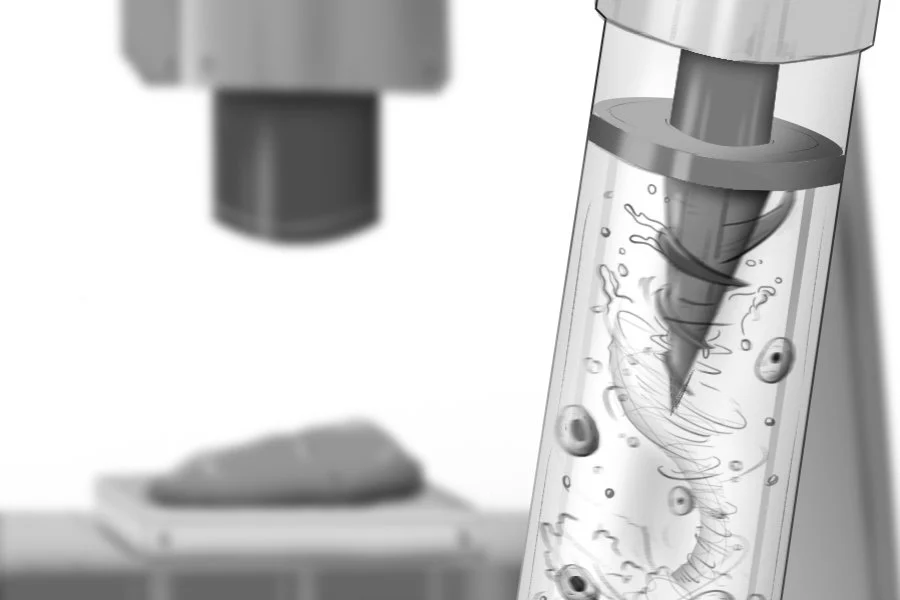
The core innovation of MagMix lies in its ability to counteract the gravitational pull on cells within the bio-ink. The system comprises two primary components: a miniature magnetic propeller designed to fit snugly inside the syringes used by bioprinters, and an external permanent magnet attached to a motor. This motor is positioned to move vertically along the exterior of the syringe, dynamically controlling the rotation and movement of the internal propeller. This ingenious design ensures that the bio-ink remains continuously and uniformly agitated throughout the printing operation.
Ferdows Afghah, a postdoctoral researcher in mechanical engineering at MIT and the lead author of the study, emphasized the critical importance of precise control over the bio-ink’s properties. "Precise control over the bio-ink’s physical and biological properties is essential for recreating the structure and function of native tissues," Afghah stated. MagMix directly addresses this by maintaining the homogeneity of the bio-ink, thereby ensuring that each layer of the printed tissue receives an equitable distribution of cells.
The development process involved a rigorous approach, beginning with computational simulations. The team utilized these simulations to meticulously design the optimal geometry and rotational speed of the magnetic propeller, aiming to achieve maximum mixing efficiency with minimal shear stress on the cells. Following the computational design phase, the system’s performance was experimentally validated, confirming its efficacy in real-world bioprinting scenarios.
Impact on Research, Drug Development, and Regenerative Medicine
The implications of reliable 3D bioprinting extend far beyond simply creating tissue models. Professor Raman highlighted the profound impact on understanding human diseases and evaluating therapeutic agents. "If we can print tissues that more closely mimic those in our bodies, we can use them as models to understand more about human diseases, or to test the safety and efficacy of new therapeutic drugs," she explained. This capability is particularly timely, given the U.S. Food and Drug Administration’s increasing interest in New Approach Methodologies (NAMs) that offer faster, more cost-effective, and more informative alternatives to traditional animal testing. These advanced tissue models could significantly accelerate the development of new treatments and therapies by providing more accurate preclinical data.
Looking further ahead, the ultimate goal of this research is to advance the field of regenerative medicine. "Eventually, we are working towards regenerative medicine applications such as replacing diseased or injured tissues in our bodies with 3D printed tissues that can help restore healthy function," Raman articulated. The ability to reliably produce functional, cell-dense tissues is a prerequisite for such life-changing medical interventions.
MagMix: Performance and Versatility
Experimental results have demonstrated the remarkable effectiveness of MagMix. The system successfully prevented cell settling for over 45 minutes of continuous printing across a variety of bio-ink formulations. This extended period of homogeneity significantly reduced instances of nozzle clogging, a common issue that disrupts printing processes and leads to material waste. Crucially, MagMix also preserved high cell viability, ensuring that the cells remained healthy and functional throughout the printing process.
"Importantly, we showed that mixing speeds could be adjusted to balance effective homogenization for different bioinks while inducing minimal stress on the cells," Raman noted. This adaptability allows researchers to fine-tune the MagMix system to suit the specific requirements of different bio-inks and cell types, maximizing both mixing efficacy and cell welfare.
As a proof-of-concept, the team successfully utilized MagMix to 3D print cells that, over several days, matured into functional muscle tissues. This demonstration underscores the system’s capability to support the complex biological processes required for tissue development post-printing.
Accessibility and Scalability: A Key Focus
A significant advantage of the MagMix platform is its inherent accessibility and scalability. The device is designed to be compact, low-cost, and easily customizable, allowing for seamless integration into existing 3D bioprinting setups. This broad applicability makes it a valuable tool for a wide range of laboratories and industries engaged in the development of engineered tissues. By providing a broadly accessible solution, MagMix aims to democratize access to high-quality bioprinting capabilities, accelerating progress across various research and industrial sectors.
The development of MagMix was significantly bolstered by support from the Safety, Health, and Environmental Discovery Lab (SHED) at MIT. The SHED lab plays a vital role in facilitating the translation of biofabrication innovations from laboratory-scale demonstrations to scalable and reproducible applications. Tolga Durak, the founding director of the SHED, highlighted the lab’s mission: "At the SHED, we focus on accelerating the translation of innovative methods into practical tools that researchers can reliably adopt." He further commented on MagMix as a prime example of how integrated technical infrastructure and interdisciplinary support can drive biofabrication technologies towards real-world impact.
The SHED’s involvement reflects a broader commitment to strengthening technological pathways that enhance reproducibility and accessibility within both engineering and the life sciences. This commitment is manifested through equitable access to advanced equipment and the fostering of cross-disciplinary collaboration. Durak emphasized the essential role of integrated labs like SHED in building sustainable capacity as the field advances towards larger-scale and more standardized systems. "Our goal is not only to enable discovery, but to ensure that new technologies can be reliably adopted and sustained over time," he stated.
Future Horizons: Beyond Medical Applications
While the immediate impact of MagMix is anticipated in the medical field, the researchers also envision its application in non-medical domains. The ability to reliably print functional tissues, such as muscles, opens up possibilities for powering "biohybrid" robots. These robots, integrating biological components with mechanical systems, could offer enhanced efficiency, improved safety, and novel functionalities for a variety of applications.
Conclusion: A Leap Forward for 3D Bioprinting
The development of MagMix represents a significant advancement in the field of 3D bioprinting. By effectively addressing the pervasive challenge of cell sedimentation, this technology promises to enhance the reliability, reproducibility, and scalability of engineered tissue fabrication. The potential impacts on human health are substantial, ranging from accelerating drug discovery and disease modeling to enabling future regenerative medicine therapies. The research, published under the title "Advancing Bioink Homogeneity in Extrusion 3D Bioprinting with Active In Situ Magnetic Mixing" in the journal Device, is now available and poised to empower researchers and industries striving to create the next generation of functional biological constructs. The work, supported in part by the SHED at MIT, underscores the critical importance of collaborative environments and robust infrastructure in translating scientific breakthroughs into tangible, impactful solutions.