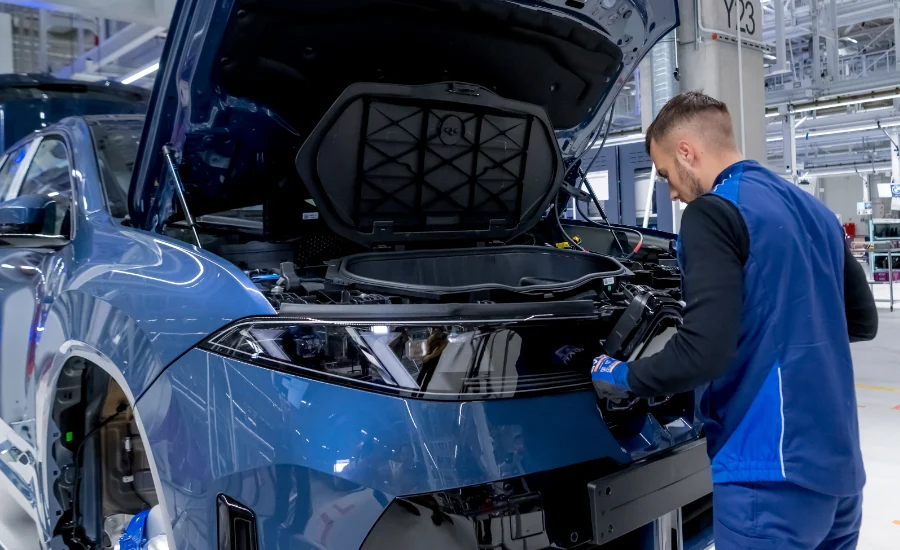
DEBRECEN, Hungary – The BMW Group’s state-of-the-art Debrecen plant has achieved an unprecedented milestone, marking the fastest production ramp-up in the automaker’s history. Just nine months after the commencement of series production, the facility has successfully rolled out 50,000 units of the fully electric BMW iX3, demonstrating exceptional efficiency and operational agility. This rapid acceleration underscores not only the plant’s advanced capabilities but also its pivotal role in BMW’s ambitious electrification strategy and global manufacturing network.
Raymond Wittmann, a member of the board of management of BMW AG, lauded the achievement, stating, “The 50,000th BMW iX3 underscores the capabilities of our plant in Debrecen: Never before have we built so many vehicles so quickly at a new plant. This milestone is the result of an outstanding team effort.” His remarks highlight the significant human and technological investment that has positioned the Debrecen facility as a cornerstone of BMW’s future production landscape. While the iX3 itself is based on BMW’s flexible CLAR platform, adapted for electric powertrains, its successful and swift production at Debrecen serves as a crucial proving ground for the plant’s readiness to eventually produce models based on the revolutionary Neue Klasse architecture.
Debrecen’s Strategic Significance and the iFACTORY Vision
The decision to establish a new manufacturing plant in Debrecen, Hungary, announced in 2018, was a strategic move by the BMW Group to expand its production footprint in Europe and bolster its capacity for electric vehicle manufacturing. Representing an investment exceeding €1 billion, the Debrecen plant is not merely another assembly line; it embodies BMW’s forward-thinking “iFACTORY” concept. This vision encapsulates the future of automotive production, characterized by three core pillars: LEAN (efficiency, precision, and agility), GREEN (sustainability, resource efficiency, and circularity), and DIGITAL (advanced data analytics, artificial intelligence, and virtual planning).
The plant’s strategic location in Eastern Europe offers several advantages, including access to a skilled workforce, robust infrastructure, and proximity to key markets and suppliers. The Hungarian government has actively supported the project, recognizing its potential to stimulate economic growth, create thousands of high-value jobs, and position Hungary as a hub for advanced manufacturing and electric mobility. With an initial planned capacity of up to 150,000 vehicles per year, the Debrecen plant is designed to be fully flexible, capable of producing both internal combustion engine (ICE) and fully electric vehicles on the same line, a critical capability as BMW navigates the transition to an all-electric future.
The Road to 50,000: A Timeline of Accelerated Production
The journey to this rapid production milestone has been meticulously planned and executed. Construction of the Debrecen facility commenced in 2020, with a focus on integrating cutting-edge technologies and sustainable practices from the outset. The plant was designed with the upcoming Neue Klasse architecture in mind, making it BMW’s first factory purpose-built to produce these next-generation electric vehicles, though their production is slated to begin in 2025. The initial series production, starting in late 2022 or early 2023 with the BMW iX3, served as a crucial test of the plant’s operational readiness and the efficiency of its newly established processes.
The rapid scaling of production was significantly accelerated by the proactive addition of a second shift in February, several months ahead of the original schedule. This strategic decision was a direct response to the unexpectedly strong global demand for the BMW iX3, a testament to the model’s appeal and BMW’s growing strength in the premium EV segment. The seamless integration of the second shift, without compromising quality or efficiency, speaks volumes about the meticulous planning, advanced training programs, and robust digital infrastructure in place at Debrecen. Achieving 50,000 units within nine months sets a new internal benchmark for BMW, surpassing previous ramp-up speeds at other new facilities globally.
Meeting Robust Demand: The BMW iX3’s Market Impact
The impressive production figures at Debrecen are a direct reflection of the BMW iX3’s strong performance in the global market. BMW has indicated that customer orders for the iX3 are rapidly approaching the 100,000 mark, far exceeding initial expectations. This robust demand underscores the growing consumer appetite for premium electric SUVs and validates BMW’s strategy of offering a compelling electric alternative in a popular vehicle segment.
The iX3, while not a Neue Klasse vehicle, plays a vital role in BMW’s current electrification portfolio. It offers customers a familiar and trusted BMW X3 experience, now with a fully electric powertrain, making it an accessible entry point into electric mobility for many. Its success helps to build brand trust in BMW’s electric offerings and paves the way for the broader adoption of future electric models, including those based on the Neue Klasse. The high demand has placed pressure on BMW’s production capabilities, making the rapid ramp-up at Debrecen even more critical to meet market needs and avoid lengthy waiting lists for customers.
Pioneering the Future: Debrecen as a Global Manufacturing Blueprint
Beyond its impressive production volume, Plant Debrecen is envisioned as a launchpad for innovative manufacturing processes that will be deployed throughout BMW’s extensive global production network. The lessons gleaned during the successful iX3 launch are not confined to Hungary but are actively being analyzed, refined, and shared with other BMW facilities worldwide. This knowledge transfer is particularly critical as the company gears up for an ambitious product offensive, preparing to introduce approximately 40 new or significantly updated vehicle models by the end of 2027.
The experiences at Debrecen, especially regarding the rapid integration of new production lines and the efficient scaling of EV manufacturing, provide invaluable insights. These insights will inform the design and operational strategies for future plants and upgrades across BMW’s network, ensuring that the company can quickly and effectively bring its next generation of electric and conventionally powered vehicles to market. Debrecen is thus not just a factory but a living laboratory for the future of BMW production.

The Digital Backbone: Enhancing Efficiency and Quality
A core tenet of the iFACTORY concept, prominently showcased at Debrecen, is extensive digitalization. BMW has leveraged advanced digital tools and a comprehensive shared production database to achieve its remarkable ramp-up speed and maintain high-quality standards. This digital ecosystem allows manufacturing teams across different plants to seamlessly transfer process improvements, conduct detailed quality analyses, and share critical launch experiences in real-time.
This interconnected digital infrastructure enables BMW to identify potential production issues proactively and implement preventative measures before they can escalate or be repeated elsewhere in the global network. From virtual planning and simulation of assembly processes to AI-powered quality control and predictive maintenance, digital technologies are embedded at every stage of production. This not only optimizes efficiency and reduces waste but also ensures consistent product quality, a hallmark of the BMW brand. The ability to rapidly disseminate best practices and troubleshoot collaboratively across continents is a significant competitive advantage, allowing BMW to accelerate its manufacturing evolution.
Sustainability at the Core: A Green Future for Automotive Production
In line with the "GREEN" pillar of the iFACTORY, the Debrecen plant is designed with sustainability as a fundamental principle. BMW aims for the facility to be fully carbon-neutral in its operations from day one. This commitment involves sourcing 100% renewable energy, primarily through locally generated solar power and certified green electricity. The plant also incorporates advanced resource-saving technologies, including comprehensive waste management systems, efficient water usage, and the implementation of circular economy principles wherever possible.
For instance, heat generated from production processes is recaptured and reused, and innovative solutions are being explored to minimize the environmental footprint of the entire value chain. The plant’s focus on sustainable manufacturing extends to its supply chain, where BMW works closely with suppliers to ensure environmentally responsible practices. This holistic approach to sustainability not only aligns with BMW’s corporate social responsibility goals but also positions the Debrecen plant as a leader in environmentally conscious automotive production, setting a new standard for the industry.
Looking Ahead: The Neue Klasse Era and Global Expansion
The experience gained at Plant Debrecen, particularly with its flexible production lines and advanced digital infrastructure, will play an indispensable role in scaling the production of future Neue Klasse models across BMW’s global manufacturing network. The Neue Klasse, set to debut in 2025, represents a fundamental shift for BMW, featuring an entirely new electric-first architecture, new battery technology, and a reimagined user experience. Debrecen will be the first BMW plant globally to produce these revolutionary vehicles.
The success of the iX3 ramp-up validates Debrecen’s capability to handle complex manufacturing challenges and sets a precedent for how BMW will introduce its next generation of electric vehicles. The knowledge acquired here will directly inform the conversion and preparation of other BMW plants, such as those in Munich and Shenyang, to produce Neue Klasse models in the coming years. This strategic approach ensures a smooth and efficient transition to the new architecture, allowing BMW to rapidly scale its electric vehicle offerings and maintain its leadership position in the premium automotive segment.
Economic Ripple Effects: Impact on Hungary and Beyond
The BMW Debrecen plant’s success extends beyond the company’s internal achievements, generating substantial economic ripple effects for Hungary and the broader European region. The investment has created thousands of direct jobs in Debrecen, encompassing a wide range of highly skilled positions in manufacturing, engineering, IT, and logistics. Furthermore, the plant’s operation stimulates indirect job creation across its extensive supply chain, benefiting local businesses and fostering economic growth.
The presence of a major automotive player like BMW also acts as a magnet for further foreign direct investment, attracting other high-tech companies and suppliers to the region, thereby strengthening Hungary’s industrial base. The transfer of advanced manufacturing technologies and best practices contributes to the upskilling of the local workforce, enhancing Hungary’s human capital and innovation capabilities. This economic dynamism positions Debrecen as a significant industrial hub within Central and Eastern Europe, reinforcing its role in the global automotive landscape.
Conclusion: Setting New Industry Standards
The BMW Debrecen plant’s achievement of producing 50,000 iX3s in just nine months is more than a production milestone; it is a powerful demonstration of advanced manufacturing capabilities, strategic foresight, and an unwavering commitment to electrification and sustainability. As a flagship iFACTORY, Debrecen is not only contributing significantly to BMW’s current electric vehicle output but is also actively shaping the future of automotive production. By refining lean, green, and digital processes, and by serving as the blueprint for the upcoming Neue Klasse era, the Debrecen plant is setting new industry standards for speed, efficiency, and environmental responsibility, solidifying BMW’s position at the forefront of the automotive transformation.