Emerson has introduced its DeltaV Automation Platform for Data Centers, a specialized automation portfolio engineered to meet the burgeoning and complex demands of data centers that power artificial intelligence (AI) workloads. This innovative platform is designed to provide comprehensive monitoring and control over critical infrastructure by seamlessly integrating thermal, mechanical, and electrical subsystems within a unified, scalable automation architecture. The launch marks a significant step in addressing the unique challenges posed by the rapid expansion of AI, which necessitates unprecedented levels of efficiency, speed, and reliability in data center operations.
The AI Imperative: Unprecedented Demands on Infrastructure
The proliferation of AI applications, from large language models (LLMs) to advanced machine learning algorithms, has created an exponential surge in computational power requirements. This surge translates directly into immense pressure on data center infrastructure. AI workloads are not only computationally intensive but also generate significantly more heat than traditional enterprise computing tasks, demanding sophisticated and dynamic thermal management solutions. Furthermore, the sheer scale and complexity of these deployments mean that traditional data center project timelines are being drastically shortened, requiring unparalleled coordination across a diverse array of stakeholders.
Industry reports consistently highlight the escalating demands. Research firm Statista projects the global AI market to grow from approximately $387 billion in 2022 to over $1.8 trillion by 2030, underscoring the massive infrastructure buildout underway. Each AI chip, such as NVIDIA’s H100 GPU, can consume hundreds of watts, and a single rack filled with these accelerators can draw tens of kilowatts, far exceeding the power density of conventional servers. This increased power consumption directly correlates with elevated heat generation, making advanced cooling strategies, including liquid cooling, not just an option but often a necessity. The need to provision and manage power and cooling for these high-density environments is pushing existing data center designs to their limits and demanding new approaches to automation and control.
Challenges in the Current Data Center Landscape
Historically, data center infrastructure management has often relied on a fragmented approach. Different subsystems—such as power distribution units (PDUs), uninterruptible power supplies (UPS), computer room air conditioners (CRACs), chillers, and building management systems (BMS)—have frequently been controlled by disparate, vendor-specific point solutions. This siloed management leads to several critical inefficiencies and risks:
- Increased Engineering Effort: Integrating multiple proprietary systems requires extensive custom programming and manual configuration, significantly prolonging design and commissioning phases.
- Coordination Nightmares: The need for constant manual coordination among various engineering teams, design teams, electricians, and other project personnel across the supply chain creates bottlenecks and increases the likelihood of errors.
- Extended Project Timelines: The complexity of integrating disparate systems contributes to delays in bringing new facilities online, impacting time-to-market for critical AI services. A typical hyperscale data center project, from groundbreaking to commissioning, can take 18-36 months, but AI’s urgency is compressing these schedules, demanding faster deployment.
- Operational Inefficiencies: Lack of a unified view hinders real-time optimization, leading to suboptimal energy utilization, increased operational costs, and slower response times to critical events.
- Reduced Reliability: The absence of a holistic control system can lead to cascading failures if one subsystem malfunctions and the others cannot react cohesively. Ensuring uptime, especially for mission-critical AI workloads, is paramount, with the cost of downtime for a hyperscale data center estimated in the millions per hour.
- Inconsistent Performance: Without a centralized control philosophy, maintaining consistent operating parameters and performance across an entire facility, or even between different sections, becomes challenging.
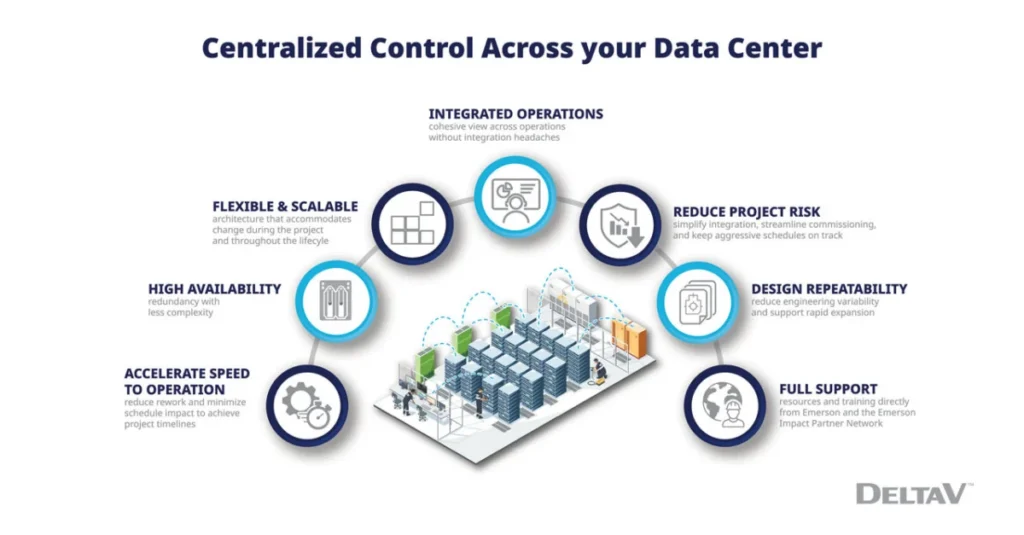
Emerson’s DeltaV Automation Platform directly confronts these challenges by advocating for an integrated automation architecture from the very inception of project design. By replacing isolated point solutions and manual subsystem coordination with a unified control approach, the platform aims to streamline processes, reduce human error, and accelerate the deployment of large-scale AI-ready facilities.
The DeltaV Automation Platform: A Unified Approach to Data Center Control
The DeltaV Automation Platform for Data Centers offers a comprehensive solution built upon Emerson’s robust industrial automation heritage. At its core, the platform leverages the DeltaV Distributed Control System (DCS) and DeltaV Programmable Logic Controllers (PLCs). These components are designed to work synergistically, providing system-wide process control that extends across all critical data center infrastructure.
The architecture facilitates the seamless connection and orchestration of previously disparate elements. For instance, the platform can monitor and control the precise temperature and humidity levels maintained by CRAC units, manage the flow and pressure within liquid cooling loops, optimize the operation of chillers, and oversee the reliability of power distribution systems—all from a single, integrated interface. This holistic view not only simplifies operational management but also enables predictive maintenance and more efficient resource allocation.
A standout feature of the DeltaV platform is its integration of context-specific AI tools. These tools are embedded to support various aspects of data center operations:
- Engineering Workflows: AI-powered assistance can automate routine engineering tasks, suggest optimal control strategies, and flag potential design conflicts, significantly reducing the manual effort required in system configuration and programming. This accelerates the design and commissioning phases, allowing projects to meet aggressive AI deployment timelines.
- Advanced Process Control: AI algorithms can analyze vast amounts of operational data in real-time to dynamically adjust control parameters for power, cooling, and environmental systems. For example, AI can predict peak loads and pre-emptively adjust cooling capacity, or identify inefficiencies in power distribution and recommend reconfigurations. This leads to substantial energy savings and enhanced operational stability.
- Integration with AI Optimization Models: The platform is built to integrate with higher-level AI optimization models, which can be developed by data center operators or third-party providers. This allows for a continuous feedback loop where operational data from the DeltaV system feeds into sophisticated AI models for facility-wide optimization, resource scheduling, and even workload placement strategies to maximize efficiency and minimize energy footprint.
The combined power of the DeltaV DCS and PLCs, augmented by these AI capabilities, ensures that data center infrastructure can not only support but also dynamically adapt to the evolving demands of AI workloads. This collaboration is instrumental in enhancing project execution, ensuring stringent cost control, improving overall operating performance, and laying the groundwork for future autonomous operations within data centers.
Benefits of an Integrated Automation Architecture
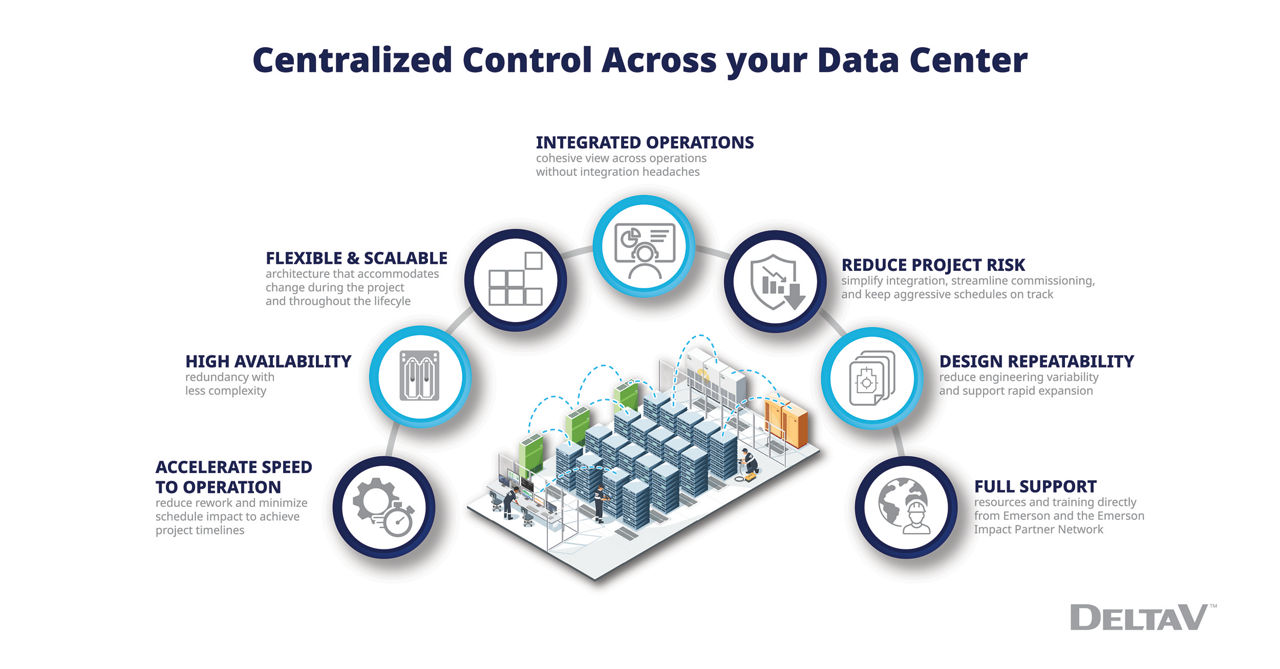
The adoption of Emerson’s DeltaV Automation Platform for Data Centers promises a multitude of benefits, directly addressing the pain points of modern, AI-driven infrastructure:
- Accelerated Time-to-Market: By streamlining engineering, simplifying integration, and reducing manual coordination, the platform significantly shortens the design, construction, and commissioning phases. This enables data center operators to bring AI-ready facilities online faster, capitalizing on market opportunities.
- Reduced Operational Expenditure (OpEx): Advanced process control and AI-driven optimization lead to more efficient energy consumption for cooling and power, which are typically the largest components of a data center’s operating budget. Improved reliability also reduces maintenance costs and prevents costly downtime.
- Enhanced Reliability and Uptime: A unified control system provides a comprehensive view of all critical infrastructure, enabling proactive problem detection and faster, more coordinated responses to anomalies. This minimizes the risk of outages, which are particularly detrimental for continuous AI operations.
- Improved Scalability and Flexibility: The DeltaV architecture is designed to be inherently scalable, allowing data centers to expand their capacity and adapt to new technologies (e.g., evolving liquid cooling solutions) without requiring a complete overhaul of their control systems. This future-proofs investments in infrastructure.
- Simplified Operations and Maintenance: A consistent interface and integrated data stream across all subsystems simplify training for operators and maintenance staff. Troubleshooting becomes more efficient, and routine tasks can be automated, freeing up personnel for higher-value activities.
- Data-Driven Decision Making: The platform aggregates data from all connected systems, providing a rich source of information for analytics, performance benchmarking, and continuous improvement initiatives. This empowers data center managers to make informed decisions that optimize efficiency and performance.
- Sustainability and Energy Efficiency: By precisely controlling power and cooling, the platform helps data centers reduce their carbon footprint and meet increasingly stringent environmental regulations. This aligns with broader corporate sustainability goals and investor expectations.
Inferred Industry Perspectives and Emerson’s Vision
While direct statements from related parties are not available in the original text, the implications of Emerson’s move can be logically inferred from industry trends and the company’s strategic positioning. An executive from Emerson’s Automation Solutions division, for instance, might emphasize: "The DeltaV Automation Platform for Data Centers represents a pivotal shift in how hyperscale and enterprise data centers will manage the complexities of AI workloads. We are addressing the critical need for speed, reliability, and efficiency by offering a truly integrated solution that empowers operators to optimize their infrastructure from design through autonomous operations. Our deep expertise in industrial control systems uniquely positions us to deliver the robustness and scalability required for this demanding environment."
Industry analysts would likely concur, highlighting the growing imperative for such integrated platforms. "The days of piecemeal data center management are drawing to a close, especially with the power and cooling densities required by AI," an analyst might observe. "Integrated platforms like Emerson’s DeltaV are essential for navigating the complexities of AI-driven data centers, offering a path to greater efficiency, faster deployment, and improved resilience. The embedded AI tools within the control system itself are particularly noteworthy, indicating a forward-thinking approach to operational intelligence."
Chronology and Market Context
Emerson’s entry into this specialized segment of data center automation aligns with a broader industry trend that has gained significant momentum over the past five years. As AI research progressed from theoretical concepts to practical applications, the computational requirements began to outstrip the capabilities of traditional IT infrastructure. Companies like Google, Amazon, and Microsoft, operating hyperscale data centers, have long developed proprietary automation and orchestration layers to manage their vast infrastructure. However, for a wider range of enterprise data centers and co-location facilities supporting AI, off-the-shelf, robust, and integrated solutions have been a growing need.
The development of the DeltaV Automation Platform for Data Centers can be seen as a direct response to this market demand, likely initiated in anticipation of the AI boom that accelerated in the early 2020s. The timeline reflects a strategic move by Emerson to leverage its decades of experience in distributed control systems and industrial automation, adapting it to the unique environment of mission-critical IT infrastructure. This positions Emerson not just as a provider of components but as a comprehensive solution architect for the future of data centers.
Broader Impact and Implications
The introduction of the DeltaV Automation Platform has several profound implications for the data center industry and the broader adoption of AI:
- Democratization of Advanced Data Center Management: By offering an integrated, commercial-off-the-shelf solution, Emerson makes advanced, holistic data center control accessible to a wider range of operators, not just those with the resources to build custom systems.
- Standardization and Best Practices: The platform can help standardize best practices in data center design and operation, promoting greater consistency and efficiency across the industry.
- Enabling the Next Generation of AI: By ensuring that the underlying infrastructure can reliably and efficiently support complex AI workloads, Emerson’s platform plays a crucial role in enabling the continued advancement and deployment of AI technologies across various sectors, from scientific research to enterprise applications.
- Workforce Transformation: The automation of routine tasks and the provision of integrated insights will likely shift the roles of data center personnel from manual intervention to higher-level supervision, analytics, and strategic planning.
- Competitive Landscape: This move intensifies competition in the data center infrastructure management (DCIM) and industrial control system (ICS) markets, encouraging other vendors to develop more integrated and AI-aware solutions.
In conclusion, Emerson’s DeltaV Automation Platform for Data Centers is a timely and strategic innovation designed to tackle the multifaceted challenges presented by the relentless growth of AI. By offering a unified, intelligent, and scalable automation architecture, Emerson is not only simplifying the management of complex data center infrastructure but also accelerating the deployment of AI workloads, enhancing operational efficiency, and paving the way for more sustainable and autonomous data center operations in the future.