A groundbreaking advancement in additive manufacturing has emerged from the École Polytechnique Fédérale de Lausanne (EPFL), offering a novel approach to producing dense, high-strength metal and ceramic objects with unprecedented precision. This innovative technique, developed by a team led by Daryl Yee at EPFL’s School of Engineering, bypasses the inherent limitations of traditional vat photopolymerization by utilizing a hydrogel-based framework and a unique post-printing material infiltration process. The findings, published in the prestigious journal Advanced Materials, promise to unlock new possibilities for creating complex, robust components for a wide array of advanced technological applications.
The Limitations of Traditional Vat Photopolymerization
Vat photopolymerization, a popular 3D printing method, involves immersing a build platform in a vat of liquid photopolymer resin. A light source, typically a laser or ultraviolet (UV) projector, selectively cures (solidifies) the resin layer by layer, gradually building a three-dimensional object. While this method excels at producing intricate geometries and fine details, its practical applications have been historically constrained by the inherent properties of light-sensitive polymers. These materials, by their nature, are limited to the specific characteristics of the polymers used in the resin formulation.
For years, researchers have sought to overcome this limitation by transforming these printed polymer structures into more robust materials, such as metals and ceramics. However, existing methods have consistently encountered significant hurdles. Daryl Yee, who heads the Laboratory for the Chemistry of Materials and Manufacturing at EPFL, explains the shortcomings of these prior attempts. "These materials tend to be porous, which significantly reduces their strength, and the parts suffer from excessive shrinkage, which causes warping," he states. The resulting components, while possessing the desired shape, often lacked the structural integrity and dimensional stability required for demanding engineering applications. This porosity arises from the difficulty in uniformly infusing metal or ceramic precursors into the pre-formed polymer matrix without creating voids. The high temperatures often required for sintering or calcining these infused materials further exacerbate shrinkage and warping issues, leading to a significant deviation from the intended design.
A Paradigm Shift: Hydrogel Frameworks and Post-Printing Infiltration
The EPFL team’s innovative solution centers on a fundamental shift in the manufacturing sequence. Instead of attempting to print a resin already containing metal or ceramic compounds, they first 3D print a temporary, high-precision framework using a simple, water-based gel known as a hydrogel. Hydrogels are highly absorbent polymer networks capable of holding large amounts of water, and they offer an excellent biocompatible and printable scaffold.
The process begins with the digital design of the desired object. This design is then used to guide a 3D printer, which deposits layers of the hydrogel precursor solution. This precursor, upon curing (often through UV light, similar to traditional photopolymerization, but with a different material base), forms a stable, yet flexible, hydrogel structure. This "blank" structure serves as a precisely shaped mold.
Following the printing of the hydrogel framework, the crucial infiltration process begins. The printed hydrogel is submerged in a solution containing metal salts. Through a series of carefully controlled chemical reactions, these metal salts are converted into tiny, solid metal-containing nanoparticles that are deposited and spread uniformly throughout the porous network of the hydrogel. This controlled deposition within the hydrogel matrix is a key differentiator, ensuring a much more uniform distribution of the metal precursor compared to methods that attempt to mix it into the initial printing resin.
The researchers employ a cyclical approach, repeating this infiltration and chemical conversion process multiple times. Each "growth cycle" incrementally increases the concentration of metal or ceramic precursors within the hydrogel. This iterative strategy allows for the creation of composites with exceptionally high metal or ceramic content, a critical factor for achieving dense, robust final products.
"After 5–10 of these ‘growth cycles,’ the remaining hydrogel is removed through heating," explains Yee. This heating process, often referred to as calcination or sintering depending on the target material, serves a dual purpose. Firstly, it evaporates any residual water and decomposes the polymer network of the hydrogel, effectively burning away the temporary scaffold. Secondly, it promotes the sintering of the embedded metal or ceramic nanoparticles, fusing them together to form a solid, continuous structure. The result is a dense, solid object that precisely replicates the intricate shape of the original printed hydrogel template.
Material Versatility and Design Freedom
A significant advantage of this hydrogel-based approach is its inherent material versatility. Because the metal or ceramic compounds are introduced after the initial 3D printing of the hydrogel framework, the same hydrogel template can be used to fabricate a wide variety of different materials. By simply changing the type of metal salts or ceramic precursors used in the infiltration baths, manufacturers can produce objects made from iron, silver, copper, aluminum, or various ceramics, all from the identical initial printed structure. This offers unprecedented flexibility in material selection, allowing for the rapid prototyping and production of components with tailored properties without requiring entirely new printing molds or setups.
"Our work not only enables the fabrication of high-quality metals and ceramics with an accessible, low-cost 3D printing process; it also highlights a new paradigm in additive manufacturing where material selection occurs after 3D printing, rather than before," Yee summarizes, emphasizing the transformative nature of their discovery. This paradigm shift democratizes the creation of advanced materials, moving away from material-specific printing processes to a more adaptable, post-processing-driven material diversification.
Targeting Advanced 3D Architectures: Strength and Precision
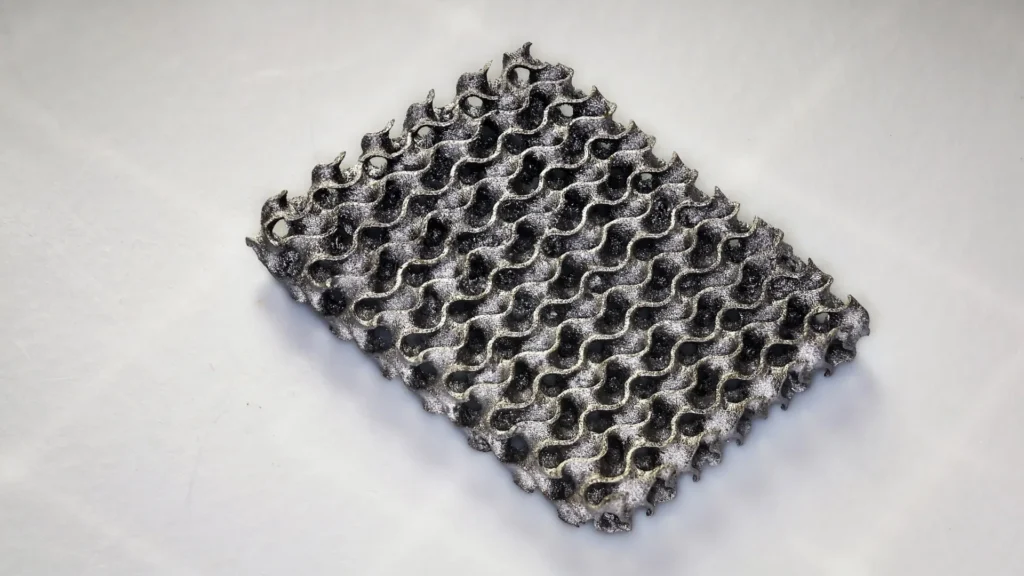
The research team demonstrated the efficacy of their technique by fabricating intricate mathematical lattice structures known as gyroids. Gyroids are highly efficient, triply periodic minimal surfaces that exhibit remarkable mechanical properties and high surface area to volume ratios. These structures are of significant interest in fields ranging from aerospace and automotive engineering to catalysis and energy storage.
The EPFL team successfully produced gyroid structures out of iron, silver, and copper, showcasing the technique’s ability to create complex geometries with high fidelity. To rigorously test the mechanical performance of these novel materials, they subjected the printed gyroids to extreme pressures using a universal testing machine. The results were striking.
"Our materials could withstand 20 times more pressure compared to those produced with previous methods, while exhibiting only 20% shrinkage versus 60–90%," states PhD student Yiming Ji, the first author of the study. This dramatic improvement in strength and reduction in shrinkage is attributed to the dense, non-porous nature of the final structures achieved through the uniform nanoparticle infiltration and effective sintering. The minimal shrinkage ensures that the final components maintain their precise dimensions, a critical requirement for high-performance engineering parts.
Broad Implications for Future Technologies
The implications of this new 3D printing method are far-reaching, particularly for the fabrication of advanced 3D architectures that demand a combination of high strength, low weight, and complex design. Potential applications span numerous cutting-edge fields:
- Sensors: The ability to create intricate, high-surface-area metal structures can lead to the development of more sensitive and efficient chemical and physical sensors.
- Biomedical Devices: The precision and biocompatibility of hydrogels, combined with the ability to form dense metal or ceramic structures, open doors for advanced implants, prosthetics, and drug delivery systems.
- Energy Conversion and Storage: Devices for energy technologies often require materials with specific surface properties and structural integrity. This technique is ideal for creating components like metal catalysts essential for converting chemical energy into electricity, or high-surface-area metals with advanced cooling properties for energy systems. For instance, metal foams with optimized pore structures could significantly enhance heat exchange in thermal management systems.
- Aerospace and Automotive: The demand for lightweight yet incredibly strong components in these industries is constant. The ability to print complex, high-strength metal parts with minimal defects and precise dimensions is a significant advantage.
- Catalysis: The high surface area and controllable porosity of structures like gyroids made from catalytic metals can dramatically improve the efficiency of chemical reactions.
The researchers highlight that their technique is particularly well-suited for applications where metallic or ceramic components need to be integrated into complex, otherwise inaccessible geometries, or where traditional manufacturing methods are prohibitively expensive or technically impossible.
The Path Forward: Industrial Adoption and Process Optimization
While the research team has achieved a significant breakthrough, they are actively pursuing further refinements to facilitate wider industrial adoption. A primary focus is on increasing the density of the materials even further, which would enhance their mechanical properties and open up even more demanding applications.
Another key area of development is speed. The repeated infusion steps, while essential for achieving high material content and density, currently make the process more time-consuming compared to some other 3D printing techniques. To address this, the team is investing in automation. "We are already working on bringing the total processing time down by using a robot to automate these steps," Yee states. Robotic control of the infiltration and rinsing cycles can significantly reduce manual intervention and potentially speed up the overall production time.
The successful development and ongoing optimization of this hydrogel-based 3D printing method by Daryl Yee and his team at EPFL represent a pivotal moment in additive manufacturing. By decoupling the printing of the form from the selection of the material, they have unlocked a new level of versatility and performance in the creation of metal and ceramic components, paving the way for a new generation of advanced technologies. The journey from laboratory innovation to industrial application is often long, but the remarkable results achieved by the EPFL researchers suggest that this novel technique is poised to make a substantial impact on the future of manufacturing.