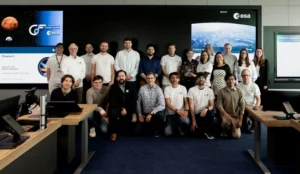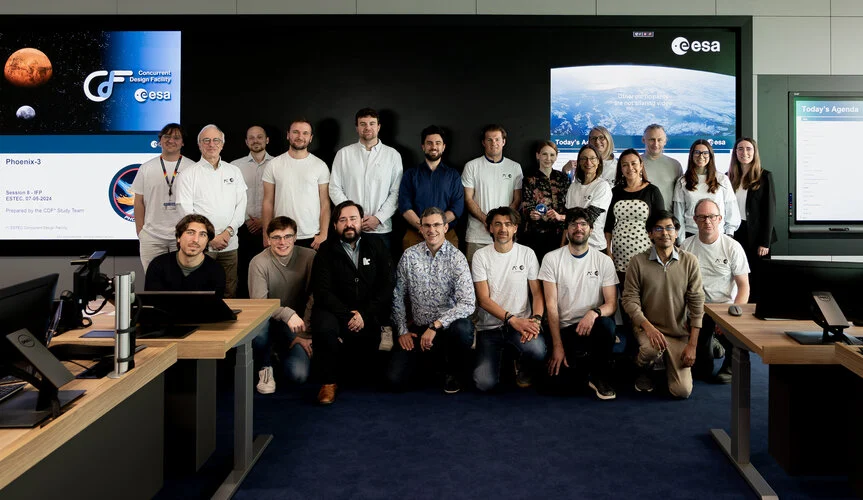
Engineers from the European Space Agency (ESA) and its industry partners have successfully concluded an intensive concept study for Phoenix 3, a groundbreaking reusable spacecraft designed to transport scientific experiments and commercial payloads into microgravity and return them safely to Earth. This milestone marks a significant step forward in Europe’s ambition to foster a robust and sustainable space economy, bolstering its capabilities in orbital services and in-orbit manufacturing. The comprehensive evaluation, conducted within ESA’s highly specialized Concurrent Design Facility (CDF), has validated the foundational feasibility of the Phoenix 3 concept proposed by ATMOS Space Cargo, a burgeoning European startup.
The Concurrent Design Facility: A Hub of Innovation
The ESA’s Concurrent Design Facility (CDF), situated at ESTEC, the agency’s technical heart in the Netherlands, transformed into a multidisciplinary think-tank earlier this year. This state-of-the-art facility is equipped with an integrated network of computers, advanced multimedia devices, and sophisticated software tools, enabling rapid and collaborative design assessments. The CDF’s unique methodology allows experts from a diverse array of engineering disciplines to converge, share their collective expertise, and critically evaluate complex designs within a matter of weeks, a process that would typically span many months through traditional sequential engineering. This accelerated approach is vital for young companies like ATMOS, allowing them to quickly refine their concepts and move towards tangible development.
Phoenix 3: A Vision for Reusable Orbital Services
The Phoenix 3 concept envisions a fully European reusable orbital return vehicle, poised to revolutionize access to microgravity for scientific research and commercial applications. The intensive study focused on assessing the viability of this ambitious project, with a specific reference scenario outlining its operational profile.
"For this study, we focused on a scenario where Phoenix 3 would be launched into low Earth orbit, to an altitude of around 350 km," explained Enrico Tormena, ESA’s lead for the study. This orbital destination is a common and highly sought-after altitude for a variety of space-based activities, offering a balance between accessibility and a consistent microgravity environment.
The spacecraft is intended to serve a multifaceted role in orbit. "There, it would support commercial microgravity manufacturing, science experiments and in-orbit demonstration and validation of new technologies," Tormena elaborated. The potential for commercial microgravity manufacturing, ranging from advanced materials to pharmaceuticals, represents a burgeoning market that requires reliable and cost-effective access to space. Furthermore, the ability to conduct in-orbit demonstrations and validation of new technologies is critical for accelerating the development and deployment of future space systems and terrestrial innovations.

The operational lifespan of Phoenix 3 in orbit is projected to be substantial, "After several months to one year in orbit, it would perform a controlled deorbit and atmospheric entry before being recovered, refurbished and prepared for a new launch," Tormena added. This extended mission duration, coupled with the spacecraft’s reusability, is central to reducing the cost of access to space and promoting a more sustainable approach to space operations. The ability to recover, refurbish, and redeploy the spacecraft multiple times is a cornerstone of the circular economy principles being increasingly applied to space exploration.
Key Design Elements and Trade-offs
The configuration assessed during the CDF study incorporated a sophisticated service module responsible for providing Phoenix 3 with essential power and propulsion. Crucially, it also features a pressurized cabin area designed to replicate Earth-like atmospheric conditions, capable of accommodating over 1000 kg of scientific and commercial payloads. This substantial payload capacity underscores the vehicle’s potential to support a wide range of missions, from large-scale scientific endeavors to significant commercial ventures.
It is important to note that this configuration served as a reference for the study and is not a final design. The CDF process intentionally leaves key trade-offs open for the next phase of development, Phase A, which represents the second critical step in a mission’s life cycle. This iterative approach allows for flexibility and optimization as the project progresses.
A pivotal technological component of ATMOS’s approach is an inflatable decelerator, a technology the company has been diligently maturing and flight-testing across its Phoenix family of spacecraft. This innovative system plays a vital role in the spacecraft’s return to Earth.
"During reentry, the spacecraft uses its Inflatable Atmospheric Decelerator to slow down through the atmosphere ahead of a safe recovery," explained Jeffrey Hendrikse, Chief Technology Officer and Co-Founder of ATMOS Space Cargo. "What pleases me most is that the study confirmed we can maintain the modularity of the microgravity platform, serving our customers from late access before launch to early access after return, as well as the communication bandwidth they need in orbit." The confirmation of modularity is significant, as it allows for greater flexibility in payload integration and mission planning, catering to diverse customer needs. Enhanced communication bandwidth is also a critical factor for enabling real-time data acquisition and control during orbital missions.
Addressing Risks and Paving the Way for Phase A
The CDF study not only validated the concept but also identified key trade-offs and risks that require further attention in subsequent development phases. Daniela Lomanto from ESA’s Concurrent Engineering and Future Missions section highlighted the study’s outcome: "The CDF study also identified key trade-offs and risks to be addressed next, providing a solid starting point for Phase A, in which ATMOS will focus on the optimisation of aerodynamics, stability and thermal design, and on improving entry modelling and guidance to increase landing accuracy."

Achieving high landing accuracy is paramount for efficient recovery operations and minimizing the potential for damage to the returned payload. The focus on aerodynamics, stability, and thermal design directly addresses the challenging environment of atmospheric re-entry, ensuring the spacecraft’s structural integrity and the safety of its contents.
ESA’s commitment to supporting the Phoenix 3 study aligns perfectly with the agency’s core mandate: to stimulate and accelerate the competitiveness of European industry. By providing essential technical support and access to its advanced facilities, ESA empowers innovative companies to overcome technical hurdles and bring their ambitious projects to fruition.
Sustainability and Industrialization: A Dual Focus
The collaboration on Phoenix 3 underscores a broader strategic vision within ESA. Ilaria Roma, Head of the CDF, emphasized the win-win scenario created by this partnership. "ATMOS has created a win-win scenario for the future of European space exploration, so their vision and this specific mission assessment is supported by ESA’s Directorate of Human and Robotic Exploration."
A central theme driving this collaboration is sustainability. "By defining a new, scalable class of reusable return vehicles, the study addresses the urgent need for circularity in orbit and reduced environmental footprint in space operations," Roma stated. The increasing volume of space debris and the environmental impact of expendable launch vehicles and spacecraft necessitate the development of more sustainable solutions. Reusable systems like Phoenix 3 are at the forefront of this paradigm shift.
Simultaneously, ATMOS’s development efforts are contributing to the enhancement of industrialization capabilities and the establishment of sovereign infrastructure within Europe. This dual focus on environmental responsibility and economic growth positions Europe as a leader in the next generation of space services.
The value of the CDF’s integrated approach was further emphasized by Marta Oliveira, Chief Operating Officer and Co-Founder of ATMOS Space Cargo. "The value of the CDF is the ability to examine every major subsystem and interface at the same time," she remarked. "Bringing specialists from across disciplines into one concurrent process helped us identify dependencies that would be difficult to resolve through sequential engineering work." This highlights the efficiency and foresight gained from concurrent engineering, enabling early detection and resolution of potential integration issues.

The Third Party Activity Initiative: Enabling Collaboration
Partnerships like the Phoenix 3 CDF study are made possible through ESA’s Third Party Activity (TPA) initiative. This program plays a crucial role in democratizing access to ESA’s extensive consultancy and testing infrastructure, making it available to the entire industrial ecosystem, from nimble startups to established large-scale enterprises. The TPA initiative fosters a collaborative environment, allowing external entities to leverage ESA’s expertise and facilities to advance their own technological developments, thereby strengthening the broader European space sector.
Future Outlook and Implications
The successful completion of the Phoenix 3 concept study signifies a critical inflection point for ATMOS Space Cargo and for Europe’s aspirations in the reusable space systems market. The validation of the core concept, coupled with the identification of clear pathways for further development, positions the company for a successful transition into Phase A and subsequent development stages.
The implications of a successful Phoenix 3 program are far-reaching. It promises to:
- Lower the Cost of Space Access: Reusability is a key driver for reducing the cost of launching and operating in space, making it more accessible for a wider range of scientific, commercial, and governmental users.
- Boost In-Orbit Economy: A reliable return vehicle facilitates the growth of industries focused on microgravity manufacturing, advanced materials science, and in-orbit servicing.
- Enhance Scientific Research: Scientists will have more frequent and cost-effective opportunities to conduct experiments in microgravity, leading to new discoveries and technological advancements.
- Promote Space Sustainability: The emphasis on reusability and circularity in operations directly contributes to reducing the environmental footprint of space activities.
- Strengthen European Industrial Sovereignty: Developing and operating such a system domestically enhances Europe’s independent capabilities in the critical space sector.
As ATMOS Space Cargo moves forward, the continued support from ESA and its industry partners will be instrumental in navigating the complex engineering challenges ahead. The journey of Phoenix 3 from concept to operational reality will be a testament to European innovation and collaboration in shaping the future of space exploration and utilization. The successful completion of this intensive study is not just a technical achievement; it is a strategic investment in Europe’s future in space, paving the way for a more sustainable, accessible, and prosperous orbital economy.