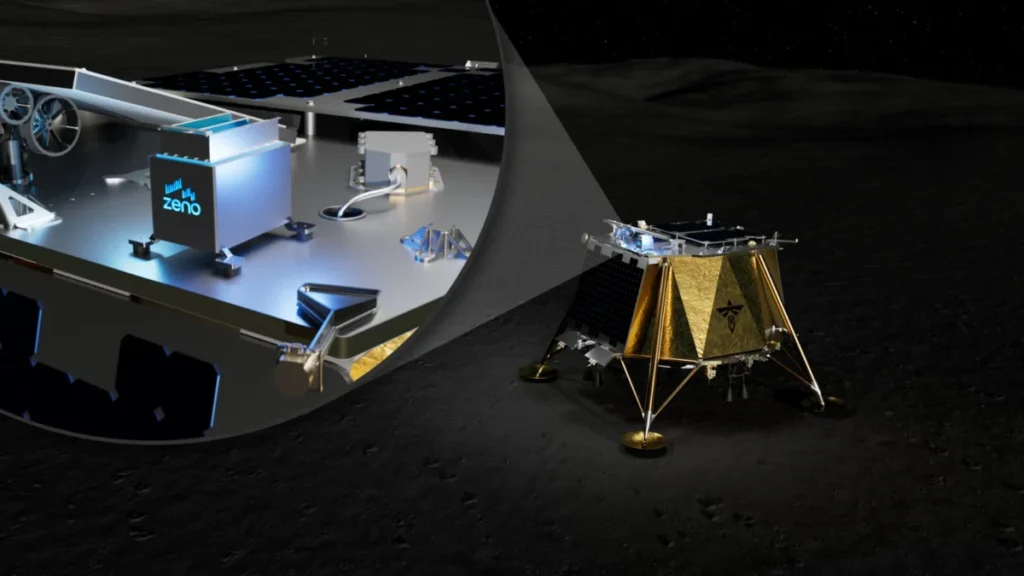
Firefly Aerospace is set to deploy a groundbreaking nuclear-powered heating technology to the Moon in 2028, a crucial step toward addressing one of the most significant challenges in lunar exploration: the extreme cold of the lunar night. The mission, leveraging Zeno Power Systems’ "Survive-the-Night Package," will be carried aboard an existing Blue Ghost mission targeting the Moon’s near side. This ambitious endeavor aims to validate whether spacecraft can endure and operate through the prolonged periods of darkness and sub-freezing temperatures, marking a pivotal advancement for sustained lunar presence. Firefly Aerospace anticipates launching this mission no earlier than 2028, underscoring the careful planning and technological integration required for such a critical experiment.
The Lunar Night Challenge: A Major Hurdle for Exploration
The lunar environment presents a dichotomy of extreme conditions. While a lunar day, lasting approximately 14 Earth days, brings scorching temperatures that can exceed 230°F (110°C), the ensuing lunar night plunges the surface into an equally brutal cold, with temperatures plummeting below minus 275°F (-170°C). This dramatic thermal swing poses immense engineering challenges for any mission designed for extended operations. Current solar-powered spacecraft, while effective during daylight hours, face severe limitations once the sun sets. Batteries can provide temporary power, but their efficiency and lifespan are significantly degraded by extreme cold, which can also critically compromise sensitive electronics, lubricants, and mechanical components.
This vulnerability to the lunar night has historically curtailed the operational duration of many lunar landers and rovers. For instance, several early lunar missions, including some of NASA’s Surveyor series in the 1960s, were not designed to survive the lunar night. More recently, some commercial lunar attempts have also faced this insurmountable hurdle, highlighting the pressing need for robust thermal management solutions. Overcoming this challenge is paramount for America’s and indeed, humanity’s, growing lunar ambitions, which increasingly focus on establishing long-term bases, conducting extensive scientific research, and exploring resource utilization. Future lunar infrastructure, whether robotic or human-crewed, must operate beyond the confines of a single lunar day to be truly effective.
Zeno Power’s Innovative Solution: The Survive-the-Night Package
The "Survive-the-Night Package" developed by Zeno Power Systems represents a significant leap forward in addressing this thermal challenge. Central to its design is a compact five-watt radioisotope heater unit (RHU) that utilizes americium-241. This radioactive isotope, a byproduct of plutonium-239 decay, naturally releases thermal energy as it undergoes radioactive decay. Unlike solar panels, which depend entirely on sunlight, this process provides a continuous and reliable source of thermal energy, independent of illumination. The choice of americium-241 is notable; while plutonium-238 is the traditional radioisotope fuel for space applications due to its high power density and relatively long half-life, americium-241 offers a viable alternative, especially for lower power heating applications, with a half-life of 432 years. Its use demonstrates an innovative approach to leveraging available isotopes for critical space technologies.
The RHU will be strategically placed on a dedicated platform aboard the Blue Ghost lander. This package is not merely a heat source; it is a self-contained system comprising its own communications, electrical power management, and thermal management subsystems, ensuring autonomous operation. The primary function of this RHU is not to generate electricity for the entire spacecraft, but rather to supply continuous heat, maintaining critical components such as batteries, scientific instruments, and electronic systems within their safe operating temperature ranges. This targeted thermal protection is designed to preserve the integrity and functionality of the lander’s core systems, allowing them to effectively "hibernate" through the intense cold of the lunar night and potentially reactivate when sunlight returns.
Mission Profile and Chronology
The 2028 mission will follow a precise operational sequence. The Firefly Blue Ghost lander will first complete its scheduled primary payload operations during the lunar day, utilizing solar power for its various scientific and technological demonstrations. Once the lunar night descends, marking the disappearance of direct sunlight, Zeno Power’s Survive-the-Night system will initiate its demonstration phase. Engineers on Earth will then meticulously study the performance of this compact nuclear heating system over the roughly 14 Earth days of darkness. The package is designed to transmit critical operational data back to Earth, providing invaluable insights into its thermal regulation capabilities, power consumption, and overall resilience in the unforgiving lunar environment.
This upcoming mission builds upon the critical data gathered during Firefly’s Blue Ghost Mission 1, which is slated for a Moon landing in 2025. That precursor mission is designed to provide direct measurements of the lunar surface’s harsh thermal conditions, offering firsthand insight into the extreme temperature swings and their effects on spacecraft materials and systems. The observations from Mission 1 will be instrumental in refining the operational parameters and expectations for the 2028 nuclear heating demonstration, ensuring that the experiment is as informed and robust as possible. The chronological progression from data acquisition to targeted technology demonstration exemplifies a systematic approach to tackling complex space exploration challenges.
Background Context: NASA’s Artemis Program and CLPS
This mission is embedded within a broader, ambitious framework of lunar exploration, particularly NASA’s Artemis program. The Artemis program aims to return humans to the Moon, establish a sustainable human presence, and use the Moon as a proving ground for future missions to Mars. A cornerstone of this strategy is the Commercial Lunar Payload Services (CLPS) initiative, through which NASA partners with American companies like Firefly Aerospace to deliver payloads to the lunar surface. This approach leverages commercial innovation and efficiency, fostering a vibrant lunar economy and accelerating technological development.
The CLPS program is designed to be cost-effective and agile, enabling frequent access to the Moon for scientific research, technology demonstrations, and resource prospecting. Firefly Aerospace, as a CLPS provider, plays a crucial role in this ecosystem. The integration of Zeno Power’s nuclear heating technology into a Blue Ghost mission highlights how commercial partnerships are driving the innovation necessary to achieve NASA’s ambitious long-term goals. The ability to survive the lunar night is not merely a scientific curiosity; it is a fundamental requirement for the kind of sustained human and robotic presence envisioned by Artemis, including the development of lunar habitats, resource extraction facilities, and advanced scientific observatories.
Statements from Key Stakeholders and Broader Implications
Tyler Bernstein, CEO and co-founder of Zeno Power Systems, emphasized the criticality of this technology, stating, "Surviving the lunar night will prove essential for sustained operations on the Moon." He highlighted that the experiment will rigorously test whether a compact nuclear heat source can effectively shield critical spacecraft systems from plummeting temperatures, potentially unlocking new possibilities for missions targeting permanently shadowed regions (PSRs). These PSRs, located primarily at the lunar poles, are of immense scientific interest due to the potential presence of water ice, a vital resource for future human missions (for drinking water, oxygen, and rocket propellant).
Ray Allensworth, Firefly’s vice president of spacecraft, echoed this sentiment, referencing the invaluable data from their previous missions. "Our first Blue Ghost mission gave us firsthand insight into the Moon’s extreme thermal environment," Allensworth stated, underscoring how these observations revealed the true scale of the challenge. The 2028 demonstration, therefore, is not just a test of Zeno’s technology but a direct response to empirically gathered data, aiming to provide real-world performance metrics for nuclear-powered and radioisotope heating technology under actual lunar conditions.
The implications of a successful demonstration are profound. It would significantly extend the operational lifespan of lunar landers and rovers, moving beyond the current limitations of a single lunar day. This capability would enable more extensive scientific investigations, longer periods of data collection, and the deployment of more complex lunar infrastructure. For NASA and other space agencies, this technology could unlock access to previously inaccessible areas, particularly the permanently shadowed regions at the poles, which hold promise for valuable resources. The ability to maintain operational temperatures would also enhance the reliability and longevity of sophisticated instruments, ensuring maximum return on investment for costly space missions.
Technical Deep Dive: RHUs vs. RTGs
It is crucial to differentiate between radioisotope heater units (RHUs) and radioisotope thermoelectric generators (RTGs). While both utilize the heat from radioactive decay, their primary functions differ. RTGs convert thermal energy directly into electrical power, typically used to power entire spacecraft or significant subsystems, especially on deep-space missions where solar power is insufficient (e.g., Voyager, Cassini, Perseverance rover). These are generally more complex and larger.
In contrast, the RHU on this mission is specifically designed to provide heat, not electricity for the entire spacecraft. Its five-watt output is modest compared to the hundreds of watts generated by an RTG, but it is precisely calibrated to maintain critical components above their freezing point. This targeted heating approach is highly efficient for its specific purpose, conserving precious power resources that can be used for other operational functions during the lunar night, or simply for "survival mode" until solar power becomes available again. The choice of a small RHU reflects a pragmatic engineering solution for a specific problem: thermal resilience.
Future Lunar Endeavors
Firefly Aerospace is not limiting its lunar ambitions to the near side. The company also has plans for future Blue Ghost missions targeting the Moon’s far side, a region of immense scientific interest due to its unique geological features and potential for radio astronomy free from Earth’s interference. Additionally, missions to specific geological sites, such as the Gruithuisen Domes, are also on Firefly’s roadmap. These diverse missions underscore the company’s commitment to advancing lunar exploration capabilities and contributing to a deeper understanding of Earth’s closest celestial neighbor. The 2028 mission, by testing a technology vital for extended stays, represents a critical stepping stone in Firefly’s broader strategy to enable a more robust and enduring human and robotic presence on the lunar surface.
In conclusion, the partnership between Firefly Aerospace and Zeno Power Systems for the 2028 lunar mission signifies a monumental stride in addressing the challenges of sustained lunar exploration. By demonstrating the efficacy of nuclear-powered heating technology, this mission aims to transform our ability to operate in the Moon’s extreme environment, opening new frontiers for scientific discovery, resource utilization, and the establishment of a long-term human presence beyond Earth. The data gathered will be instrumental in shaping the future design of lunar landers, rovers, and habitats, ultimately paving the way for a new era of lunar and deep space exploration.