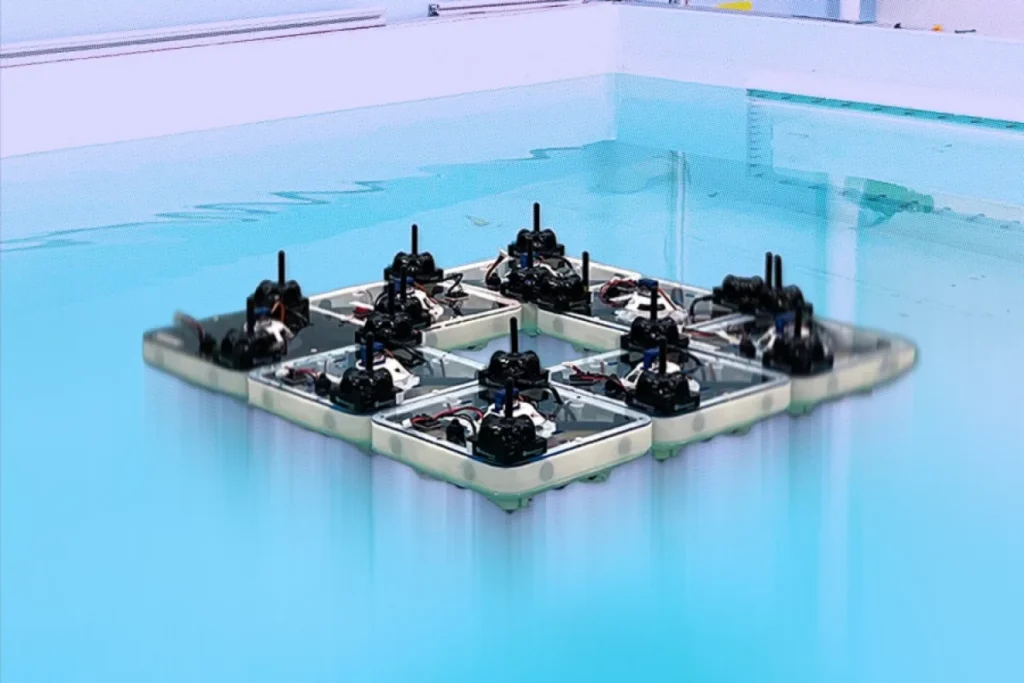
A team of researchers at the Massachusetts Institute of Technology (MIT) has unveiled a groundbreaking robotic system named FloatForm, which reimagines the potential of urban waterfronts. Moving beyond the traditional perception of waterfronts as mere city edges, FloatForm envisions them as dynamic, programmable spaces where swarms of small, autonomous robotic boats can self-assemble into larger, adaptable structures on demand. This innovative approach promises to unlock new possibilities for urban mobility, emergency response, public space utilization, and the very definition of water-based infrastructure.
The FloatForm system comprises a collection of small, square robotic boats, each approximately the size of a dinner plate (21 centimeters square). These individual units are designed as self-contained vessels, equipped with their own thrusters for propulsion, sensors for environmental awareness, and magnetic latches for inter-robot connectivity. The core innovation lies in their ability to autonomously coordinate and connect, forming larger, cohesive structures that can be reconfigured or dissolved with minimal human intervention. This modular, adaptable nature hints at a future where floating infrastructure is not static but fluid and responsive to immediate needs.
"Our FloatForm project envisions a future where the waterfront becomes a programmable extension of the city, where autonomous boats can self-organize into bridges, platforms, and other useful structures on demand," stated Daniela Rus, the Panasonic Professor of Electrical Engineering and Computer Science at MIT and director of MIT’s Computer Science and Artificial Intelligence Laboratory (CSAIL). "This kind of distributed robotics opens new possibilities for mobility, emergency response, public space, and infrastructure on water."
The research, published in the open-access journal Nature Communications, builds upon years of investigation into autonomous watercraft by MIT’s Senseable City Lab and CSAIL. It represents a significant evolution from the earlier Roboat project, a collaboration with the Amsterdam Institute for Advanced Metropolitan Solutions that deployed full-size autonomous vessels in Amsterdam’s canals. While Roboat explored the potential of larger boats for urban services like waste collection and transport, FloatForm addresses a more intricate challenge: orchestrating the collective behavior of a large number of small, independent robots.
"With FloatForm, we are essentially turning static water surfaces into dynamic, programmable spaces," explained Wei Wang, lead author of the paper and a former MIT research scientist now heading the Marine Robotics Lab at the University of Wisconsin at Madison. "Imagine an urban environment where public space isn’t fixed, but can autonomously expand, contract, or reconfigure on demand."
From Concept to Reality: The Biological Inspiration
The inspiration for FloatForm’s decentralized coordination strategy comes from the natural world, specifically from the remarkable ability of fire ants to survive floods. These insects, when faced with rising water levels, link their bodies together to form living rafts, a complex structure that emerges without any single ant directing the operation. Each ant adheres to simple local rules, and through this collective adherence, a robust and resilient raft materializes.
"Each ant is an independent agent," noted Alejandro Gonzalez-Garcia, a former researcher with MIT CSAIL and the Senseable City Lab, who also contributed to the project. "We wanted each robot to have its own capabilities, the same way ant colonies form a raft."
This biological blueprint contrasts sharply with many existing self-assembling robotic systems, which often rely on a central computer to dictate every movement. Such centralized control can be a single point of failure and scales poorly, as the computational load increases exponentially with the number of robots. The FloatForm approach flips this paradigm. A lightweight central planner provides high-level guidance, assigning each robot a target position to refine the overall structure. However, the critical tasks of navigation, collision avoidance, and adaptation to disturbances are managed by the robots themselves, coordinating through communication with their immediate neighbors. This distributed processing allows the entire swarm to move and reconfigure simultaneously, significantly improving efficiency and scalability.
"The beauty of this largely decentralized approach is that the computation doesn’t get bogged down as the swarm grows," elaborated Wang. "Whether you are working with eight boats or 80, the entire fleet coordinates and moves simultaneously. Because the overall assembly time doesn’t significantly increase in principle, the system remains highly scalable."
Engineering the "Origami Handshake" and Collective Motion
The physical connection between the FloatForm robots is achieved through a cleverly designed latching mechanism concealed within each hull. Inspired by origami principles, an auxetic structure, which contracts uniformly in all directions, is driven by a single servo motor. This mechanism manipulates permanent magnets, either retracting them to release a neighbor or extending them to engage. The precise arrangement of alternating magnetic polarities ensures that the boats reliably connect into a clean, square lattice formation.
A key engineering triumph of this latching system is its energy efficiency. Once latched or unlatched, the mechanism maintains its state without continuous power draw, thanks to a 3D-printed gearbox. "It uses energy to latch and de-latch, but in between those states, it doesn’t use any energy," explained Niklas Hagemann, an MIT graduate student in architecture, CSAIL affiliate, and former Senseable City Lab researcher who has been involved with the project since its early stages. This low power consumption is crucial for small robots with limited battery capacity, allowing more energy to be allocated to computation and movement.
The robots are equipped with four miniature thrusters arranged in an ‘X’ configuration, enabling omnidirectional movement and precise maneuvering, including turning in place. However, at this small scale, the powerful thrusters interacting with the robots’ low inertia presented early challenges, leading to twitchy movements and aggressive spins. The research team addressed this by incorporating stabilizing fins to increase hydrodynamic drag and meticulously tuning control algorithms to ensure robust performance across robots that, by nature of their size, exhibit slight manufacturing variations. The magnetic latches themselves also posed an initial hurdle; their strong attraction sometimes required robots to twist and maneuver to break free.
In controlled experiments conducted at MIT, a fleet of eight FloatForm robots demonstrated remarkable proficiency. They repeatedly assembled from random positions into a designated shape, latched into a rigid structure, broke apart on command, reconfigured into a new arrangement, and then collectively traversed a test pool as a single vessel. Each cycle of assembly, reconfiguration, and movement typically took between four to eight minutes. In the "collective transport" mode, a central planner charts a course for the entire structure, and each individual robot calculates its contribution to the overall movement, effectively turning each robot into an actuator for the larger formation. Simulations have shown this framework to scale effectively, smoothly accommodating swarms of up to 64 robots.
Resilience and Scalability in Real-World Conditions
The FloatForm system’s performance in experimental trials has been highly encouraging. Across multiple tests, the system achieved mission completion without human intervention in 90% of trials with four robots and 70% with eight robots. Crucially, the decentralized architecture demonstrates significant resilience. A robot that momentarily loses its bearings can reintegrate into the swarm autonomously, without disrupting the entire operation. Similarly, robots caught in formation deadlocks have shown the ability to resolve such issues and retry their movements.
The transition from controlled indoor environments to real-world waterways like canals and harbors presents further engineering challenges. "There’s always a relationship between the size of a boat and the magnitude of the disturbance it can handle," noted Gonzalez-Garcia. "These boats are very small, so in very disturbed water, they cannot work." Scaling up will necessitate reinforcing the latching mechanisms, potentially incorporating mechanical interlocking systems similar to those used in the full-size Roboat, and upgrading navigation systems from laboratory ultrasonic positioning to more robust GPS or vision-based sensing. The underlying coordination algorithm, however, is designed to be sensor-agnostic, allowing for seamless integration of different sensing technologies without altering the core logic.
The potential applications of FloatForm extend far beyond urban canals. The researchers envision its use in creating temporary platforms for offshore inspection and maintenance, deploying adaptive sensor networks for wildlife monitoring, and establishing reconfigurable docking stations for emergency response in remote or difficult-to-access areas. Offshore operations, including temporary construction platforms and scientific expeditions, also stand to benefit from this adaptable technology.
Cities with extensive waterways, such as Venice, the Netherlands, Belgium, and coastal regions of Norway, could significantly leverage this technology. "The project uses spaces where water is already important, but it also raises the question: Where else can water be used for something more?" Gonzalez-Garcia posited.
Steven Ceron, Assistant Professor at the University of Michigan, who was not involved in the research, lauded the achievement. "This is an exciting step forward in realizing distributed collective behaviors on water," he stated. "Assembly, self-reconfiguration, and collective motion are difficult enough in dry environments, but achieving these behaviors in a predominantly distributed fashion on water represents a serious additional challenge, and this team has credibly overcome it. By shifting the computational burden onto the robots themselves, they have built a more resilient system that in the near future could enable robot collectives like this to be deployed in open-water environments for search operations, environmental monitoring, and reconfigurable marine infrastructure."
The research was supported by grants from the Amsterdam Institute for Advanced Metropolitan Solutions and the University of Wisconsin at Madison, with contributions from MIT Sea Grant and Professor Michael Triantafyllou, who provided the test tank facility. The paper’s authors include Gonzalez-Garcia, Hagemann, Wang, senior authors Carlo Ratti (professor at Politecnico di Milano and director of MIT’s Senseable City Lab), and Daniela Rus. Gonzalez-Garcia is also affiliated with the MECO Research Team at KU Leuven.