Ford Motor Co. is undertaking a monumental transformation of its Louisville Assembly Plant in Kentucky, committing an estimated $2 billion to convert the sprawling 3-million-square-foot facility from a traditional gasoline-powered vehicle production hub into a cutting-edge center for electric vehicle (EV) manufacturing. This significant investment is earmarked for the assembly of the upcoming Ford Fathom midsize electric truck, signaling a bold step in Ford’s aggressive electrification strategy. Prototype builds utilizing production-qualified components are slated to commence in the first quarter of 2027, with full customer production expected to follow later the same year.
The Universal EV Production System: A New Era of Manufacturing
At the core of this ambitious overhaul is Ford’s innovative Universal EV Production System (UEV Production System), a manufacturing methodology designed to fundamentally redefine the automotive assembly line. This system moves away from the conventional sequential assembly process, where a vehicle gradually takes shape along a single, linear path. Instead, Ford is implementing what it terms an "assembly tree" approach, characterized by parallel production streams that converge at a later stage.
The UEV Production System divides the vehicle into three primary subassemblies: the front section, the rear section, and a structural battery assembly. Crucially, this battery assembly is not merely a power source but also integrates interior components such as seats, consoles, and carpeting, effectively serving as the vehicle’s structural floor. These three major sections are assembled simultaneously in dedicated parallel lines, allowing for more efficient component installation and improved access for workers. Only after these subassemblies are largely complete are they brought together, joined securely with bolts and industrial adhesives to form the complete vehicle.
A key enabler of this parallel assembly paradigm is the strategic use of large aluminum unicastings for both the front and rear sections of the vehicle. Each of these massive, single-piece castings replaces dozens of individually stamped and welded parts, a significant simplification of the manufacturing process. Beyond reducing part count, these unicastings provide immense structural integrity, allowing for the installation of numerous components and systems onto these sections before they are joined with the central battery unit. This innovative application of gigacasting technology, similar to techniques pioneered by other EV manufacturers, streamlines production, reduces complexity, and contributes to the overall structural rigidity and safety of the vehicle.
Deep Dive into the Transformation and Technological Upgrades
The transition of the Louisville Assembly Plant is not merely an equipment upgrade; it represents a complete reimagining of the manufacturing space. Ford initiated the transformation by essentially emptying the existing factory, a colossal undertaking that involved the removal of nearly 25,000 gross tons of scrap metal, transported in 2,618 truckloads. This clearing made way for approximately 230,000 square feet of new concrete foundations, specifically poured to accommodate the advanced final assembly equipment of the UEV Production System.
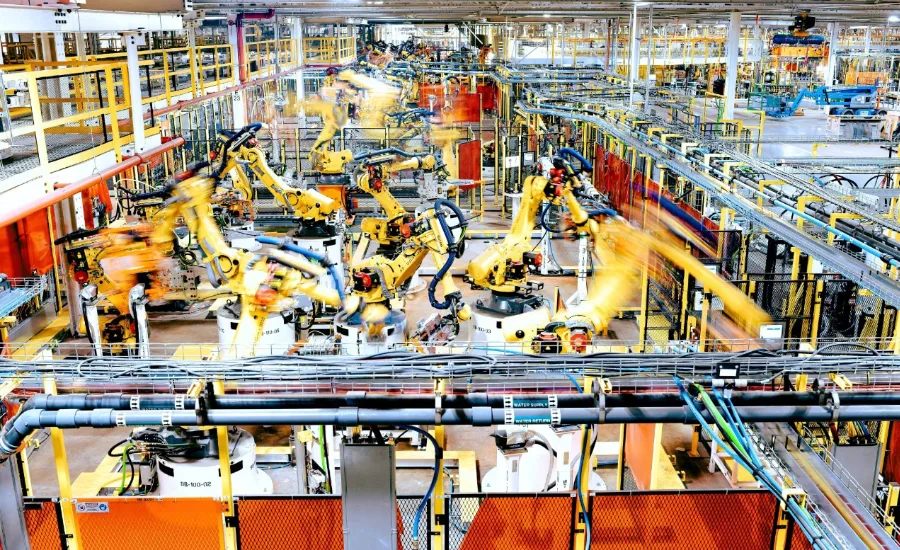
The revamped final assembly operation will feature an extensive network of approximately 17,000 feet of conveyor systems, meticulously engineered to facilitate the parallel flow of subassemblies. Ford states that this new setup will boast the highest level of final assembly automation among its manufacturing plants worldwide, signifying a major leap in robotic integration and process control.
Beyond physical infrastructure, the digital backbone of the plant is undergoing a dramatic expansion. The number of Wi-Fi access points has surged from 385 to 1,080, establishing a robust, high-bandwidth, low-latency connectivity network across the entire production floor. This enhanced digital infrastructure is vital for supporting an increased number of in-process quality checks as vehicles move through the "assembly tree," enabling real-time data collection and immediate issue identification.
A groundbreaking innovation within this digital transformation is the introduction of a software module flash station – a first for a Ford assembly plant. Historically, software modules were updated after a vehicle had been fully assembled, a process that Ford estimates could add approximately 10 minutes per vehicle to address potential software issues. With the new system, software modules will be updated and validated before their installation, ensuring that components are "software-ready" from the outset. Furthermore, the integration of private 5G connectivity will allow for continuous quality tests to be performed on components and subassemblies even as they are actively moving through various stages of production, drastically reducing diagnostic time and improving overall quality assurance.
Prioritizing Ergonomics and Workforce Empowerment
A significant benefit touted by Ford for the UEV Production System is its profound impact on worker ergonomics and overall job satisfaction. The traditional sequential assembly line often forces operators into awkward positions, requiring extensive twisting, turning, and bending to install components within the confined spaces of a largely assembled vehicle body. The new system is specifically designed to alleviate these physical strains.
Bryce Currie, Ford’s chief manufacturing officer, highlighted this aspect, stating, "We listened to all the things operators don’t like. Their work at Louisville Assembly Plant will be significantly more ergonomic." Kevin Young, Ford’s advanced program manufacturing chief, echoed this sentiment, adding, "It is simply foundationally different from how we have done things before. Operators can see everything in front of them and don’t need to bend or reach to do it."
For instance, under the traditional system, installing a seat often requires operators to squeeze through a vehicle doorway and maneuver around the interior structure with tools. In the UEV Production System, the seat is installed directly onto the rear subassembly, with unobstructed access and without the vehicle’s full structure impeding the process. Similarly, installing components on the dash – typically the section with the most parts – becomes far more ergonomic. Operators can stand facing the front clip with a direct line-of-sight, optimizing both installation efficiency and comfort. Currie quantified these improvements, noting an "84% reduction in reaching over the fender." He also pointed out that the wiring harness for the Fathom is more than 4,000 feet shorter and 22 pounds lighter than those in Ford’s first-generation electric SUVs, making installation considerably easier and reducing material costs.
Louisville employees have been actively involved in training on the new process at Ford’s New Model Product Development Center in Allen Park, Michigan. Their valuable feedback is being directly incorporated into the production system design, ensuring that the UEV Production System is not only technologically advanced but also highly practical and worker-friendly before the Fathom’s official launch.
Ford’s Broader Electrification Strategy and Market Context
The $2 billion investment in Louisville is part of Ford’s broader, ambitious push into the electric vehicle market, a strategy encapsulated by its "Ford+" plan and the creation of the Model e division dedicated solely to EVs. This transformation comes at a crucial time for the automotive industry, which is grappling with the complexities of scaling EV production, achieving profitability, and meeting evolving consumer demands.
Ford has committed tens of billions of dollars to its electrification efforts, including major investments in battery manufacturing facilities like BlueOval SK Battery Park in Kentucky and Tennessee, and the massive BlueOval City campus in Tennessee. The Louisville plant’s retooling for the Fathom midsize electric truck positions Ford to compete aggressively in the burgeoning electric truck segment, which already features rivals like the Rivian R1T, Tesla Cybertruck, GMC Sierra EV, Chevrolet Silverado EV, and the upcoming Ram 1500 REV. The Fathom will likely target a segment that balances capability with a more urban-friendly footprint compared to the larger F-150 Lightning, further diversifying Ford’s EV truck offerings.
The Universal EV Production System is a direct response to the need for greater efficiency and cost reduction in EV manufacturing. While EVs offer long-term operational savings, their upfront production costs, particularly for batteries, can be higher than internal combustion engine vehicles. By accelerating assembly time by 40% – with a net assembly-time improvement of 15% even after reinvesting time into insourcing and automation for quality and cost reduction – Ford aims to significantly improve its competitive edge and path to EV profitability. This efficiency gain is critical as Ford targets an annual EV production run rate of 2 million units by 2026.
Economic Impact and Future Implications
The comprehensive Ford Fathom manufacturing program represents a total investment of $5 billion, encompassing both the Louisville Assembly Plant and the BlueOval Battery Park Michigan. This substantial capital injection is projected to create 4,000 new jobs across these two operations, providing a significant economic boost to the region and underscoring Ford’s commitment to job creation within the evolving automotive landscape.
The UEV Production System’s adoption of parallel assembly and unicasting technology holds significant implications for the broader automotive industry. It demonstrates a viable path for other legacy automakers to transition their manufacturing processes to be more suitable for electric vehicles, which often feature simpler mechanical structures but more complex software and battery integration. The focus on integrating interior components directly onto the structural battery pack is another design-for-manufacturing innovation that could become an industry standard.
Furthermore, the heightened level of automation, advanced digital infrastructure, and in-process quality checks signify a move towards "Industry 4.0" principles in automotive manufacturing. The ability to flash software modules pre-installation and conduct quality tests via private 5G connectivity while vehicles are in motion represents a significant leap in quality control and efficiency, minimizing costly rework and enhancing overall product reliability.
Ford’s transformation of the Louisville Assembly Plant is more than just a facility upgrade; it is a strategic maneuver designed to optimize EV production, enhance worker conditions, and solidify the company’s position as a leader in the electric vehicle revolution. As the Ford Fathom electric truck prepares for its 2027 debut, the innovative manufacturing processes underpinning its creation will be closely watched by the entire automotive world, potentially setting new benchmarks for efficiency, quality, and ergonomics in the age of electric mobility.