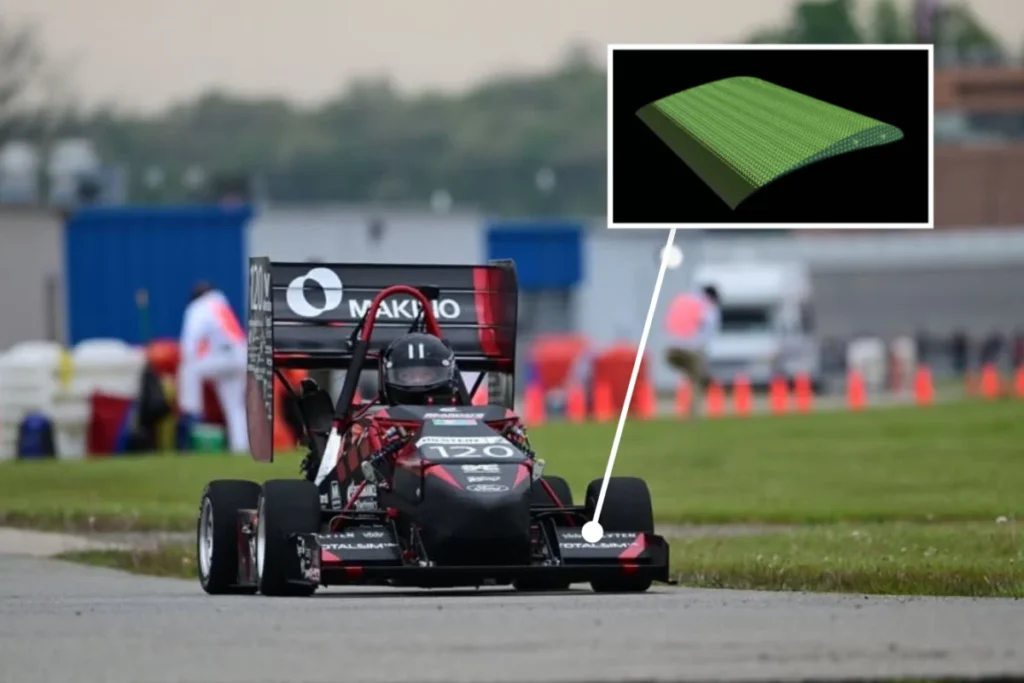
The University of Cincinnati Bearcats Motorsports team has achieved a significant advancement in their Formula SAE race car design, leveraging cutting-edge additive manufacturing technology and advanced material science to create a dramatically improved front wing second element. This innovation not only slashed production time and weight but also demonstrated remarkable resilience under extreme racing conditions, showcasing the transformative potential of 3D printing in high-performance automotive applications.
From Traditional Manufacturing to Additive Revolution: A Paradigm Shift
The development of the new front wing second element represents a departure from traditional manufacturing methods, which had previously required a substantial investment of time and resources. The original component, a complex assembly of carbon fiber and aluminum, demanded approximately 65 hours for design, manufacturing, and assembly. This laborious process yielded a part weighing 621 grams. The Bearcats Motorsports team recognized the inherent limitations of this approach and sought a more efficient and performance-oriented solution.
Their journey led them to collaborate with three key industry partners: Vixiv, GZero Additive, and Lyten. This strategic alliance brought together expertise in design optimization, large-format additive manufacturing, and advanced material development, setting the stage for a groundbreaking redesign.
Vixiv’s AI-Powered Design Optimization: Speed and Precision
The first critical step in the redesign process involved Vixiv, a specialist in design optimization. Vixiv’s sophisticated software was employed to analyze the existing front wing design. The objective was to translate the functional requirements into a 3D printable structure that minimized material usage while maximizing aerodynamic efficiency and structural integrity.

Vixiv’s proprietary AI engine played a pivotal role. This cloud-based system is designed to intelligently integrate lattice geometries within a specified volume, adhering to user-defined parameters such as maximum load-bearing capacity and desired shell thickness. For the airfoil of the front wing’s second element, Vixiv’s AI engine generated an optimized 3D printable design in an astonishing 34 seconds. This rapid iteration capability is a hallmark of advanced design software and dramatically accelerates the product development cycle compared to manual design processes. The ability to quickly explore numerous design permutations allows engineers to fine-tune performance characteristics with unprecedented speed and accuracy.
GZero Additive and Lyten: Bringing the Design to Life with Advanced Materials
Following Vixiv’s design optimization, the digital model was seamlessly transferred to GZero Additive, a prominent provider of large-format additive manufacturing (LFAM) solutions and 3D printing services. GZero Additive’s expertise in industrial-scale 3D printing was crucial in translating the intricate digital design into a tangible, high-performance component.
The chosen manufacturing platform was GZero Additive’s LFAM system. This technology is capable of producing large and complex parts that are often challenging or impossible to create with conventional manufacturing techniques. For this specific application, GZero Additive utilized a specialized filament from Lyten, a leader in advanced materials. The filament was a graphene-reinforced nylon, a material engineered for its exceptional strength-to-weight ratio, durability, and thermal properties. The incorporation of graphene into the nylon matrix significantly enhances its mechanical performance, making it an ideal choice for demanding applications like motorsport components.
The additive manufacturing process allowed for the creation of the entire front wing second element as a single, integrated part. This eliminated the need for the multi-component assembly that characterized the original design, thereby removing assembly time and potential points of failure. The resulting 3D printed component weighed a remarkable 395 grams, a substantial reduction from the original 621 grams – a saving of over 36%. This significant weight reduction directly contributes to improved vehicle performance, including better acceleration, braking, and cornering capabilities.
Performance Under Pressure: The True Test at FSAE Michigan
The ultimate validation of this innovative design came at the prestigious Formula SAE Michigan competition. This event is a rigorous test of engineering prowess, where student teams design, build, and race formula-style cars. The Bearcats Motorsports team’s new 3D printed front wing second element was put to the ultimate test, enduring the intense dynamic loads and stresses inherent in competitive racing.

Throughout the competition, the component consistently sustained structural loads ranging from 60 to 80 pounds-force (lbf). This performance itself was impressive, demonstrating the material and design’s ability to withstand significant forces. However, the component’s true mettle was revealed during a critical incident. An impact occurred that resulted in the snapping of the endplates of the car’s first element.
In a conventional scenario, such damage could have led to immediate disqualification or forced the team to retire from the event. However, the robust design and manufacturing of the 3D printed second element proved instrumental. It managed to hold the broken assembly aloft, preventing further damage to the car and allowing the Bearcats Motorsports team to continue competing for the remainder of the event. This unexpected resilience highlights the superior structural integrity and the fail-safe characteristics engineered into the 3D printed component. The ability to withstand such an event, not only by maintaining its own structural integrity but also by supporting a damaged primary component, speaks volumes about the advanced engineering and material selection involved.
The Broader Implications of Additive Manufacturing in Motorsport
The success of the Bearcats Motorsports team with their 3D printed front wing second element offers a compelling case study for the broader adoption of additive manufacturing in motorsport and other high-performance industries. The benefits are multifaceted and extend far beyond weight reduction.
Accelerated Design Iteration and Prototyping
The ability of Vixiv’s AI to generate optimized designs in seconds represents a paradigm shift in the design process. This allows teams to rapidly prototype and test multiple design variations, leading to faster development cycles and the identification of optimal aerodynamic and structural solutions. This speed is invaluable in the competitive world of motorsport, where marginal gains can make a significant difference.
Material Innovation and Performance Enhancement
The use of advanced materials like Lyten’s graphene-reinforced nylon opens up new avenues for performance enhancement. These materials offer superior mechanical properties compared to traditional composites or metals, enabling engineers to design lighter, stronger, and more durable components. The ability to tailor material properties for specific applications is a key advantage of additive manufacturing.

Cost and Resource Efficiency
While the initial investment in advanced 3D printing technology and materials can be significant, the long-term benefits in terms of reduced manufacturing time, lower labor costs, and minimized material waste can lead to substantial cost savings. The elimination of complex tooling and assembly processes further contributes to overall efficiency.
Democratization of Advanced Manufacturing
Projects like this demonstrate how universities and student teams can access and leverage state-of-the-art manufacturing technologies. This democratizes access to advanced capabilities, empowering the next generation of engineers to innovate and push the boundaries of what is possible. The collaborative model, involving specialized industry partners, also fosters valuable real-world experience for students.
Enhanced Durability and Reliability
The incident at FSAE Michigan underscores the potential for 3D printed components to exhibit exceptional durability and reliability, even in the face of unexpected stresses. The integrated nature of 3D printed parts can eliminate weak points associated with traditional assembly methods, leading to more robust and dependable designs.
A Look Ahead: The Future of Racing and Engineering
The integration of AI-driven design, advanced additive manufacturing, and novel materials is poised to redefine the landscape of motorsport engineering. The Bearcats Motorsports team’s achievement is not merely a success for a single university project; it is a testament to the ongoing revolution in how high-performance components are conceived, developed, and manufactured.
As these technologies mature and become more accessible, we can anticipate seeing them deployed across a wider range of racing disciplines, from Formula 1 and NASCAR to endurance racing and beyond. The ability to rapidly iterate on designs, optimize for performance, and create lightweight, durable parts will undoubtedly lead to faster, safer, and more innovative racing machines in the future. The University of Cincinnati Bearcats Motorsports team has not only improved their race car but has also provided a glimpse into the future of engineering design and manufacturing.