In the intricate world of modern motion control systems, the Serial Peripheral Interface (SPI) stands as a cornerstone for efficient and reliable data transmission at the circuit board level. While high-level network protocols such as Ethernet, EtherCAT, and CAN are indispensable for connecting disparate drives, motors, and controllers across expansive industrial environments, SPI provides a vital, often unseen, communication backbone within the core components of these systems. This synchronous serial data transmission standard has become a ubiquitous input-output solution, particularly in embedded systems, where it facilitates short-distance communication between microcontrollers and a diverse array of peripheral integrated circuits.
The landscape of communication protocols in motion systems is stratified, addressing varying scales and requirements. For broad system-level interconnectivity, industrial Ethernet variants or CAN networks offer robust, real-time data exchange across multiple devices. However, within the confines of a single control board or a microcontroller unit, these protocols can be overkill in terms of complexity, resource consumption, and physical footprint. This is precisely where protocols like SPI, alongside others such as I2C (Inter-Integrated Circuit) and UART (Universal Asynchronous Receiver-Transmitter), carve out their essential niche. SPI distinguishes itself by offering full-duplex communication, higher data rates, and simpler hardware implementation compared to some of its counterparts, making it exceptionally well-suited for high-speed data exchange between a master microcontroller and its peripheral devices.
The Foundational Role of SPI in Embedded Systems
At its most fundamental physical layer, SPI operates as a four-wire serial interface, supporting full-duplex communication, meaning data can be sent and received simultaneously. This capability significantly enhances its efficiency in scenarios requiring rapid, two-way data flow. The four wires typically comprise:
- MOSI (Master Out Slave In): The line on which the master sends data to the slave.
- MISO (Master In Slave Out): The line on which the slave sends data to the master.
- SCK (Serial Clock): The clock signal generated by the master to synchronize data transmission.
- SS (Slave Select) or CS (Chip Select): An active-low signal generated by the master to select a specific slave device for communication.
Data rates achievable with SPI can vary widely, ranging from a few megahertz (MHz) up to 10 MHz or even higher in specialized implementations. The data transmission itself is highly flexible, supporting word lengths typically from 8 to 16 bits, though programmable options can extend this from 2 to 24 bits, depending on the microcontroller and peripheral capabilities. This flexibility allows designers to optimize communication for various data types, from simple control commands to more complex sensor readings or memory block transfers.
SPI’s primary advantage in embedded systems, especially in motion control, lies in its ability to transmit data between microcontrollers and a wide range of peripheral devices. These include various types of sensors (e.g., encoders, accelerometers, gyroscopes for feedback loops), control devices (e.g., motor drivers, digital-to-analog converters), memory cards (e.g., flash memory for firmware or data logging), and displays (e.g., small OLED or LCD screens for status indicators). By utilizing only four wires, SPI significantly conserves Printed Circuit Board (PCB) space compared to parallel bus systems, which require a dedicated line for each data bit, plus control lines. This compact footprint is paramount in modern embedded designs where miniaturization and high component density are critical design constraints.
A Brief History and Evolution of SPI
The Serial Peripheral Interface was originally developed by Motorola (now part of NXP Semiconductors) in the mid-1980s. Its creation addressed a growing need for a simple, efficient, and fast method for microcontrollers to communicate with peripheral devices without the complexity and pin count associated with parallel interfaces. Motorola’s initial adoption of SPI in its 68000 family of microcontrollers quickly demonstrated its utility, leading to its widespread acceptance across the semiconductor industry. While not formally standardized by a body like IEEE or ISO, SPI has become a de facto industry standard due to its simplicity, performance, and broad support from component manufacturers.
Over the decades, SPI has evolved in terms of implementation specifics, data rates, and error handling capabilities (though basic SPI lacks inherent error checking). Its enduring relevance stems from its fundamental design principles: a master-slave architecture that simplifies bus arbitration, synchronous operation ensuring reliable data transfer, and full-duplex capability maximizing throughput. Its continuous integration into new generations of microcontrollers and peripheral chips underscores its foundational importance in the embedded world, maintaining its position as a go-to protocol for intra-board communication.
SPI in Motion Control: Bridging Microcontrollers and Peripherals
In the context of drive and control circuits, SPI plays a crucial role in enabling precise and responsive motor operation. Typically, a motor driver equipped with SPI connectivity will feature an SPI port designed to interface directly with a microcontroller. The microcontroller then transmits critical control signals, such as Pulse Width Modulation (PWM) signals for speed regulation, direction commands, or more complex motion profiles, directly to the driver via the SPI bus. In highly integrated designs, the controller and driver functionalities might even reside on the same silicon chip, with SPI serving as an internal communication channel between these logical blocks.
Beyond basic motor control, SPI’s utility extends significantly into diagnostic and feedback functions. Modern motion systems demand not only precise control but also continuous monitoring for performance optimization and fault detection. SPI can be used to read back sensor data (e.g., motor current, temperature, position from encoders), configure driver parameters on the fly, and retrieve diagnostic information (e.g., overcurrent warnings, thermal shutdowns) from the motor driver or other associated peripherals. This bidirectional communication capability is essential for closed-loop control systems, predictive maintenance, and ensuring the overall reliability and safety of motion applications.
The master/follower (often termed master/slave) configuration is central to SPI’s operation. A single master controller orchestrates communication with one or more follower devices. When multiple followers are present, each typically has its own dedicated Slave Select (SS) line. The master activates the SS line of the specific follower it intends to communicate with, thereby addressing only that device. Alternatively, some SPI peripherals can be daisy-chained, where the MOSI output of one follower connects to the MOSI input of the next, and so on. While this reduces the number of SS lines required from the master, it can complicate individual addressing and may introduce latency.
Technical Deep Dive: The Mechanics of SPI Communication
The synchronous nature of SPI is defined by the Serial Clock (SCK) signal, generated by the master. Data bits are typically shifted out on one edge of the clock (e.g., rising edge) and sampled on the opposite edge (e.g., falling edge). This synchronization eliminates the need for complex clock recovery mechanisms often found in asynchronous protocols.
SPI also offers flexibility in clock polarity (CPOL) and clock phase (CPHA), allowing for four distinct modes of operation:
- CPOL (Clock Polarity): Determines the idle state of the clock. CPOL=0 means the clock is low when idle, while CPOL=1 means it’s high when idle.
- CPHA (Clock Phase): Determines when data is sampled. CPHA=0 means data is sampled on the first clock edge, and CPHA=1 means data is sampled on the second clock edge.
These four modes (0,0; 0,1; 1,0; 1,1) ensure compatibility between different manufacturers’ devices, as long as the master and slave are configured to the same mode. The absence of a built-in acknowledgment mechanism or error correction (like CRC checks) in standard SPI implementations means that higher-level software protocols are often responsible for ensuring data integrity, though for short-distance, noise-free intra-board communication, this is often not a significant limitation.
Industry Adoption and Supporting Data
The prevalence of SPI across various industries underscores its significance. The global embedded systems market, valued at approximately $250 billion in 2023, is projected to exceed $400 billion by 2030, driven by advancements in IoT, AI, and automation. SPI remains a critical enabler within this ecosystem, with industry analysts frequently citing it as one of the most widely adopted protocols for intra-board communication due to its efficiency and reliability. A recent survey of embedded engineers indicated that SPI is utilized in over 60% of new microcontroller-based designs for peripheral communication, reflecting its sustained importance.
Leading semiconductor manufacturers such as Analog Devices, Toshiba, NXP, STMicroelectronics, and Texas Instruments consistently integrate SPI controllers into their microcontrollers, microprocessors, and specialized peripheral chips. This broad industry support ensures a rich ecosystem of compatible devices, simplifying design and accelerating time-to-market for developers.
Case Studies: SPI in Action
-
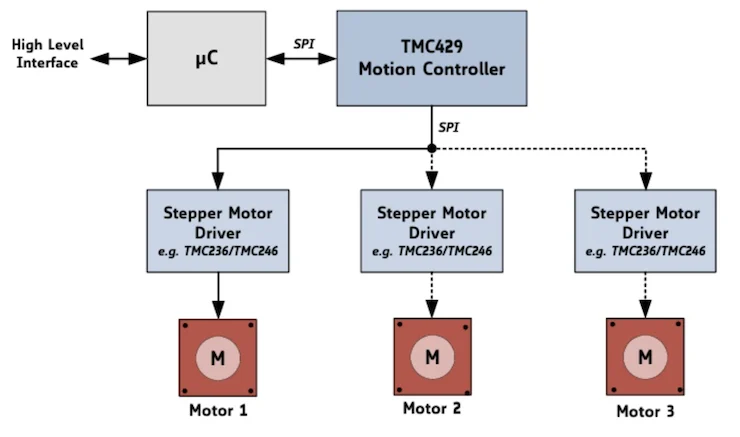
Industrial Automation and Robotics: Consider a multi-axis motion control system, such as those found in industrial robots or CNC machines. Here, a central microcontroller might utilize SPI to communicate with multiple motor driver chips, each controlling a specific axis. For instance, the Analog Devices TMC429 motion controller chip exemplifies this. The TMC429 acts as a sophisticated three-axis motion controller, featuring both an SPI controller and driver interface. It commands stepper motor positions by generating precise step and direction pulses. These pulses are then transmitted via SPI to individual stepper motor driver chips, which translate these signals into the coil currents required to actuate the stepper motors. The TMC429 itself uses two separate four-wire SPI interfaces: one for communication with a higher-level host microcontroller (e.g., for receiving motion commands) and another to communicate with up to three daisy-chained stepper motor drivers. This architecture allows for a hierarchical control scheme, where the host MCU specifies high-level tasks, and the TMC429 meticulously executes the low-level motion control, leveraging SPI for rapid and synchronized data exchange. Experts in industrial automation emphasize SPI’s critical role in ensuring the precision and responsiveness required for high-performance robotics, enabling intricate movements and real-time feedback.
-
3D Printing Systems: Modern 3D printers rely heavily on precise motor control for their X, Y, Z axes and extruder mechanisms. SPI is frequently employed here for the microcontroller to communicate with stepper motor drivers (like those from Trinamic, now part of Analog Devices). The microcontroller sends step/direction commands, micro-stepping configurations, and diagnostic requests via SPI to the drivers, which then translate these into motor movements. The speed and reliability of SPI ensure smooth, accurate layer deposition, critical for print quality.
-
Automotive Electrification: As vehicles become increasingly electrified, the number of motors controlling various subsystems is skyrocketing—from power seats, windows, and mirrors to HVAC systems and advanced driver-assistance systems (ADAS) components. Toshiba, for example, has been at the forefront of introducing motor controllers tailored for these automotive applications. Their TB9104FTG gate driver for brushed DC motors features integrated SPI alongside on-board motor control circuits. This integration allows a central vehicle ECU (Electronic Control Unit) to communicate efficiently with numerous motor drivers, sending control parameters and receiving diagnostic feedback. The built-in motor current sense amplifiers and PWM drive circuits further enhance the driver’s capabilities, all configurable and monitored via SPI. The compact nature and robust performance of SPI make it an ideal choice for the space-constrained, high-reliability environment of automotive electronics, enabling sophisticated control of multiple small motors with minimal wiring complexity. A representative from Toshiba’s automotive division underscored the efficiency of integrating SPI, stating, "Our gate drivers leverage SPI to provide seamless communication with vehicle microcontrollers, enabling precise motor control and comprehensive diagnostics, which are paramount for the next generation of electrified vehicles."
-
Laboratory and Medical Equipment: Automated laboratory equipment, such as robotic pipetting systems, automated sample handlers, and diagnostic devices, demands extreme precision and repeatability. Motion control chips utilizing SPI are crucial in these applications. For instance, precise stepper motor control enabled by SPI ensures accurate fluid dispensing or sample positioning. In medical devices, where reliability and safety are paramount, SPI’s direct and synchronous communication contributes to the dependable operation of electromechanical components.
Advantages and Limitations of SPI
While SPI’s benefits are substantial, it’s also important to acknowledge its limitations:
Advantages:
- High Speed: Typically faster than I2C or UART for equivalent clock rates, due to full-duplex operation and simpler overhead.
- Full-Duplex: Simultaneous send and receive capabilities maximize throughput.
- Simple Hardware: Requires only a shift register for implementation, making it easy to integrate into ICs.
- Low Pin Count: Uses only four wires for communication, saving valuable PCB space and reducing complexity.
- No Arbitration: The master controls all communication, eliminating bus contention issues.
- Flexible Data Size: Supports a wide range of data word lengths.
- No Address Overhead: Slave selection via dedicated SS lines means no addressing bytes are needed during communication.
Limitations:
- No Acknowledgment/Error Handling: Standard SPI lacks built-in acknowledgment from the slave or error detection mechanisms (like CRC).
- No Hot-Swapping Standard: Devices cannot typically be added or removed while the system is running without potential issues.
- Requires More Pins for Multiple Slaves: Each slave requires a dedicated SS line from the master, increasing pin count on the microcontroller if many slaves are present (though daisy-chaining can mitigate this).
- Short Distances: Primarily designed for intra-board communication, not suitable for long-distance data transfer due to signal integrity issues.
- No Standardized Protocol: While a de facto standard, there’s no single, formal specification, leading to minor variations between implementations.
The Future Landscape: SPI’s Continued Relevance
Despite the emergence of newer, more complex communication protocols, SPI’s fundamental advantages ensure its continued relevance in the evolving landscape of embedded systems. As the demand for miniaturization, higher integration, and real-time performance intensifies across industries, SPI’s efficient use of pins, high data rates, and straightforward implementation remain highly attractive.
Its role is likely to expand in:
- Edge Computing and IoT: Enabling rapid data exchange between microcontrollers and a growing array of smart sensors, actuators, and connectivity modules at the edge.
- Advanced Sensor Fusion: Facilitating the high-speed collection of data from multiple sensor types (e.g., IMUs, LiDAR, cameras) for sophisticated control algorithms in autonomous systems.
- Integrated Power Management: Communicating with power management ICs (PMICs) for dynamic voltage and frequency scaling, crucial for energy efficiency in portable and high-performance devices.
Industry outlook on embedded communication indicates a continued demand for protocols that balance performance with simplicity. SPI, with its proven track record and adaptability, is well-positioned to remain a cornerstone technology, underpinning the precise and responsive operation of motion control systems that drive innovation in automation, automotive, consumer electronics, and beyond. Its unassuming yet powerful presence will continue to empower the next generation of intelligent, connected devices.






