The legacy of the Omega Speedmaster is a storied one, a narrative woven into the fabric of space exploration and precision timekeeping. While the iconic Speedmaster Professional, with its 42mm case, has captured the imagination of generations, Omega has consistently explored variations on this beloved theme. For enthusiasts seeking the distinctive Speedmaster aesthetic in a more compact form, the "Speedmaster Reduced" moniker has long been synonymous with automatic chronographs housed in cases smaller than their Professional counterparts. These models, first introduced in the late 1980s, offered a more accessible entry point into the Speedmaster universe, with references like the 3510.50 and 3520.50 gaining significant traction. Now, with the discontinuation of the original Reduced line around 2010, and a subsequent foray into a more contemporary design with the 2017 Speedmaster 38 collection, Omega appears to be returning to its roots with the latest iteration of the Speedmaster 38. This updated line, particularly the black dial reference, aims to provide a modern, smaller-scale interpretation of the quintessential Moonwatch, prompting a re-evaluation of its place in the Speedmaster lineage and its appeal to both new and seasoned collectors.
The Evolution of the Compact Speedmaster
The concept of a "Speedmaster" extends beyond a single timepiece; it represents a distinct design language characterized by its typography, marker styles, hands, and bezel. This inherent versatility has allowed Omega to adapt the Speedmaster ethos to various formats, a principle clearly demonstrated in the Mark series and, notably, in the Reduced models. These earlier automatic Speedmasters, while sharing the core Speedmaster DNA, offered a distinct experience. They were typically powered by automatic movements, often derived from robust ETA calibers, which allowed for a slimmer profile compared to the manual-wind Professional models. The reference 3510.50, for instance, epitomized this by offering the classic Speedmaster look in a more approachable 39mm case, powered by the Omega caliber 1140 (based on the ETA 2890-A2). This movement, while not as technically intricate as the manual-wind calibers, provided the convenience of automatic winding and a date complication on many references, features that distinguished them from the purist approach of the Professional line.

The discontinuation of the original Speedmaster Reduced series around 2010 left a void in Omega’s catalog for a smaller, automatic chronograph within the Speedmaster family. Omega’s response in 2017 was the introduction of the Speedmaster 38 collection. This line marked a departure from the aesthetic of the earlier Reduced models, opting for a softer, more contemporary, and arguably more fashion-forward design. Key differentiators included oval-shaped sub-dials on many variations, a unique split-insert bezel design, and a shift in typography from the bolder forms of the Moonwatch to a thinner, almost Bauhaus-inspired sans-serif font. While these models found their audience, anecdotal evidence suggests they were less prevalent within the dedicated watch enthusiast community compared to their predecessors.
A Return to Core Speedmaster Principles
The latest iteration of the Speedmaster 38, launched in 2023, signals a deliberate pivot back towards the more traditional Speedmaster aesthetic, aiming to bridge the gap left by the original Reduced models while appealing to a broader market. Omega has introduced seven references at launch, encompassing a variety of dial colors and case materials. However, one model, the reference 324.30.38.50.01.002, with its classic black dial, stands out as being particularly oriented towards the traditional Speedmaster enthusiast. This model eschews the date complication found on other Speedmaster 38 variants, bringing it into closer alignment with the purist design of the Speedmaster Professional and the earlier Reduced models.

This strategic recalibration suggests Omega’s recognition of a persistent demand for a smaller, automatic Speedmaster that more closely adheres to the iconic Moonwatch design language. The new Speedmaster 38 is not presented as a direct revival of the original Reduced models, but rather as their logical modern successor – a smaller, automatic chronograph that embodies the spirit and visual cues of the Speedmaster Professional.
The Watch: Design and Dimensions
The core appeal of the new Speedmaster 38 lies in its ability to answer the question: "What if I want a Speedmaster, but smaller?" This straightforward approach is precisely why it works. The case design is unmistakably Speedmaster, albeit in a reduced scale. Measuring 38mm in diameter, 44.96mm lug-to-lug, and a substantial 14.73mm in thickness, with 18mm lugs, the watch presents a compact footprint with one notable exception: its thickness. This increase in girth is attributed to its automatic, Co-Axial chronograph caliber 3332. Unlike the manually wound caliber 3861 powering the current Speedmaster Professional, Omega does not currently offer a particularly thin automatic chronograph movement in its arsenal.

This thickness, while perhaps not ideal for purists, is a pragmatic reality of modern automatic chronograph movements. The older Reduced references, such as the 3510.50, utilized the Omega caliber 1140, a thinner movement that allowed for a total thickness of under 12mm, including the crystal. The 14.73mm measurement of the new Speedmaster 38 includes its robust box sapphire crystal, which visually mitigates some of the perceived thickness. Nevertheless, "stout" is an apt descriptor, suggesting a watch with a solid, substantial feel, rather than a wafer-thin instrument. While a slimmer profile would undoubtedly enhance its wearability, the current dimensions do not render the watch unappealing.
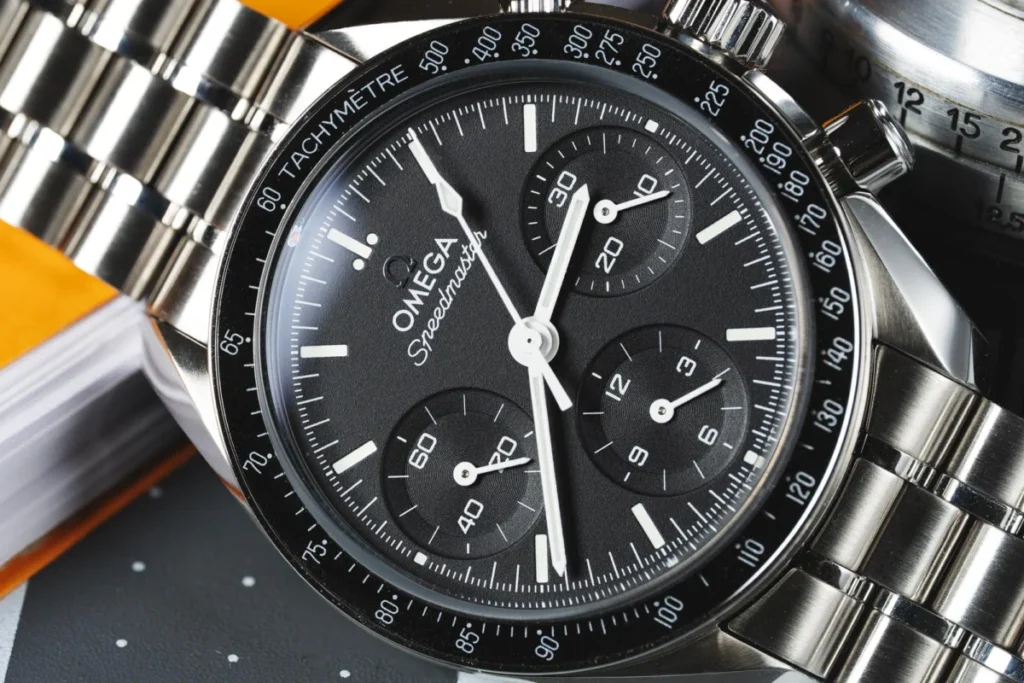
The dial of the Speedmaster 38 further reinforces its direct lineage to the Professional. It features the instantly recognizable Speedmaster layout, executed in a smaller format. The matte black varnish surface is adorned with crisp white print and lumed rectangular hour markers, complemented by the signature luminous dots flanking the 12 o’clock position. The sub-dials employ the same typeface and layout as the Professional, and the handset also mirrors that of its larger sibling. Proportional adjustments are present, but the fundamental visual identity remains.

A key distinction of the black dial Speedmaster 38 among the seven launched references is its lack of a date window. This decision aligns it more closely with both the original Reduced models and the classic Speedmaster Professional, offering a cleaner, more focused aesthetic. While a date complication might have been conceptually fitting for an automatic chronograph designed for everyday convenience, its absence undoubtedly enhances the dial’s visual harmony and its adherence to Speedmaster tradition.
Design Cues and Historical References
Intriguingly, the new Speedmaster 38 incorporates the dot-over-ninety (DON) bezel, a design element historically found on Speedmasters from the pre-1970 era. This nod to vintage Speedmasters, also present on the most recent Speedmaster Professional models, suggests Omega’s intention to draw from the broader Speedmaster heritage rather than exclusively referencing the Reduced line. The placement of the dot has no functional impact, but its inclusion signals a clear objective: to translate the essence of the current Moonwatch into a smaller, more accessible package.

While a direct homage to the minute and second numerals printed along the inside of the lume markers on original Reduced references could have imbued the new models with a distinct personality, Omega’s strategic focus appears to be on creating a smaller Speedmaster Professional for the contemporary market. This approach, while potentially overlooking an opportunity to celebrate the cult status of the Reduced models, is likely driven by broader market considerations. The potential for future special or limited editions, perhaps incorporating more direct callbacks to the Reduced era, remains an exciting prospect for enthusiasts.
Measuring Up: A Comparative Analysis
To fully appreciate the nuances of the Speedmaster 38, a direct comparison with its larger counterpart, the Speedmaster Professional, is essential. The new Speedmaster 38 measures 38mm x 44.96mm x 14.73mm, while the current Speedmaster Professional Hesalite version is 42mm x 47.2mm x 13.5mm. Crucial to this comparison are the bezel diameters: 36.7mm for the Speedmaster 38 and 39.8mm for the Professional. These figures highlight how the watches wear on the wrist, particularly the relationship between the bezel diameter and the overall case dimension.

It is often argued that Speedmaster Professionals, despite their 42mm diameter, wear closer to 40mm, largely due to the bezel’s size. The Speedmaster 38, in contrast, presents itself as a true 38mm watch. This perception is influenced by a smaller delta between the bezel and case diameters, coupled with several proportional and design choices that enhance its perceived size.
Dial Design and Visual Perception
The dial of the Speedmaster 38, while physically smaller than that of the Professional, paradoxically appears larger or at least equivalent in size. This optical illusion is primarily achieved through the placement and dimensions of the sub-dials. On the Speedmaster 38, these registers are positioned further from the dial’s center and are proportionally larger than those on the Professional, even encroaching upon the lume plots at 3, 6, and 9 o’clock. This arrangement creates a visual "pressure" towards the dial’s periphery, making it seem more expansive. Furthermore, the dial printing generally extends closer to the edge, contributing to this perception.

Another significant factor is the continued use of large crown and pushers, particularly the pronounced pump pushers. These elements retain their full-sized proportions, lending a sense of substance and presence to the smaller case that might have been diminished had they been scaled down. This design choice ensures that the Speedmaster 38 does not feel like a miniaturized version of the Professional, but rather a proportionally balanced watch in its own right. The 18mm lug width, while a practical consideration for the lug design, also helps maintain the overall proportions of the Speedmaster Professional in this smaller form factor. A perhaps humorous, yet noteworthy, detail is the Speedmaster 38’s water resistance rating of 100 meters, a significant upgrade from the typical 50 meters of the Professional.
Wearing Experience and Bracelet Quality
On a 6.75-inch wrist, the Speedmaster 38 wears exceptionally well, offering a comfortable and visually balanced experience. While the Speedmaster Professional is not considered overly large by many, the appeal of a smaller Speedmaster remains strong. The Reduced models and the current Speedmaster 38 are not mere novelties; they represent logical downsized options that don’t compromise the core Speedmaster identity.

Despite its 38mm diameter, the watch possesses a tangible sense of substance. The iconic twisted lugs are broad, the crown and pushers are full-sized, and as previously noted, its thickness is a defining characteristic. The inclusion of the box sapphire crystal helps to mitigate the visual impact of its 14.73mm thickness, and the case’s chamfered edges and break lines further contribute to a slightly more svelte appearance than the raw number might suggest. Moreover, the lugs are positioned approximately halfway up the case, allowing the bracelet to pull the watch down onto the wrist, effectively concealing the caseback and enhancing its perceived thinness. While it doesn’t feel thin, it certainly doesn’t feel as imposing as its thickness might imply.
For those who appreciate the Speedmaster aesthetic, the 38 will undoubtedly resonate. While subtle differences exist, the design language is clearly derived from the Professional. The result is a dial that is clean, classic, reserved yet subtly ornate, and undeniably sporty. The most striking visual alteration stems from the reconfigured sub-dial placement, which shifts the dial’s balance rather than fundamentally altering its aesthetic. The sub-dials on the 38 command a greater visual presence than those on the Professional.

The bracelet accompanying the Speedmaster 38 is also noteworthy. While lacking direct experience with previous generations of the Reduced bracelets, the current iteration closely resembles that of the newer Speedmaster Professional models. It features smaller, rounded links with subtle polished accents, tapering elegantly from 18mm at the lugs to 15mm at the clasp. The clasp itself is well-proportioned and equipped with a dual-pusher deployment mechanism and a limited amount of micro-adjustment. While sizing it can be a minor inconvenience, the overall quality and comfort of the bracelet are excellent.
Conclusion: A Compelling Proposition
As the Speedmaster 38 enters the market, its reception among collectors and the broader watch-buying public remains to be seen. With the vast array of Speedmaster options available, the question arises: will a smaller, automatic Moonwatch generate significant excitement? Will enthusiasts of the original Reduced models embrace this return to a more traditional aesthetic?

The black dial variant of the Speedmaster 38, by virtue of its date-free configuration, emerges as the most compelling option for purists. It represents Omega’s most direct effort to offer the Speedmaster Professional in a more compact and automatic package. The proportions are well-executed, the wearability is excellent, and the aesthetic aligns closely with the iconic model. While perhaps not the most groundbreaking release, its strength lies in its logical and well-executed execution of a clear objective. The author’s personal desire for a dial that more closely emulates the cult appeal of the 3510.50 is understandable, but Omega’s strategic focus on a smaller Moonwatch is a pragmatic choice. The anticipation of potential panda dial variants further fuels this speculation.
Priced at $6,500, the 2023 Speedmaster 38 represents a modest $200 increase over its predecessor. Considering it is an Omega, an automatic, Co-Axial Chronometer chronograph, this price point is justifiable. However, for enthusiasts who recall the pre-owned market for original Speedmaster Reduced models, which now hover around $3,000, the modern version represents a significant financial leap.

For individuals who own or have owned both Speedmaster Professionals and Speedmaster Reduced models, the allure of a smaller, modern Speedmaster is undeniable. The author’s personal experience with a vintage Speedmaster Professional (105.012-66) highlights the desirability of a more robust, everyday-wearable Speedmaster that doesn’t demand the same level of careful handling. The Speedmaster 38, with its automatic movement and more resilient build, offers this convenience without the redundancy of owning a second Speedmaster Professional.
Ultimately, the Speedmaster 38 carves out its niche by offering a compelling blend of reduced size, automatic convenience, and authentic Speedmaster aesthetics. It is a watch that, while perhaps not the most avant-garde, successfully captures the essence of its legendary predecessor in a more accessible package. Its ability to stand apart from the Professional while retaining its core identity makes it a significant and potentially very popular addition to Omega’s extensive Speedmaster family.