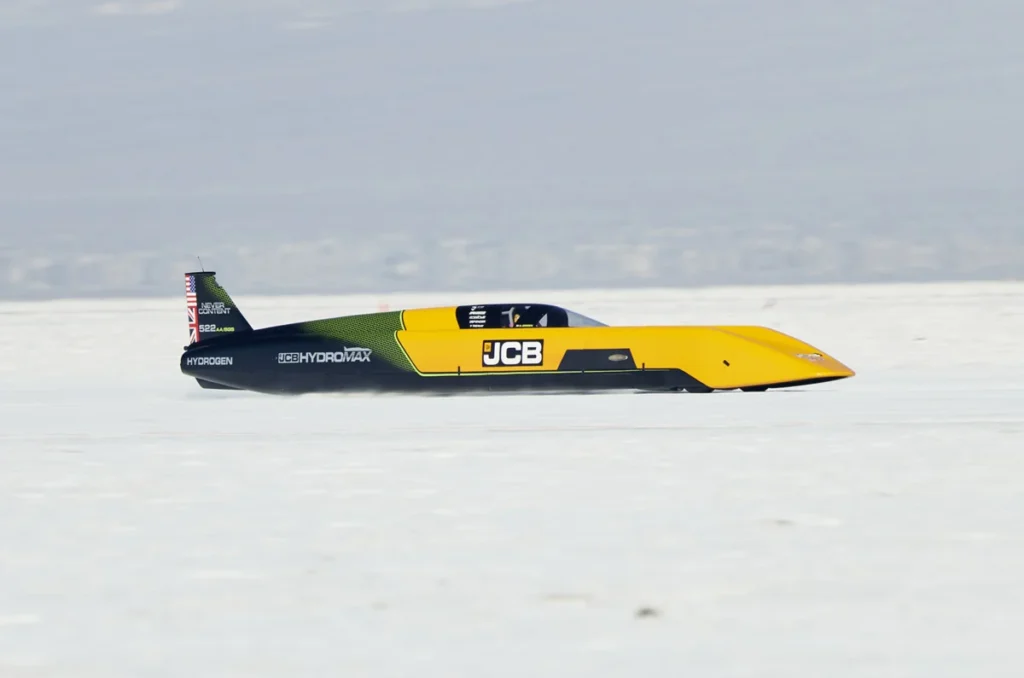
British engineering firm JCB has achieved a monumental feat in automotive history, shattering the land speed record for a hydrogen-powered vehicle. The groundbreaking 1597bhp Hydromax machine, a testament to JCB’s innovative spirit, conquered the legendary Bonneville Salt Flats in Utah, averaging an astonishing 406.320 mph. This remarkable achievement not only sets a new benchmark for hydrogen propulsion but also solidifies the legacy of driver Andy Green, who has now secured his third land speed record.
The Hydromax is a marvel of engineering, a 32-foot slipstreamer designed for ultimate speed. Its propulsion system is powered by a pair of meticulously crafted hydrogen-combustion engines, developed by JCB, which collectively generate an immense 1597bhp. These 4.8-litre engines are not entirely new territory for JCB; they represent upgraded versions of the units currently employed in the company’s robust line of diggers. The transformation for land speed record contention involved significant modifications by Riccardo, including the integration of specialized radiators, intercoolers, and racing-specification turbochargers to optimize performance under extreme conditions.
The Rigorous Path to Record Breaking
To qualify for an official FIA land speed record, the Hydromax faced a stringent set of regulations. The vehicle was required to complete two runs in opposite directions over a precisely measured 10-mile course, all within a one-hour timeframe. The official average speed is then calculated from the measured mile in each direction of these two runs. The Hydromax successfully navigated this challenge, achieving an average speed of 406.320 mph (663.267 km/h), a figure that underscores the vehicle’s unparalleled capability.
JCB Chairman Lord Bamford expressed immense pride in the team’s accomplishment, calling it "right up there in terms of engineering" achievements. He emphasized the profound significance of proving that an internal combustion engine can be operated efficiently and cleanly on hydrogen, producing zero emissions and at a minimal cost. "JCB is all about looking forwards," Lord Bamford stated. "We need to reduce our dependence on fossil fuels, and I believe very strongly hydrogen must be one of the solutions." This statement highlights JCB’s commitment to sustainable innovation and its vision for the future of industrial machinery and beyond.
A New Era for Hydrogen Propulsion
The Hydromax’s record-breaking performance significantly surpasses previous benchmarks for hydrogen-powered vehicles. The prior official record for a hydrogen-powered vehicle stood at 302.877 mph, set in 2009 by the University of Ohio’s Buckeye Bullet 2, which utilized hydrogen fuel cells. For hydrogen combustion cars specifically, an unofficial speed record of 185.5 mph was previously held by a BMW research prototype from 2004. JCB’s Hydromax has effectively redefined the upper limits of what is achievable with hydrogen combustion technology.
This triumph marks JCB’s second land speed record, a remarkable achievement that echoes their past success. Twenty years prior, Andy Green piloted the twin-engined Dieselmax to a new diesel land speed record of 350 mph. Green’s piloting prowess is legendary; the former RAF wing commander also holds the outright land speed record, a staggering 763 mph achieved with Thrust SSC in 1997. His continued success at such extreme speeds demonstrates an exceptional level of skill and courage.
Strategic Motivations Behind the Record Attempt
The Hydromax record attempt served a dual purpose for JCB. Firstly, it was a powerful showcase for the company’s burgeoning hydrogen engine business. This initiative aims to present hydrogen as a viable route to zero-emissions solutions for industrial equipment, particularly for machinery operating in remote locations where electric vehicle charging infrastructure is often absent. Secondly, the endeavor was designed to bolster JCB’s growing ambitions in the United States, including the establishment of a new manufacturing facility in San Antonio, Texas. This strategic move underscores JCB’s global outlook and its commitment to expanding its presence in key international markets.
The Road to Bonneville: A Detailed Chronology
The journey to the record-breaking run involved meticulous planning and execution, including participation in the preceding Bonneville Speed Week event. During Speed Week, JCB’s Hydromax was presented in a more subdued configuration, with each engine detuned to 600 bhp, rather than their full 800 bhp output. Despite this limitation, the team achieved a commendable record of 368.347 mph in the Southern California Timing Association (SCTA) Blown Gas Streamliner class. While an impressive feat, this speed did not qualify as an official FIA land speed record due to procedural differences in event regulations.
Following the conclusion of Speed Week, JCB’s dedicated engineering team undertook a critical upgrade. Both engines were replaced with brand-new units, meticulously tuned to unleash their full 800 bhp potential. Each of these formidable engines drives its respective axle through a sophisticated six-speed transaxle gearbox. The fuel for this powerful system is supplied from a pair of high-pressure 700bar hydrogen tanks, representing cutting-edge fuel storage technology.
Engineering Excellence and Collaborative Innovation
The Hydromax’s advanced chassis and suspension systems were developed by the renowned British engineering firm Prodrive. This collaboration brought a tubular chassis, a multi-link suspension, and a robust carbon composite driver’s cell, all designed to withstand the immense forces generated at record-breaking speeds. Further enhancing the vehicle’s capabilities, Goodyear developed custom tires specifically engineered to endure speeds far exceeding those experienced by the previous Dieselmax record-holder. The limitations of the Dieselmax’s tires had previously capped its top speed at 350 mph, highlighting the critical role of tire technology in achieving new land speed milestones.
The successful record attempt was conducted during dedicated sessions at the Bonneville Speedway, strictly adhering to FIA regulations. This environment, steeped in motorsport history, provided the ideal backdrop for JCB’s ambitious undertaking. The meticulous preparation, engineering prowess, and collaborative efforts of all involved have culminated in a historic achievement, paving the way for a future where hydrogen plays a significant role in sustainable transportation and industrial applications.
Implications and Future Outlook
JCB’s Hydromax success carries significant implications for the future of hydrogen technology. It demonstrates the viability and immense potential of hydrogen as a clean fuel source, capable of powering high-performance internal combustion engines. This is particularly relevant for sectors like heavy machinery and construction, where electrification faces significant infrastructure challenges. The company’s commitment to exploring hydrogen propulsion aligns with global efforts to decarbonize industries and reduce reliance on fossil fuels.
The record also serves as a powerful marketing tool for JCB, enhancing its brand visibility and showcasing its technological leadership. The successful integration of hydrogen engines into a record-breaking vehicle positions JCB as an innovator at the forefront of sustainable engineering solutions. Furthermore, the emphasis on US expansion, particularly the new Texas factory, signals a strategic intent to capture a larger share of the North American market, leveraging this technological advancement as a key differentiator.
The Bonneville Salt Flats, a legendary proving ground for speed records since the early 20th century, has once again witnessed a historic moment. The vast, flat expanse of salt, formed by ancient lakebeds, offers a unique and challenging environment for achieving extreme speeds. The tradition of land speed racing at Bonneville dates back to 1914, attracting enthusiasts and manufacturers from around the world to push the boundaries of automotive engineering. JCB’s Hydromax now joins the ranks of legendary vehicles that have etched their names into the annals of speed history on this iconic salt desert. The successful transition from digger engines to a record-breaking land speed machine underscores the versatility and adaptability of JCB’s engineering expertise, a testament to their forward-thinking approach.