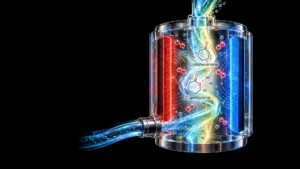
A groundbreaking semiconductor device developed by researchers at KAIST promises to fundamentally alter how electronic systems process dynamic, real-world data by enabling hardware to adapt its response speed to incoming signals. This innovation, dubbed the programmable dynamic memtransistor (PDM), represents a significant leap towards more efficient and intelligent computing at the edge, circumventing the traditional reliance on extensive software processing to manage varying data rates.
The core of this breakthrough lies in the PDM’s unique ability to combine the memory function of a storage device with the computing capabilities of a transistor, but with a crucial enhancement: its temporal response can be dynamically programmed to different settings and, critically, retained without continuous power input. This contrasts sharply with conventional semiconductor devices, which are fabricated with fixed response speeds, forcing software layers to compensate for discrepancies between hardware capabilities and the fluctuating nature of real-world data.
In rigorous testing, the PDM demonstrated its superior performance when tasked with processing complex time-series data, particularly signals that incorporated both rapid, transient changes and slower, more gradual shifts. The results were compelling: the PDM managed to reduce prediction errors by an astonishing margin, up to 40 times, compared to traditional fixed-response semiconductor devices. This significant reduction in error highlights the device’s potential to enhance accuracy and reliability in a wide array of applications where data variability is a constant challenge.
Further pushing the boundaries of its utility, the research team successfully constructed an integrated PDM array. This array comprised multiple PDM devices, each configured for distinct response speeds, allowing for the parallel processing of various time-varying signals. This parallel architecture also enabled the simultaneous extraction of information across different timescales, a capability vital for comprehensive data analysis in complex systems.
The Inherent Challenge of Time-Varying Data
The need for adaptive hardware has become increasingly urgent in an era dominated by ubiquitous sensors, artificial intelligence (AI), and autonomous systems. Data generated by real-world phenomena rarely conforms to a single, constant rate. Consider a sensor embedded in a robotic arm: it might need to register rapid, sub-second movements as the robot manipulates an object, while simultaneously tracking much slower changes in its environmental context or its own internal temperature.
Conventional hardware, designed with a fixed temporal response post-fabrication, struggles to efficiently handle such diverse data streams. When incoming data behaves differently from the hardware’s inherent processing speed, the burden invariably falls on software. This necessitates complex algorithms and computational layers to preprocess, filter, and adapt the data, adding significant computational overhead, increasing latency, and consuming substantially more power. This software-centric approach, while functional, creates bottlenecks and inefficiencies, particularly in power-constrained or real-time sensitive edge computing environments.
The KAIST researchers directly addressed this fundamental limitation by ingeniously integrating two distinct functional layers within the transistor structure of the PDM. One layer is dedicated to storing and processing incoming electrical charge, a fundamental operation in computing. The innovation lies in the second layer: an electron-trapping layer meticulously engineered to control the speed at which the device returns to its original, quiescent state after processing a signal.
By precisely adjusting the properties of this electron-trapping layer, the researchers achieved remarkable tunability. They could modify the device’s current recovery time across an approximately fivefold range. Concurrently, its characteristic frequency – a measure of how quickly it can respond to and process signals – could be adjusted across a range exceeding 10 times. This unprecedented degree of hardware-level tunability allows the PDM to be configured for optimal performance across a wide spectrum of data rates, from very fast to very slow, without requiring continuous external power to maintain its programmed characteristics. This inherent, built-in adaptability is a distinct advantage that fixed-response semiconductor hardware simply cannot offer.
Experimental Validation and Performance Metrics
To validate the PDM’s capabilities, the research team conducted extensive experiments using datasets characterized by multiple timescales. For instance, they tested the device with signals that deliberately mixed both fast and slow patterns, simulating the complexity of real-world inputs. In these scenarios, the PDM consistently produced substantially lower prediction errors than its fixed-response counterparts, underscoring its superior ability to discern and process information embedded within multi-timescale data.
Beyond individual device performance, the PDM array also demonstrated impressive collective capabilities. The team reported that their integrated PDM array achieved accuracy comparable to conventional software-based systems, which typically run on powerful general-purpose processors, but with a drastically reduced energy footprint. This energy efficiency is a critical factor for the proliferation of AI in battery-powered devices and distributed sensor networks where power consumption is a primary design constraint.
Hardware Learns Signal Speeds: A Paradigm Shift for Edge AI
The implications of this technology are far-reaching, particularly for systems that demand local, real-time processing of constantly changing data. Key application areas include autonomous vehicles, advanced robotics, and sophisticated wearable devices. In these domains, the ability to perform significant computational work directly within the semiconductor hardware, rather than offloading it to complex software running on more powerful central processing units, offers distinct advantages in terms of latency, power, and data security.
For autonomous vehicles, PDMs could enable more robust real-time perception, allowing the vehicle’s sensors to dynamically adjust their processing speed based on varying road conditions – for instance, rapidly responding to a sudden obstacle while calmly monitoring distant traffic patterns. In robotics, a PDM-equipped sensor could seamlessly switch between processing the nuanced forces required for delicate manipulation and the broad movements needed for navigation. Wearable devices, from health monitors to smartwatches, could benefit from more accurate and energy-efficient processing of biometric data, distinguishing between rapid heart rate spikes during exercise and slower, resting heart rate trends.
The researchers effectively demonstrated this concept using diverse signals whose characteristics evolved over time, including handwriting patterns and object movement at different speeds. The PDM proved its capacity to adjust its response characteristics dynamically to match these distinct input timescales, showcasing a form of hardware-level intelligence.
Chair Professor Shinhyun Choi, a leading figure in the research, encapsulated the significance of the discovery: "This study demonstrates an AI semiconductor whose response characteristics can be programmed to efficiently process data changing at different speeds. We expect it to become a core technology that improves the performance of AI devices such as autonomous vehicles, robots, and wearables while reducing their power consumption." His statement underscores the strategic importance of moving beyond fixed-function hardware towards adaptive, energy-efficient solutions for the future of AI.
The Road to Commercialization and Broader Impact
This pioneering device was the result of a collaborative effort, led by KAIST, involving researchers from Samsung Electronics’ Semiconductor R&D Center. This partnership is highly significant, as it bodes well for the future commercialization prospects of the PDM. The device’s reported compatibility with materials and processes commonly used in established semiconductor manufacturing suggests a smoother transition from laboratory prototype to industrial production. This "fab-friendly" characteristic is often a major hurdle for novel semiconductor technologies, and its early consideration indicates a strong potential for widespread adoption.
The research was formally published in the esteemed scientific journal Nature Communications on [Insert Publication Date if available, otherwise omit or state "recently"], lending further credibility and scientific rigor to the findings.
The development of the PDM arrives at a crucial juncture in the evolution of computing. For decades, Moore’s Law has driven exponential increases in transistor density, but the industry is now facing physical limits. The focus has increasingly shifted from merely shrinking components to designing more intelligent and efficient architectures, particularly for AI workloads. Neuromorphic computing, which seeks to mimic the brain’s structure and function, is one such promising direction. The PDM, with its integrated memory and processing capabilities and adaptive temporal response, aligns well with the principles of neuromorphic design, offering a biologically inspired approach to signal processing.
The broader implications of the PDM extend beyond mere performance improvements. It represents a potential paradigm shift in hardware design, moving away from the "one-size-fits-all" approach towards a more flexible, context-aware hardware. This could lead to:
- Enhanced Energy Efficiency: By offloading temporal adaptation from software to hardware, significant energy savings can be achieved, crucial for battery-powered devices and reducing the carbon footprint of data centers.
- Reduced Latency: Real-time applications like autonomous navigation or high-frequency trading benefit immensely from direct hardware adaptation, bypassing software overhead.
- Decentralized Intelligence: The PDM facilitates more sophisticated processing at the edge, reducing the need to transmit all raw data to centralized cloud servers, improving privacy and reducing bandwidth requirements.
- New Design Methodologies: This breakthrough could inspire new architectures for AI accelerators, fostering a new generation of application-specific integrated circuits (ASICs) that are inherently more versatile.
While the PDM presents a compelling vision for the future of adaptive hardware, the path to mass commercialization will undoubtedly involve further research and development. Challenges may include scaling manufacturing to meet demand, integrating PDMs with other complex system-on-chip (SoC) components, and developing robust programming interfaces for diverse applications. However, the foundational work by the KAIST-led team has laid a robust groundwork, offering a tangible solution to one of the most persistent challenges in modern computing: efficiently processing the inherently dynamic and varied data of the real world. This programmable dynamic memtransistor stands as a testament to ongoing innovation in semiconductor technology, poised to empower the next generation of intelligent devices.