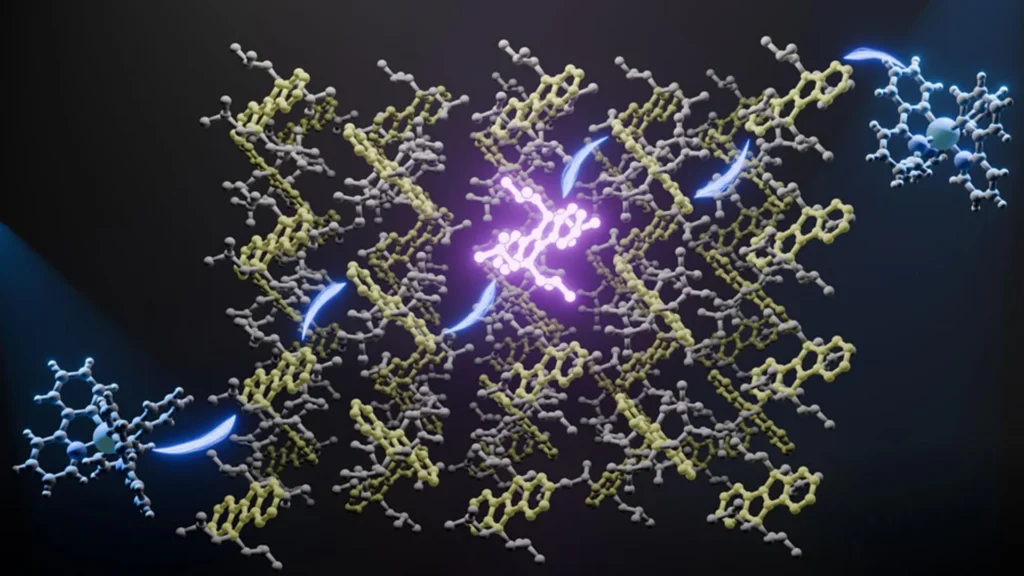
Imagine a world where the subtle warmth of visible sunlight could be amplified, transformed, and harnessed to power a range of advanced technologies. This may sound like science fiction, but at the quantum level, a phenomenon known as photon upconversion allows for precisely this kind of energy manipulation. Now, researchers at Kyushu University have taken a significant leap forward, developing a novel solid-state molecular material capable of converting ambient visible sunlight directly into ultraviolet (UV) light under ordinary outdoor conditions. This groundbreaking achievement, detailed in a study published on June 23 in the prestigious journal Nature Communications, boasts a remarkable photo upconversion efficiency of 1.9%, a figure that has long eluded scientists in solid-state applications.
The Underappreciated Power of UV Light
While often associated with the adverse effects of sunburn, UV light plays an indispensable role in a surprising array of modern technologies. Its energetic properties make it ideal for applications such as sterilizing water and air, a crucial component in public health and hygiene. In the rapidly evolving field of additive manufacturing, UV light is essential for curing resins in 3D printing, allowing for the rapid solidification of complex designs. The dental industry relies on UV light for hardening fillings and bonding materials, ensuring durable and aesthetically pleasing dental work. Even in personal care, UV light is integral to the process of hardening gels in nail treatments.
Despite its technological significance, UV light constitutes a relatively small fraction of the solar spectrum that reaches the Earth’s surface, accounting for approximately 6%. Furthermore, not all of this UV radiation is practically usable for technological purposes due to variations in wavelength and intensity. The challenge has been to efficiently capture the more abundant visible light photons and convert them into the higher-energy UV photons required by these applications.
"What we do here is ‘add together’ the energy from two visible light photons to make one ultraviolet photon. It’s a fascinating process called photo upconversion," explains Yoichi Sasaki, Associate Professor at Kyushu University’s Faculty of Engineering and the study’s corresponding author. This process essentially doubles the energy of absorbed photons, transforming lower-energy visible light into higher-energy UV light.
The Quantum Leap: From Liquid to Solid-State Upconversion
The mechanism underpinning this remarkable transformation is a phenomenon known as triplet-triplet annihilation (TTA). In this process, a molecule, referred to as a donor, absorbs a visible light photon and enters an excited, high-energy state called a triplet state. This energy is then efficiently transferred to a nearby acceptor molecule, also in its triplet state. When two such triplet-excited molecules collide, they can annihilate each other, releasing their combined energy as a single, higher-energy photon – in this case, a UV photon.
For decades, TTA has been effectively demonstrated and utilized in liquid solutions. The inherent mobility of molecules in liquids allows for frequent collisions and energy transfer, making the process highly efficient. However, liquid-based systems are not without their drawbacks. They often necessitate the use of toxic organic solvents, posing environmental and health concerns. Moreover, liquid systems are prone to evaporation over time, leading to a loss of efficiency and requiring frequent replenishment, which limits their long-term practicality and scalability. Consequently, the scientific community has long sought a robust and reliable solid-state alternative.
"In solids, molecules are packed tightly, and the π electron clouds – regions of high electron density hovering above and below each molecular plane – can overlap," explains Professor Sasaki. "When that happens, triplets easily fizzle out before they ever meet. Molecules must be close enough for energy to transfer but separated enough to prevent quenching of excitons." This delicate balance between molecular proximity for efficient energy transfer and sufficient separation to prevent energy dissipation has been the primary hurdle in achieving effective solid-state photo upconversion. The challenge lies in engineering molecular architectures that facilitate energy migration without compromising the excited states through detrimental intermolecular interactions.
Dihydroindenoindenedene: A Novel Molecular Architecture
The breakthrough at Kyushu University centers on a class of organic semiconductors known as dihydroindenoindenedene (DHI) derivatives. The research team ingeniously modified the DHI molecule by strategically attaching alkyl chains to its sp³ hybridized carbon atoms. These carbon atoms, characterized by their four bonds pointing in fixed three-dimensional directions, allowed for precise control over the spatial arrangement of the DHI molecules within the solid-state material.
This architectural innovation resulted in a carefully engineered molecular spacing. The DHI molecules were positioned close enough to enable efficient triplet energy transfer between them, but crucially, they were also sufficiently separated to prevent the strong electronic interactions that typically lead to the premature quenching of excited states in solid materials. This delicate molecular dance allowed the triplet excitons to survive long enough to find each other and undergo annihilation, leading to the emission of UV photons.
The resulting material exhibited exceptional photophysical properties. It demonstrated strong luminescence, indicating efficient emission of light, and possessed long-lived excited states, a critical prerequisite for TTA to occur effectively. The engineered molecular packing facilitated highly efficient energy transfer throughout the material. As a testament to its intrinsic quality, the solid-state fluorescence quantum yield of the material exceeded an impressive 60%, signifying that over 60% of absorbed photons were re-emitted as light.
When this DHI-based material was paired with a suitable donor molecule to initiate the upconversion process, the system achieved a remarkable upconversion efficiency of 1.9%. "This means roughly two UV photons are produced for every hundred visible-light photons absorbed," Professor Sasaki elaborates. "It may sound low, but it runs on natural sunlight alone. Most solid-state materials cannot realize this even at much higher light intensity." This efficiency is particularly noteworthy given the low intensity of natural sunlight and the inherent challenges of solid-state upconversion.
A 14-Year Journey Towards a Sustainable Future
The development of this novel material is not a sudden revelation but the culmination of over 14 years of dedicated research, driven by a vision of sustainable energy solutions. The foundational work began in 2012 when Professor Emeritus Nobuo Kimizuka, then at Kyushu University’s Research Center for Negative Emissions Technologies, embarked on exploring photon upconversion through triplet energy migration in self-assembled molecular systems. His overarching goal was to establish a paradigm of molecular systems chemistry where self-assembly could be leveraged to perform practical, functional tasks.
Over the subsequent years, Professor Kimizuka’s group made consistent progress, initially focusing on solution-based and gel-based systems. While these approaches yielded valuable insights, achieving efficient and stable solid-state upconversion remained an elusive goal. The inherent difficulties in controlling molecular interactions in the solid state presented a persistent challenge.
The pivotal breakthrough arrived in May 2024, a significant milestone achieved less than a year before Professor Kimizuka’s planned retirement. The ensuing months witnessed an intense period of collaborative effort to bring the project to fruition. Graduate students Naoyuki Harada, Hayato Shoyama, and Nutnicha Boonmong worked tirelessly alongside Professor Sasaki and then-Assistant Professor Kiichi Mizukami of Kyushu University’s Faculty of Engineering. Their collective dedication consolidated years of foundational research into a cohesive and impactful scientific publication.
In a poignant gesture of collegiality and scientific legacy, the research team submitted the final manuscript to Professor Kimizuka just 11 days before he departed the laboratory. "We handed the draft to Professor Kimizuka just 11 days before he left the lab, which for us felt like a heartfelt retirement gift," Professor Sasaki remarked, highlighting the profound personal and professional significance of this achievement for the entire team. Professor Kimizuka himself expressed his deep satisfaction, stating, "This discovery is the culmination of over 14 years of our research and marks a major milestone in photon-upconversion and molecular self-assembly research."
Implications and Future Applications
The implications of this breakthrough are far-reaching. The Kyushu University team has already filed a patent application for their innovative material, signaling their intent to translate this scientific advancement into practical applications. Beyond its impressive efficiency under natural sunlight, the material offers several compelling practical advantages. It can be synthesized through relatively straightforward procedures, and its constituent starting materials are inexpensive, paving the way for cost-effective manufacturing.
The researchers envision a diverse range of potential applications. Solar-powered photocatalysis, a process that uses light to drive chemical reactions, could be significantly enhanced by the ability to generate UV light directly from sunlight. This could revolutionize processes in environmental remediation, chemical synthesis, and renewable energy production. Indoor air purification systems, which often rely on UV light to neutralize pathogens and volatile organic compounds, could become more energy-efficient and accessible. Furthermore, the development of low-intensity 3D printing technologies that utilize this upconverted UV light could lead to more affordable and widespread adoption of additive manufacturing in various sectors, from prototyping to customized medical devices.
The ability to generate UV light from readily available visible sunlight without the need for external power sources or complex infrastructure represents a significant step towards sustainable and decentralized technological solutions. As the world grapples with the urgent need for cleaner energy and more efficient resource utilization, this breakthrough from Kyushu University offers a promising glimpse into a future powered by the sun’s ubiquitous energy, cleverly transformed by the principles of quantum mechanics. The ongoing research and development in this area hold the potential to unlock new possibilities and address some of the most pressing environmental and technological challenges of our time.