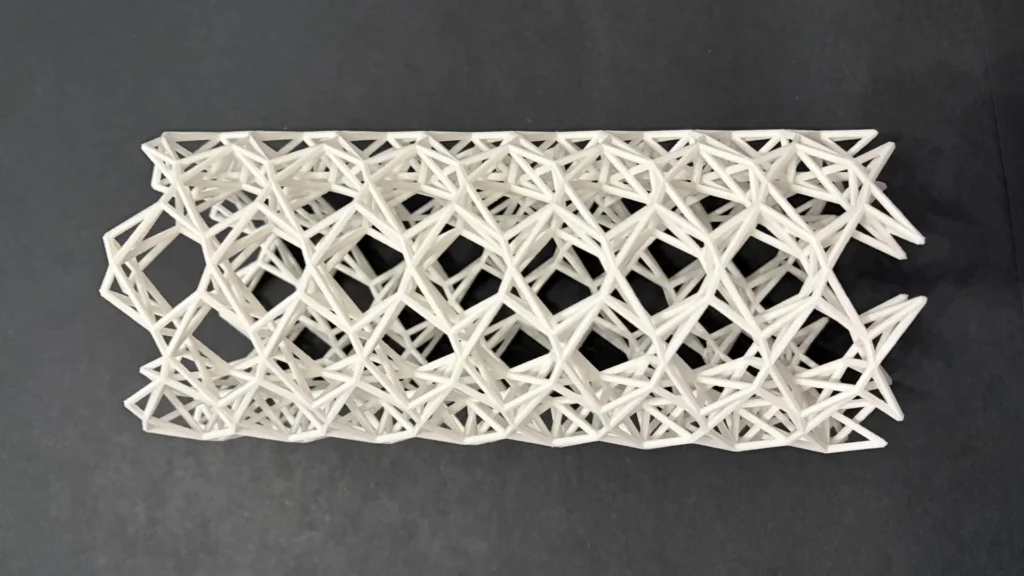
Scientific progress, often perceived as a sudden flash of insight, is more accurately characterized as a gradual, iterative process. Years of meticulous research and engineering coalesce, transforming the extraordinary into the commonplace. Now, researchers from the University of Michigan and the Air Force Research Laboratory (AFRL) stand at what appears to be a significant juncture in this evolutionary journey. They have successfully demonstrated a novel method for 3D printing intricate tubular structures, whose unique internal geometries possess an unprecedented capacity to suppress vibrations, a characteristic not observed in naturally occurring materials. These engineered substances, categorized as mechanical metamaterials, derive their remarkable properties not from their chemical composition, but entirely from their carefully designed structure.
This groundbreaking development, detailed in the latest issue of Physical Review Applied, has the potential to revolutionize industries ranging from aerospace and automotive to construction and seismic engineering. The team’s findings represent a culmination of decades of theoretical exploration and sophisticated computer modeling, now materialized into tangible structures capable of passively disrupting the propagation of vibrations.
"The true innovation lies in the realization that we can, in fact, fabricate these complex structures," stated James McInerney, a research associate at AFRL, who was instrumental in the project. McInerney, formerly a postdoctoral fellow at the University of Michigan, collaborated closely with Professor Xiaoming Mao of the physics department, a co-author of the study. "We are optimistic about the potential for these innovations to be applied for beneficial purposes, with vibration isolation being a primary application in this instance."
The ambitious project received crucial financial backing from the Defense Advanced Research Projects Agency (DARPA) and the Office of Naval Research. Additional support was provided by the U.S. National Research Council Research Associateship Program, administered by the prestigious National Academies of Sciences, Engineering, and Medicine, underscoring the national interest in advancing this field.
Key contributors to this pioneering research included Serife Tol, an associate professor of mechanical engineering at the University of Michigan; Othman Oudghiri-Idrissi from the University of Texas; and Carson Willey and Abigail Juhl from AFRL, whose combined expertise spanned multiple disciplines.
"For centuries, humanity has enhanced materials by altering their chemical makeup. Our work diverges by focusing on metamaterials, where geometry, rather than chemistry, is the source of unusual and highly useful properties," explained Professor Mao. "These geometric principles are scalable, applicable from the nanoscale to the macroscale, and imbue materials with extraordinary robustness."
Structural Foundations: Engineering Geometry for Enhanced Performance
The study represents a powerful synergy between classical structural engineering principles, contemporary physics, and state-of-the-art manufacturing techniques, most notably additive manufacturing, or 3D printing.
"There is a very real prospect that we will be able to manufacture materials from the ground up with astonishing precision," McInerney elaborated. "The overarching vision is to engineer materials with highly specific architectures, prompting the question: ‘What novel functionalities can we unlock with this capability? How can we conceive of and create materials that transcend our current limitations?’"
As Professor Mao highlighted, the research team’s focus is not on modifying the intrinsic chemistry or molecular structure of materials. Instead, they are investigating how precise control over shape and structure at a fine scale can yield novel and advantageous mechanical properties. This approach draws inspiration from nature itself. Biological structures like human bones and the shells of plankton, for instance, leverage intricate geometries to achieve remarkable strength and resilience from relatively simple constituent materials. With the advent of advanced technologies such as 3D printing, scientists are now empowered to replicate and even enhance these natural design paradigms in metals, polymers, and other substances, achieving effects that were previously unattainable.
"Our objective is not to replace existing materials like steel and plastics, but rather to utilize them in far more effective and intelligent ways," McInerney added.
A Convergence of Old and New: Historical Roots of Metamaterial Innovation
While this work represents a cutting-edge scientific achievement, its conceptual underpinnings are deeply rooted in historical scientific inquiry. A significant influence stems from the 19th-century physicist James Clerk Maxwell. Though renowned for his pioneering contributions to electromagnetism and thermodynamics, Maxwell also explored mechanics and developed crucial design considerations for stable structures composed of repeating units, known as Maxwell lattices. These lattices provided a foundational understanding of how interconnected elements could distribute stress and resist deformation.
Another pivotal concept that informs the current research emerged in the latter half of the 20th century. Physicists began to observe peculiar and intriguing behaviors occurring at the edges and boundaries of materials. This discovery led to the development of a new and dynamic field of study: topology. Topological principles are now being applied to explain these boundary phenomena and to harness them for practical applications in the real world.
"Approximately a decade ago, a seminal publication revealed that Maxwell lattices could exhibit a topological phase," McInerney noted, tracing the lineage of the current breakthrough.
Over the past several years, McInerney and his colleagues have meticulously explored the implications of this discovery for vibration isolation. They have developed a theoretical model that explains this behavior and outlines how to design physical objects that would exhibit it. The successful fabrication of these objects using 3D printed nylon, as detailed in their recent publication, marks the most advanced realization of their theoretical framework to date.
The Kagome Tube: A Glimpse into Engineered Vibration Suppression
A cursory examination of these novel structures reveals the inherent manufacturing challenges they present. They bear a resemblance to a chain-link fence that has been artfully folded and rolled into a tubular form, featuring interconnected inner and outer layers. Physicists have termed these structures "kagome tubes," a nomenclature derived from traditional Japanese basket weaving, which employs similar intricate lattice patterns.
However, the creation of these kagome tubes represents only the initial step in realizing the full potential of such geometrically engineered materials. McInerney acknowledges that there are inherent trade-offs. For instance, the study indicates that structures exhibiting superior vibration suppression capabilities may consequently support less weight. This presents a significant challenge, potentially an unacceptable compromise for certain applications. Nevertheless, it also highlights fascinating avenues for further fundamental research and innovation.
As these novel structures transition from theoretical constructs to tangible prototypes, scientists and engineers will face the critical task of developing new standards and methodologies for their testing, characterization, and assessment. This challenge, McInerney asserts, is not a deterrent but rather an exciting frontier.
"Because we are dealing with such novel behaviors, we are still in the process of not only refining our theoretical models but also developing the appropriate testing protocols, interpreting the test results, and integrating these findings into practical design processes," he explained. "I believe these fundamental questions must be thoroughly addressed before we can fully pivot to focusing on specific applications."
Broader Implications and Future Directions
The implications of this research extend far beyond academic curiosity. The ability to precisely control material properties through structural design opens up a vista of possibilities for enhancing the performance and durability of critical infrastructure and advanced technologies.
Transportation: In the automotive and aerospace sectors, vibration is a persistent enemy, leading to material fatigue, reduced passenger comfort, and increased noise levels. Metamaterial components could be integrated into vehicle chassis, engine mounts, or aircraft fuselage to dampen unwanted vibrations, leading to smoother rides, extended component lifespan, and improved fuel efficiency through weight reduction. For example, the aerospace industry constantly seeks lighter yet stronger materials. If these metamaterials can be engineered to offer both vibration isolation and structural integrity, they could significantly reduce the weight of aircraft, leading to substantial fuel savings and reduced emissions. According to industry reports, even a small percentage reduction in aircraft weight can translate into millions of dollars in annual fuel cost savings.
Construction and Infrastructure: Buildings in earthquake-prone regions could benefit immensely from vibration-suppressing foundations and structural elements. These metamaterials could act as natural shock absorbers, dissipating seismic energy and protecting structures from catastrophic damage. This could revolutionize seismic retrofitting and the design of new resilient buildings, potentially saving countless lives and billions of dollars in reconstruction costs after natural disasters. Consider the economic impact of seismic events; the 2011 Tohoku earthquake and tsunami in Japan caused an estimated $300 billion in damages. Advanced vibration mitigation technologies could significantly reduce such losses.
Precision Engineering and Scientific Instruments: Sensitive scientific instruments, such as telescopes, particle accelerators, and advanced manufacturing equipment, require environments with minimal vibration to function accurately. Metamaterial components could isolate these delicate systems from external disturbances, leading to more precise measurements and higher quality outputs. For instance, in the field of semiconductor manufacturing, even minuscule vibrations can render entire batches of microchips unusable, leading to significant financial losses.
Defense Applications: The potential for vibration suppression also holds significant value for defense applications, as hinted by the funding from DARPA and the Office of Naval Research. Quieter vehicles, more stable platforms for sensitive equipment, and improved protection against shock and blast events are all areas where this technology could be transformative.
Challenges and the Road Ahead
Despite the promising nature of this breakthrough, significant challenges remain. As McInerney pointed out, the current trade-off between vibration suppression and load-bearing capacity needs to be addressed. Further research is required to optimize the design of these kagome tubes and other metamaterial structures to achieve a balance between these competing properties. This may involve exploring different materials, varying lattice configurations, and developing advanced multi-functional designs.
The scaling up of production is another hurdle. While 3D printing offers remarkable precision, it can be a relatively slow and expensive process for mass production. Developing more efficient and cost-effective manufacturing techniques will be crucial for widespread adoption. Researchers are exploring various additive manufacturing processes and even novel methods like advanced molding or extrusion techniques that could be informed by metamaterial design principles.
Furthermore, the development of standardized testing procedures and performance metrics is essential for engineers and designers to confidently integrate these new materials into their projects. This will involve collaboration between researchers, industry professionals, and regulatory bodies.
The journey from a laboratory demonstration to widespread industrial application is often a lengthy one. However, the work by the University of Michigan and AFRL teams represents a significant leap forward, transforming theoretical concepts into tangible realities and paving the way for a new generation of materials with unprecedented capabilities. The era of geometrically engineered materials, capable of performing extraordinary feats of vibration suppression, has truly begun.