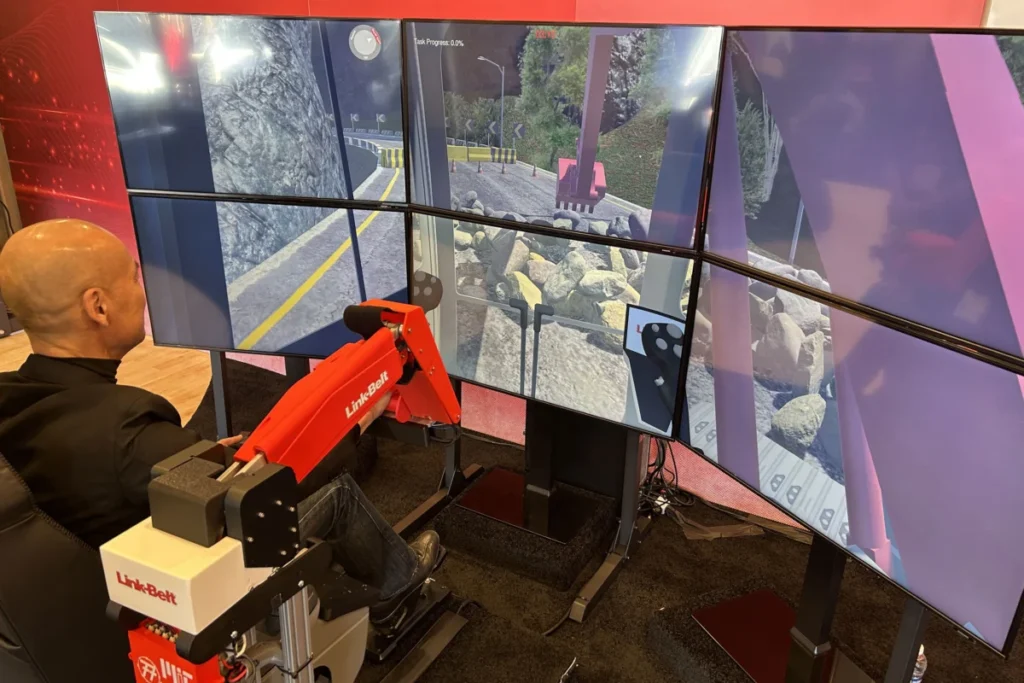
A groundbreaking innovation from researchers at the Massachusetts Institute of Technology (MIT), in collaboration with Sumitomo Heavy Industries, promises to fundamentally transform how heavy machinery, particularly excavators, are operated and how new operators are trained. Termed the "World-Space Interface" (WSI), this novel control system replaces traditional, complex joysticks with a miniature robotic arm that mirrors the excavator’s own movements, offering a dramatically more intuitive and efficient interaction. The team’s findings, detailing how novices can achieve expert-level performance from their very first use, were recently published in the Journal of Computing and Civil Engineering.
Hermano Krebs, a principal research scientist in MIT’s Department of Mechanical Engineering and a lead on the project, articulated the core benefit: "This is a more intuitive way to command the machine. With this new interface, we can eliminate a lot of the mental maps that an operator would need to build in order to operate an excavator." This simplification addresses a long-standing challenge in heavy equipment operation, where the abstract relationship between joystick movements and the excavator’s arm, bucket, and cab often requires extensive training and cognitive load.
The implications of the WSI are vast, touching upon accelerated operator training, enhanced on-site operational efficiency, and safer remote tele-operation. Krebs envisions the interface being integrated directly into an excavator’s cab as a miniature arm, functioning "kind of like an exoskeleton," allowing operators to control the machine with natural arm movements. Crucially, this technology also paves the way for advanced remote operation. "If work has to be done in a difficult or unsafe environment, you could have an operator sitting off-site in a trailer and using this arm to remotely tele-operate the excavator," Krebs explained. This capability could be a game-changer for hazardous environments such as disaster zones, demolition sites, or areas with extreme weather conditions, removing human operators from immediate danger.
The research team, which includes MIT co-authors Moises Alencastre-Miranda, Joao Buzzatto, and Eran Beeri Bamani, alongside collaborators from Sumitomo Heavy Industries, a prominent industrial machinery manufacturer based in Japan, has presented a solution that could redefine industry standards. Their work builds upon MIT’s extensive expertise in human-robot interactions, particularly in physical rehabilitation, where understanding intuitive human control of limbs has been paramount.
Addressing a Global Workforce Challenge: The Aging Operator Population
The genesis of the World-Space Interface lies in a critical demographic and industrial challenge. In 2018, Krebs initiated a collaboration with Sumitomo Heavy Industries, driven by the latter’s urgent need for a faster method to train excavator operators. Japan, like many industrialized nations, faces a rapidly aging population, and the cohort of skilled heavy machinery operators is diminishing, making the replenishment of the workforce a slow and arduous process. This demographic shift is not unique to Japan; across North America and Europe, the construction industry grapples with a significant labor shortage, exacerbated by an aging workforce and a perception among younger generations that construction jobs are physically demanding, dangerous, and lack technological sophistication.
Traditional excavator operator training is a protracted and resource-intensive endeavor. Novices typically learn by operating actual, full-sized excavators on controlled driving courses. This process involves a steep learning curve, as operators must internalize the complex mapping between the multi-axis movements of several joysticks and the corresponding actions of the excavator’s various components—the boom, stick, bucket, and slewing of the cab. Mastering the coordination of these actions to perform practical tasks such as scooping, digging, and grading can take anywhere from several months to even years. This extended training period translates directly into high costs for employers, delayed project timelines, and a bottleneck in bringing new, skilled labor into the field.
The MIT-Sumitomo team recognized that eliminating the cognitive burden of building this "mental map" could drastically shorten the training process. Their quest was for a more natural control mechanism that could bypass the abstract nature of joysticks. The mechanical arm design emerged as the most promising solution. The physical resemblance between the miniature control arm and the excavator’s own working arm and bucket was key. This "natural mapping" allows operators to directly mimic the desired movements, reducing the need for mental translation and making the interaction feel inherently more intuitive. The principle here aligns with foundational concepts in human-computer interaction, where interfaces that leverage natural human gestures and analogies tend to be more effective and require less cognitive effort.
Over several years, the researchers meticulously developed the mechanical arm hardware and the sophisticated software required to translate its movements into commands for a virtual excavator simulation. This combination of the physical arm and the virtual environment forms the core of the World-Space Interface, serving as both a novel training platform and a potential new control system for actual machines. As Krebs articulates, "’World-space’ refers to everything in the world that is outside of yourself, or in this case, outside of the excavator’s cab. Normally, operators have to build a mental map of how to manipulate things in the world-space. But now, we can just mime picking up rocks or dirt, and the computer will do that translation to the world-space for us." This direct mimicry drastically reduces the cognitive load, allowing operators to focus on the task itself rather than the mechanics of control.
Empirical Validation: Construction on Day One
To rigorously test the efficacy of the WSI, the team conducted comprehensive training experiments involving a diverse group of volunteers. These participants used both the World-Space Interface and a conventional joystick-based excavator simulator. The experimental setup was designed to replicate real-world scenarios, featuring virtual simulations of 15 distinct excavation environments. These included common construction sites, highways, forest roads, riverbanks, mining areas, and both urban and rural settings, each presenting various excavation tasks. Participants engaged in activities such as scooping and dumping materials like sand and gravel, digging and grading trenches, clearing debris, removing tree branches, and breaking up rocks.
The experiment mirrored a typical week-long excavator driving course. For one hour each day over seven days, both expert and novice volunteers engaged with the WSI and the joystick simulator, progressively tackling tasks of increasing difficulty. The results were compelling and statistically significant. While novices using the traditional joystick simulator consistently performed worse than experts, despite showing improvement over the training period, the World-Space Interface eliminated this disparity entirely. With the WSI, novice operators performed just as proficiently as experienced experts from their very first session. This remarkable finding underscores the interface’s inherent intuitiveness and its potential to drastically compress the learning curve.
Joao Buzzatto, a study co-author and MIT postdoc, highlighted the profound difference: "In this case, joysticks are a non-intuitive way to control and coordinate the machine. This is the first interface that does not require me to command the excavator with joysticks." This statement encapsulates the paradigm shift offered by the WSI – moving from abstract, learned control to natural, mimetic interaction.
The Road Ahead: Haptics and Broader Adoption
The research team is not resting on its laurels. The next critical enhancement planned for the WSI is the integration of haptics, or the sense of touch and force feedback. The vision is for the miniature control arm to generate a responsive force as the operator mimes an action, such as lifting a pile of rocks. This haptic feedback would simulate the weight and resistance encountered by the excavator’s bucket, providing the operator with a more immersive and confirmation-rich experience. "Haptics would make this an even more intuitive system," commented co-author and visiting engineer Solmon Jeong, emphasizing how adding tactile feedback could further bridge the gap between human intent and machine action, making the interaction feel even more natural and realistic.
The World-Space Interface stands poised to offer a compelling alternative to existing excavator simulators currently being developed by major construction machinery manufacturers. Companies like Caterpillar, Hyundai, and Komatsu are actively investing in virtual simulators to aid operator training and to facilitate remote control of heavy equipment. However, a significant limitation of these existing solutions is their reliance on conventional joystick controllers, which, as the MIT study highlights, still necessitate considerable time and effort for operators to master. The WSI directly addresses this fundamental bottleneck, providing a plug-and-play intuitive control system that could be integrated into these advanced simulators.
The potential impact of the WSI on the construction industry is multifaceted and profound.
Economic and Training Efficiencies:
- Reduced Training Costs: By significantly shortening the learning curve, companies can save substantial resources currently spent on extended training programs, fuel for actual machines, and wear and tear on equipment used for instruction.
- Faster Workforce Integration: New operators could be deployed to productive tasks much more quickly, addressing labor shortages more effectively. This is particularly crucial in regions facing severe demographic challenges, such as Japan.
- Wider Talent Pool: The reduced cognitive and physical demands of learning could attract a more diverse range of individuals to heavy equipment operation, including those who might have been deterred by the complexity of traditional controls.
Enhanced Safety:
- Reduced Accidents: A more intuitive interface could lead to fewer operational errors, especially among less experienced operators, thereby reducing the risk of accidents on construction sites. Heavy equipment operations are among the most dangerous aspects of construction, with significant numbers of injuries and fatalities annually.
- Safer Remote Operations: The ability to tele-operate excavators from a safe, off-site location drastically minimizes human exposure to hazardous environments (e.g., unstable ground, toxic fumes, extreme temperatures, disaster zones), thereby preventing injuries and fatalities.
Operational Flexibility and Future of Construction:
- Remote Work Capabilities: The WSI empowers construction companies to embrace remote work models for heavy equipment operation, allowing a skilled operator to manage multiple machines across different sites from a centralized control hub.
- Automation Paving: While not full automation, an intuitive tele-operation system could serve as a crucial stepping stone towards more advanced autonomous construction, where human oversight remains critical but is less physically demanding.
- Increased Efficiency and Productivity: Operators who are less burdened by complex controls can focus more on the task at hand, potentially leading to faster project completion and higher quality work.
The support from Sumitomo Heavy Industries underscores the industrial relevance and practical applicability of this research. This collaboration exemplifies a successful model of academic innovation directly addressing pressing industry needs. As the construction sector continues to evolve, facing pressures from labor shortages, demands for increased safety, and a push towards greater efficiency, technologies like the World-Space Interface are not just incremental improvements but fundamental shifts that could redefine the industry’s operational landscape. The vision articulated by the researchers is clear: with this new arm-and-bucket controller, whether integrated into an excavator cab or a virtual tele-operational simulator, even first-time operators could effectively get to work from day one, ushering in a new era of intuitive and efficient heavy equipment control.