A pioneering system developed by researchers at the Massachusetts Institute of Technology (MIT) promises to revolutionize the creation of interactive objects by eliminating the need for fragile electronic circuits. Named "ShiftLens," this innovative platform enables the fabrication of a diverse array of dynamic items, from resilient warning signs capable of withstanding severe weather conditions to intelligent packaging designed to alert users about loose fasteners during transit. The end-to-end system is also poised to significantly streamline the rapid prototyping of adaptable objects across artistic, architectural, and engineering disciplines, marking a significant stride towards more robust and intuitive human-object interaction.
Yunyi Zhu, a graduate student in the MIT Department of Electrical Engineering and Computer Science (EECS) and the lead author of the paper detailing this groundbreaking platform, emphasized the inherent simplicity and resilience of the new approach. "With our system, an object can tell you whether you are using it properly, without the need for sensors or any complicated electronics," Zhu explained. "The interactive display is mechanical, so you can create a self-contained, multistate, interactive device that a user can control very intuitively." This focus on mechanical interaction represents a paradigm shift from the pervasive reliance on electronic components, offering a robust alternative for applications where conventional electronics are impractical or prone to failure.
The research, which will be formally presented at the prestigious ACM Symposium on User Interface Software and Technology, highlights a collaborative effort. Zhu’s co-authors include Dingning Cao, an MIT undergraduate; Jeremy Mrzyglocki, a graduate student at the Technical University of Munich; Stefanie Mueller, an associate professor in EECS and the Department of Mechanical Engineering at MIT and a member of the Computer Science and Artificial Intelligence Laboratory (CSAIL); and Narjes Pourjafarian, a postdoc at Northeastern University. Their collective expertise spans human-computer interaction, materials science, and mechanical engineering, underscoring the interdisciplinary nature of the ShiftLens project.
Addressing the Vulnerability of Electronic Displays
Modern interactive products overwhelmingly depend on screens and complex electronic circuitry to achieve dynamic visual changes. While effective in controlled environments, this reliance introduces significant vulnerabilities when objects are exposed to harsh conditions. Water damage, corrosive chemicals, extreme temperatures, physical impacts such as crushing or twisting, and even simple mechanical stresses can render delicate electronic components inoperable. This inherent fragility limits the deployment of interactive features in critical applications like outdoor signage, industrial equipment, medical devices, or even consumer products subjected to everyday wear and tear.
Conversely, traditional non-electronic methods for altering an object’s appearance, often leveraging surface optics, typically involve static labels or curved lenses. These approaches create visual effects based on the user’s viewing angle, such as lenticular printing, but offer limited interactivity. The visual change is predefined and static, lacking the dynamic, user-controlled feedback that modern applications often require. For instance, a warning sign that needs to change its message based on a specific condition (e.g., "Road Closed" to "Road Open") or a package that must indicate its integrity (e.g., "Sealed" to "Compromised") cannot rely on static optical effects alone. This gap between the fragility of electronics and the inflexibility of static optics presented a significant challenge that the ShiftLens system directly addresses.
The Ingenuity Behind Mechanically Switchable Surfaces
To overcome these limitations, the MIT researchers devised a system that automatically translates a user’s design intent into a 3D printer-ready model of an object featuring a mechanically switchable surface appearance. The core innovation of ShiftLens lies in its elegant combination of two optical layers on an object’s surface: a layer of specialized lenses positioned over an underlying, patterned backplane. The magic unfolds as different visual states are displayed based on the precise relative motion between these two layers.
The upper layer comprises an array of minute lenticular lenses. These are not ordinary lenses; their curved surfaces are meticulously engineered to steer light in distinct ways depending on the observer’s viewing angle. Beneath this, the pattern layer houses strips of images, each corresponding to a different desired appearance of the object’s surface. When a user initiates a mechanical shift of the lens layer – perhaps by turning a knob, sliding a component, or rotating the object itself – different segments of the patterned backplane are brought into alignment with the lenticular lenses. The lenses then magnify these newly exposed parts of the backplane image, causing the surface appearance to change dynamically and seamlessly. This mechanical interplay creates an intuitive and robust interactive experience.
Zhu highlighted the intricate engineering challenges inherent in this design: "The biggest challenge in this project was to make sure all moving parts align. We need to make sure that the optical effect, mechanical linkages, and computational graphics align with one another." This statement underscores the complexity of harmonizing optical principles with precise mechanical engineering and sophisticated computational design, ensuring that the desired visual transformation occurs flawlessly with every mechanical actuation. The success in achieving this alignment is central to ShiftLens’s functionality and its potential for widespread adoption.
A Streamlined Design and Fabrication System
Recognizing that not all potential users would possess expertise in optics or mechanical design, the researchers dedicated significant effort to developing a user-friendly tool that manages the underlying complexities. This automated system generates the ShiftLens structure based on a few straightforward inputs from the user. These inputs typically include a set of images representing the desired visual states for the object’s surface, along with the preferred shape and curvature of the object itself. The software then takes on the intricate task of designing the lenticular lens array, the patterned backplane, and the necessary mechanical linkages to facilitate the switching action, all optimized for 3D printing.
"Another challenge is to communicate to users who are not familiar with optics or mechanical structures and let them specify and achieve what they have in mind," Zhu explained, emphasizing the importance of an intuitive design interface. This human-centered approach ensures that designers, engineers, and artists can leverage ShiftLens without requiring deep specialized knowledge, thereby broadening its applicability.
Despite its versatility, the ShiftLens design tool inherently possesses certain limitations, primarily stemming from its core mechanism. It mandates a shifting motion to enable the interaction between the two optical layers. Consequently, ShiftLens is not universally compatible with all object designs. Users must either integrate ShiftLens into an object that already incorporates a built-in shifting interaction—such as the rotational mechanism of a lipstick tube—or incorporate an explicit actuation mechanism like a switch, knob, or roller into their design. This requirement, while a design consideration, also offers creative avenues for interaction. "With ShiftLens, users can control what an object looks like while they are using it," Zhu noted, highlighting the direct and tactile nature of the interaction.
Demonstrations and Immediate Applications
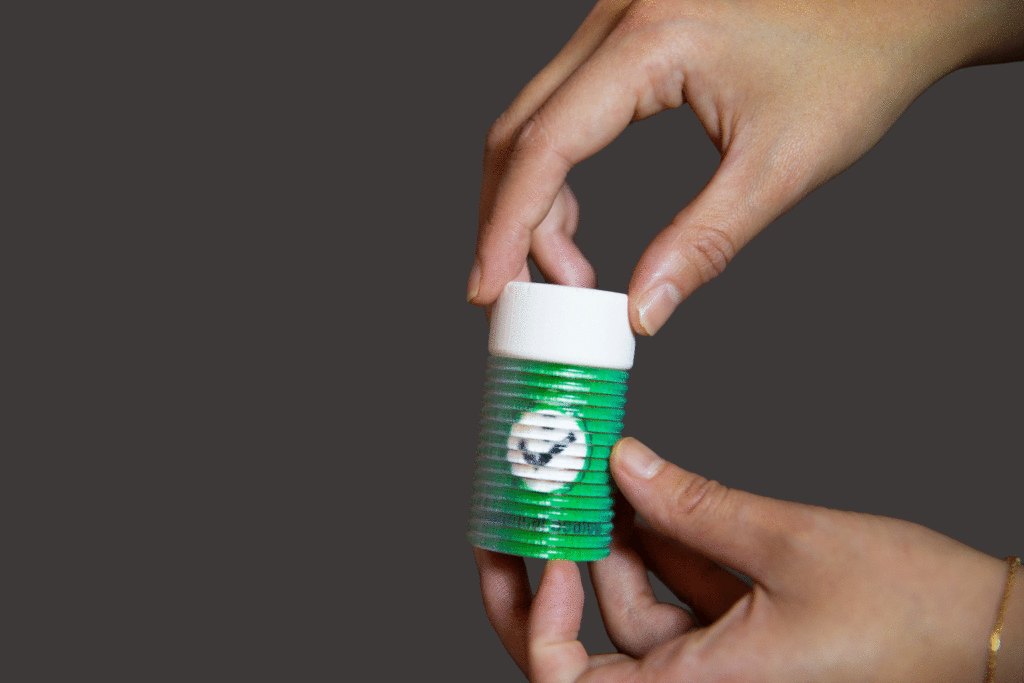
To vividly illustrate the capabilities and potential of ShiftLens, the researchers fabricated a compelling range of interactive objects. One striking experiment involved a chemical bottle designed to provide immediate visual feedback on its cap’s security. When the cap is securely tightened, the bottle’s surface turns green and displays a prominent check mark, offering clear affirmation. Conversely, if the cap is loose, the bottle instantly changes to red and shows an exclamation mark, serving as an unambiguous warning against potential spills or contamination. This application alone has profound implications for laboratory safety, hazardous material handling, and even consumer product packaging.
In another engaging demonstration, they created a tic-tac-toe game where the squares could dynamically display a red ‘X’, a blue ‘O’, or remain blank. The state of each square was controlled by the user turning a small knob, providing a tactile and intuitive gaming experience devoid of any electronic components. This showcases the system’s potential for robust, durable, and playful interactive devices.
While the ShiftLens tool is currently designed to simplify the fabrication process for individual makers and rapid prototyping, Zhu affirmed its potential for scalability in commercial and industrial contexts. She cited an example relevant to infrastructure: "For instance, it could be used to design piping that can change its appearance to identify a damaged connection that is causing a leak." This concept directly addresses a prevalent issue in residential and industrial settings. "The leaking sink in my apartment would be a lot easier to fix if it could tell me where the leak was coming from," Zhu added, personalizing the practical impact of such an innovation.
Broader Context and Technological Landscape
The development of ShiftLens arrives at a time of increasing demand for "smart" objects and pervasive computing, often referred to as the Internet of Things (IoT). However, a significant barrier to the widespread adoption of IoT in many practical scenarios has been the fragility and power requirements of electronic sensors and displays. Industries ranging from logistics and manufacturing to healthcare and environmental monitoring are constantly seeking robust, low-maintenance, and energy-efficient solutions for real-time information display and interaction. ShiftLens offers a compelling alternative to battery-dependent electronic systems, especially in environments where power is scarce, or electromagnetic interference is a concern.
Furthermore, advancements in additive manufacturing, specifically 3D printing, have been instrumental in enabling the realization of ShiftLens. The ability to precisely print complex geometries, including the intricate lenticular lens arrays and the mechanical linkages, at high resolution and relatively low cost, makes such bespoke mechanical optical systems feasible for prototyping and even small-scale production. This convergence of advanced computational design, novel optical principles, and sophisticated manufacturing techniques is a hallmark of contemporary innovation in materials science and human-computer interaction.
MIT has a long-standing legacy in pioneering research in human-computer interaction (HCI), materials science, and robotics. ShiftLens fits squarely within this tradition, pushing the boundaries of how humans interact with their physical environment without relying solely on traditional digital interfaces. It represents a move towards "calm technology" – devices that inform users without demanding constant attention or complex digital interactions.
Industry observers suggest that the implications of ShiftLens could extend to several sectors. In the packaging industry, dynamic labels could indicate product freshness, tampering, or usage instructions without the need for embedded RFID chips or complex sensors, reducing costs and improving sustainability. For industrial safety, mechanical indicators on machinery could clearly signal operational status, maintenance needs, or hazard warnings in environments where electronic displays might fail due to vibrations, dust, or temperature extremes. Even in education, robust interactive learning tools could be developed that are less prone to damage than their electronic counterparts.
Future Directions and Long-Term Impact
The MIT research team is actively exploring additional applications for ShiftLens in their future work. This includes investigating how the system could be adapted for larger-scale installations, more complex visual changes, or integration with different types of physical objects. Beyond new applications, the researchers also plan to enhance the core design tool itself. A primary objective is to develop an advanced algorithm capable of generating a ShiftLens structure with fewer user inputs, further simplifying the design process and making the technology accessible to an even broader audience. This would likely involve more sophisticated automated design optimization based on desired visual effects and mechanical constraints.
Additionally, the team intends to expand the design tool’s capabilities to allow users to incorporate a wider variety of actuation mechanisms. This could include exploring magnetic actuation, pneumatic systems, or even material-based actuation (e.g., shape-memory polymers) to trigger the lens layer’s movement, offering greater flexibility in design and interaction paradigms.
The long-term impact of ShiftLens could be profound. By demonstrating a viable and robust alternative to electronic displays for dynamic information, it opens new avenues for creating truly resilient and sustainable interactive objects. Reduced reliance on power sources, simplified manufacturing processes, and increased durability could lead to products with longer lifespans and lower environmental footprints. As the world increasingly seeks intelligent solutions embedded within everyday objects, ShiftLens stands out as a testament to the power of mechanical ingenuity and interdisciplinary research, promising a future where objects don’t just exist, but actively communicate, inform, and interact with us in intuitive and enduring ways.