Researchers at the Massachusetts Institute of Technology (MIT) have introduced a groundbreaking new class of mechanical metamaterials, dubbed "bifur-circuits," that promise to revolutionize the design of interactive objects, communication systems, and adaptive infrastructure. These innovative structures can dramatically alter their shape, sense their own configurations, and transmit corresponding electrical signals, effectively embedding intrinsic intelligence directly into hardware. The development marks a significant leap forward in the field of programmable matter, moving beyond traditional, fixed-form engineering towards a future of dynamic, responsive devices.
The core of this pioneering work, recently detailed in a paper and slated for presentation at the prestigious ACM Symposium on User Interface Software and Technology, lies in the intelligent design of repeating modular units. Unlike previous mechanical metamaterials with limited configurations, bifur-circuits leverage a unique property known as mechanical bifurcation to achieve an exponentially greater number of stable shapes. This geometric adaptability, combined with seamlessly integrated electrical conductivity, allows these structures to not only transform but also to understand and communicate their current state.
One compelling demonstration of this technology involved a chair that ingeniously converts into a table with integrated storage, and can subsequently flatten for compact stowing. As the object transitions between these forms, the bifur-circuits within its structure detect the change and relay precise messages to an electronic display, showcasing a tangible application for smart, adaptable furniture. Beyond domestic utility, the potential extends into critical areas such as telecommunications and sensing. The researchers envision antennas capable of dynamically adjusting their frequencies by changing shape in response to environmental conditions, eliminating the need for bulky, complex mechanical components that traditionally govern such adjustments.
The Genesis of Intrinsic Intelligence in Hardware
The concept of infusing intelligence into inert materials has long been a pursuit in advanced engineering and materials science. For decades, the focus has largely been on adding external sensors, processors, and actuators to conventional materials to achieve smart functionalities. However, the MIT team’s work with bifur-circuits represents a paradigm shift: embedding intelligence directly into the very geometry and material composition of the structure itself.
"Metamaterials can make complex mechanical assemblies easy to manufacture just by using repeating units. Our work expands on this design space," explains Marwa AlAlawi, a mechanical engineering graduate student and lead author of the pivotal paper. AlAlawi further elaborates on the profound implications, stating, "If we think of mechanical metamaterials as building blocks, then our work is one way to take advantage of their geometry to embed intrinsic intelligence into hardware, which could open many possibilities." This perspective underscores the potential for a new era of hardware design where form, function, and intelligence are inextricably linked from the ground up.
The research team behind this breakthrough is a testament to interdisciplinary collaboration. AlAlawi is joined by co-senior authors Ticha Sethapakdi, an electrical engineering and computer science (EECS) graduate student at MIT, and Stefanie Mueller, an associate professor in MIT’s departments of EECS and Mechanical Engineering, who also leads the Human-Computer Interaction Group at the Computer Science and Artificial Intelligence Lab (CSAIL). The collaborative effort extends further, encompassing contributions from other researchers at MIT, the University of Tokyo, and the University of Michigan, highlighting a global commitment to advancing this frontier.
Understanding Mechanical Metamaterials: A Foundation
To fully appreciate the significance of bifur-circuits, it is essential to understand the foundational principles of mechanical metamaterials. These are programmable, three-dimensional structures constructed from repeating unit cells, whose macroscopic properties are not derived from the properties of the base material alone, but rather from their intricate geometric arrangement. When subjected to external forces—be it squeezing, pushing, or pulling—these metamaterials can bend, twist, or deform in highly precise and predictable ways, often exhibiting behaviors not found in natural materials.
A prime example of such unusual behavior is seen in "auxetic" metamaterials. Unlike conventional materials that tend to narrow when stretched (exhibiting a positive Poisson’s ratio), auxetic materials do the opposite: they get wider when stretched. This counter-intuitive property grants them enhanced energy absorption, fracture resistance, and improved shear stiffness, making them attractive for applications ranging from body armor to biomedical implants.
The Evolution from Fixed States to Dynamic Configurations
The MIT researchers have a well-established history in this domain. In prior work, they successfully leveraged auxetic metamaterials to construct reconfigurable antennas. These earlier antennas could adopt three distinct shapes depending on how the structure was stretched, enabling them to dynamically adjust their frequency range without relying on cumbersome, traditional mechanical parts. This capability was a significant step towards more versatile sensing and communication systems.
However, the team soon identified a limitation: these auxetic metamaterials were constrained to a fixed, albeit small, number of predefined states. To unlock a broader spectrum of configurations, particularly for applications demanding greater adaptability, a new approach was required. This necessity spurred the development of bifur-circuits.
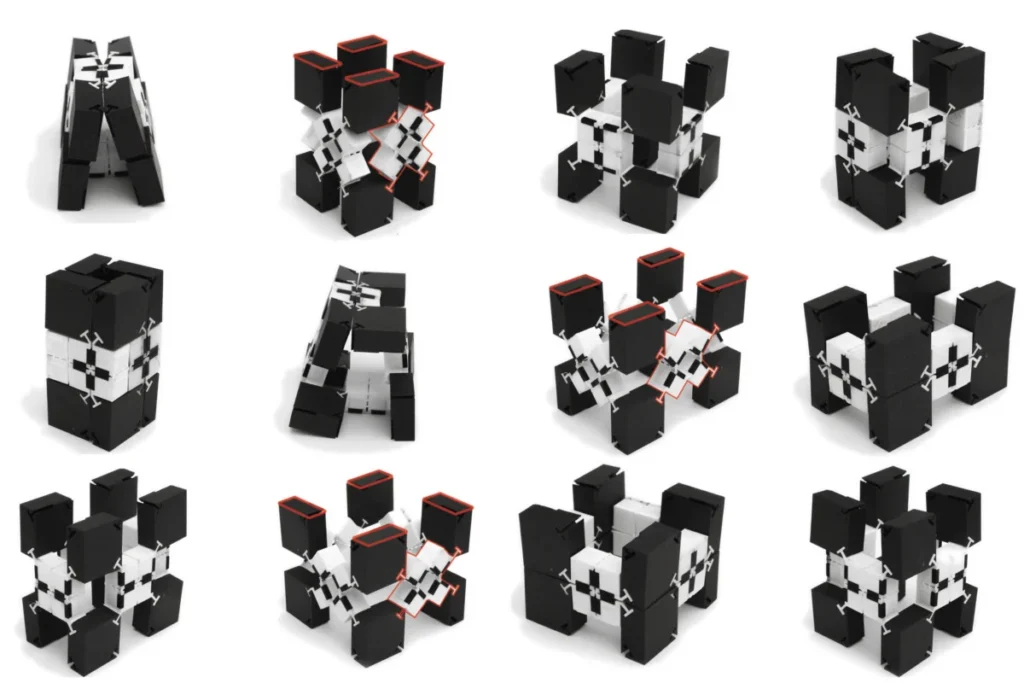
Bifur-circuits are an evolution of this concept. They are also auxetic in nature, but their modular units are designed with an unprecedented level of connectivity and rotational freedom. This innovative design allows them to form a far greater multitude of shapes, dictated by how the individual units are connected and rotated relative to one another. Crucially, these units are also electrically modular. Through ingenious integration of conductive material, electrical connections are maintained seamlessly throughout the entire structure, regardless of how the object is twisted, pressed, or rotated to achieve new forms. This continuous electrical pathway is what enables the intrinsic intelligence – the ability for the structure to sense and communicate its configuration.
The Power of Mechanical Bifurcation
The exponential increase in potential configurations for bifur-circuits is primarily attributed to their exploitation of a property known as mechanical bifurcation. Mechanical bifurcation describes a sudden and often dramatic change in how a mechanical system behaves once a force exerted upon it crosses a critical threshold. A common analogy is bending a plastic ruler: initially, it deforms smoothly, but once the applied force reaches a certain point, it suddenly buckles into a new stable configuration.
In the context of bifur-circuits, this bifurcation phenomenon occurs when connected blocks are rotated in specific ways around a pivot point. This property allows multiple connected blocks to achieve a far greater number of stable configurations than a single block could on its own. The genius of the bifur-circuit design lies in harnessing this inherent mechanical instability to create a vast design space. As AlAlawi highlights, "Bifurcation allow us to significantly expand on this reconfigurability space. Just adding one extra unit gives us so many more combinations out of the same structure." This additive effect means that even a modest increase in the number of bifur-circuit units within a structure can lead to an exponential increase in the number of possible stable configurations, opening up immense possibilities for complex, adaptive designs.
The linking and rotation of these components actively trigger unique electrical circuits between adjacent units. This inherent interactivity is the mechanism by which the units communicate with each other, enabling the entire structure to "sense" its current physical configuration. This self-awareness is a cornerstone of true intrinsic intelligence in hardware.
Overcoming Engineering Hurdles: The Conductive Material Challenge
The journey to perfecting bifur-circuits was not without its engineering challenges. One of the most significant hurdles faced by the research team involved the integration of a conductive material. The material needed to be flexible enough to withstand repeated bending, twisting, and compression inherent in shape-shifting, yet also possess sufficient electrical efficiency to ensure reliable signal flow. Achieving this delicate balance between mechanical resilience and electrical performance was a complex design problem.
"The conductive material was a constraint we had to work around in the design process, and it dictated how the sensing between blocks would happen," AlAlawi noted, underscoring the iterative nature of the development. The team meticulously refined their designs, experimenting with various conductive elements and integration methods until they achieved a robust and reliable solution. The success of their approach was rigorously validated through extensive durability testing, where reconfigurable structures were subjected to over 10,000 compression cycles. Crucially, these tests demonstrated no degradation in electrical connectivity, confirming the long-term viability and robustness of the bifur-circuit design.
Streamlining Design and Fabrication: A User-Friendly Ecosystem
Recognizing that the complexity of designing such intricate metamaterials could be a barrier to wider adoption, the researchers also developed a user-friendly construction and simulation tool. This software is designed to simplify the bifur-circuit design process, enabling engineers and designers to rapidly prototype and visualize their creations. A key feature of this tool is its ability to generate precise instructions for multimaterial 3D printers, allowing for the single-pass fabrication of these sophisticated reconfigurable objects. This integrated design-to-fabrication workflow significantly accelerates the development cycle and lowers the entry barrier for exploring bifur-circuit applications. The accessibility of such tools is vital for transitioning advanced research from the lab into practical, widespread use, democratizing the creation of intelligent hardware.
Demonstrated Versatility and Immediate Applications
The practical utility of bifur-circuits was vividly demonstrated through several compelling prototypes. Beyond the transforming chair-to-table system, the team also fabricated a shape-shifting controller. This controller, based on its physical configuration (e.g., twisted in a certain way, or collapsed into a specific form), could launch one of several different video games. This application highlights the potential for a more intuitive and physically interactive human-computer interface, where the device itself adapts to the user’s intent or the context of use. Imagine a controller that reconfigures itself for racing games versus fighting games, offering a truly immersive experience.
These initial demonstrations, while seemingly simple, lay the groundwork for a vast array of future applications across diverse sectors. The ability of an object to sense its own configuration without external sensors represents a fundamental shift in how we might design everything from consumer electronics to large-scale infrastructure.
Broader Impact and Transformative Implications
The implications of bifur-circuits extend far beyond novel furniture or gaming peripherals. The technology holds immense potential to revolutionize several key industries and societal challenges:
- Interactive Rehabilitation Tools: Imagine therapeutic devices that adapt their shape and resistance based on a patient’s movement, providing personalized feedback and progress tracking. This could significantly enhance physical therapy outcomes.
- Modular Soft Robotics: Current soft robots often rely on pneumatic or hydraulic systems for movement. Bifur-circuits could enable soft robotic grippers or manipulators that change shape and stiffness intrinsically, allowing them to grasp objects of varying sizes and fragility with unprecedented dexterity and adaptability, without complex external control systems. This is particularly relevant for delicate tasks or operations in unpredictable environments.
- Reconfigurable Shelters and Adaptive Infrastructure: In disaster relief scenarios, quickly deployable shelters that can automatically adjust their structure to changing environmental conditions (wind, rain, temperature) could provide more robust and adaptable temporary housing. Beyond disaster relief, this could lead to buildings or urban structures that dynamically respond to weather, traffic flow, or energy demands.
- Next-Generation Antennas and Communication: The initial motivation for expanding metamaterial configurations stemmed from antennas. Bifur-circuits could lead to ultra-compact, multi-band antennas for 5G, satellite communication, or IoT devices, capable of optimizing performance in real-time. This could enable more resilient and efficient communication networks, especially in challenging environments or for rapidly changing communication needs.
- Smart Wearables and Human-Computer Interaction: Wearable devices could dynamically conform to the user’s body, or provide haptic feedback through shape changes, creating a more intuitive and personalized interaction experience. Interfaces could literally reshape themselves to guide users or convey information.
- Self-Assembling and Self-Repairing Systems: In the long term, the intrinsic intelligence of bifur-circuits could contribute to the development of systems capable of self-assembly or even limited self-repair, where structures can detect damage and reconfigure to maintain functionality or signal the need for repair.
Future Directions and the Vision of Integrated Intelligence
The researchers are keenly focused on exploring an even wider range of applications for bifur-circuits. They aim to incorporate further layers of interactivity into these structures, pushing the boundaries of what "intrinsic intelligence" truly means. This includes investigating additional metamaterial shapes and unit designs to unlock even more complex and nuanced behaviors.
AlAlawi articulates a bold vision for the future: "Bifur-circuits are one step toward developing mechanical building blocks with integrated intelligence. It would be interesting to build on this work and come up with building blocks that allow us to create a structure with any form or shape we want, and which are structurally stable and can be actuated." This aspiration speaks to a future where engineering components are not just passive parts, but active, intelligent elements capable of self-organization and dynamic response, paving the way for truly autonomous and adaptive systems.
The implications for manufacturing are also significant. By simplifying complex mechanical assemblies into repeating, intelligent units, production costs and time could be dramatically reduced, making advanced, customizable hardware more accessible. The shift from complex, multi-component systems to intrinsically intelligent modular units represents a fundamental change in manufacturing paradigms.
Global Collaboration and Support
This pioneering research underscores the power of international scientific collaboration and strategic funding. The work received crucial support, in part, from Japan’s Science and Technology Agency, an organization dedicated to promoting science and technology for societal benefit. Additionally, the Bahrain Crown Prince International Scholarship Program provided funding, reflecting a global investment in cutting-edge research and the development of future scientific leaders. This international backing is critical for advancing complex, interdisciplinary projects that have the potential for broad societal impact.
In conclusion, the development of bifur-circuits by the MIT team represents a pivotal moment in materials science and engineering. By seamlessly integrating shape-shifting capabilities with intrinsic electrical intelligence, these metamaterials open up a vast new design space for hardware that is not only reconfigurable but also self-aware. As researchers continue to explore their full potential, bifur-circuits stand poised to drive innovation across diverse fields, from consumer products to critical infrastructure, ushering in an era of truly intelligent and adaptive physical systems.