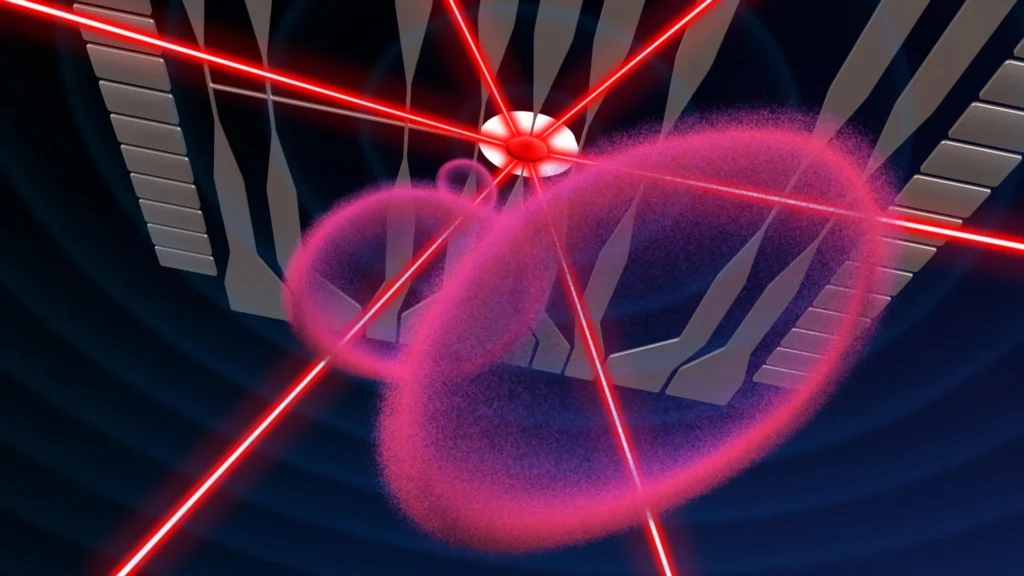
NASA’s upgraded Cold Atom Lab (CAL) is once again fully operational aboard the International Space Station (ISS), marking a significant leap forward in humanity’s quest to understand the fundamental nature of matter and accelerate the development of next-generation quantum technologies. This sophisticated facility leverages the unique microgravity environment of low Earth orbit to conduct groundbreaking experiments that are simply not feasible on Earth, offering an unparalleled window into the quantum world. The return to service of CAL, following its fourth major enhancement since its installation, underscores NASA’s commitment to maintaining leadership in space-based quantum research and its potential applications.
Unveiling the Quantum Realm: A Primer
Quantum science delves into the perplexing behavior of matter and energy at the most minuscule scales, encompassing atoms, electrons, and photons—particles of light. While our macroscopic world operates under the predictable laws of classical physics, the quantum realm defies intuition. Atoms, far from being mere miniature spheres colliding with one another, exhibit peculiar behaviors. They can manifest as waves, exist in multiple locations simultaneously through the principle of superposition, and even tunnel through seemingly impenetrable barriers under specific conditions. These phenomena, collectively known as quantum mechanics, govern the universe at its most fundamental level, forming the bedrock for technologies ranging from lasers and transistors to magnetic resonance imaging (MRI). However, directly observing and manipulating these quantum states, especially at macroscopic scales, remains a formidable challenge, one that CAL is specifically designed to address.
The Cold Atom Lab: A Micro-Refrigerator for Macroscopic Quantum States
At the heart of CAL’s mission is the creation and study of Bose-Einstein Condensates (BECs), often referred to as the fifth state of matter, alongside solids, liquids, gases, and plasma. BECs are formed when a gas of bosonic atoms is cooled to temperatures just a few billionths of a degree above absolute zero (minus 459 degrees Fahrenheit or minus 273 degrees Celsius). At these ultracold temperatures, the atoms lose their individual identities and condense into a single quantum state, behaving as one giant matter wave. This transition from individual particles to a collective quantum entity, where quantum mechanical effects become observable at a macroscopic level, was first theorized by Satyendra Nath Bose and Albert Einstein in the 1920s and experimentally realized in 1995 by Eric Cornell, Carl Wieman, and Wolfgang Ketterle, earning them the Nobel Prize in Physics in 2001.
CAL, roughly the size of a mini-refrigerator, is a self-contained atomic physics laboratory controlled remotely from NASA’s Jet Propulsion Laboratory (JPL) in Southern California, which built and operates the facility. Its primary function is to cool atoms to temperatures below minus 459 degrees Fahrenheit (minus 273 degrees Celsius), a temperature range where the wavelike nature of matter becomes dominant. Jason Williams, project scientist for Cold Atom Lab at JPL, emphasized the significance of these extreme conditions: "At the coldest temperatures, matter behaves drastically different from anything we have experienced. The wavelike nature of matter dominates, and ultracold matter can behave in ways that are not only unexpected, but that also enable extremely precise measurements of time, gravity, and motion. The lab has lots of tools – especially with this latest upgrade – to let us probe the nature of the universe."
A Timeline of Innovation: CAL’s Journey to its Latest Upgrade
The journey of the Cold Atom Lab from concept to its current advanced state on the ISS is a testament to persistent innovation in space science:
- 2014-2016: Development and construction of the Cold Atom Lab at NASA’s Jet Propulsion Laboratory. The project faced significant engineering challenges in miniaturizing a complex atomic physics laboratory to fit within the constraints of the ISS.
- May 2018: CAL was launched aboard an Orbital ATK Cygnus cargo spacecraft (OA-9) from NASA’s Wallops Flight Facility in Virginia.
- June 2018: Installation of CAL in the ISS’s U.S. Destiny laboratory module. Shortly after, it successfully created the first Bose-Einstein Condensates in space, a landmark achievement that validated the facility’s design and opened new avenues for quantum research. This initial success demonstrated the feasibility of performing highly sensitive quantum experiments in microgravity.
- 2018-Present: CAL has continuously operated, supporting five international research teams studying fundamental physics. Over its operational lifetime, it has undergone several software and hardware upgrades to expand its capabilities. These earlier enhancements focused on improving cooling efficiency, extending observation times, and enabling the study of different atomic species.
- April 11, 2024: The latest, fourth major upgrade – a newly redesigned science module – arrived at the space station aboard a Commercial Resupply Services mission. This upgrade significantly expands the range and complexity of experiments scientists can perform, building upon years of operational experience and scientific feedback.
The Mechanics of Ultracold Science: How CAL Operates
At the core of CAL’s functionality is a sophisticated collection of instruments housed within its science module. The process of creating ultracold atoms begins with heating strips of rubidium or potassium metal to temperatures as high as 750°F (400°C) inside a vacuum chamber. This generates a gas of atoms, which are then subjected to a multi-stage cooling process:
- Laser Cooling: Researchers precisely tune lasers to interact with the atoms. The photons from the lasers are absorbed by the atoms, pushing them against their direction of motion, thus slowing them down. As the atoms lose kinetic energy, their temperature drops dramatically, cooling them to temperatures far below what is achievable through conventional methods.
- Magnetic Trapping: After the initial laser cooling, magnetic fields are employed to trap and contain the chilled atoms. These magnetic fields create a "magnetic bottle" that prevents the atoms from dispersing, holding them in a confined space for further manipulation.
- Evaporative Cooling: The final and most crucial cooling stage involves evaporative cooling. In this technique, the magnetic trap is gradually lowered, allowing the most energetic (hottest) atoms to escape. As these hotter atoms leave, the average energy of the remaining atoms decreases, causing the cloud to cool even further, pushing the temperature down to nanokelvin ranges, just above absolute zero. This is the stage where atoms can combine into a Bose-Einstein Condensate.
The latest upgrade includes a redesigned magnetic trap that offers enhanced control over the shape of the quantum gas clouds. This advanced capability allows researchers to sculpt the BECs, providing new opportunities to investigate their properties and behavior in unprecedented ways. Additionally, redesigned metal atom sources have been introduced, ensuring a consistent and reliable supply of the atomic gases essential for experiments. Kamal Oudrhiri, project manager of Cold Atom Lab at JPL, noted the significance of these advancements: "It’s the closest thing we have to controlling the boundary of the quantum world. This new upgrade pushes that boundary even further."
Microgravity’s Unparalleled Advantage for Quantum Experiments
While ultracold gases can be studied in ground-based laboratories, space offers profound advantages that are critical for pushing the boundaries of quantum research:
- Extended Observation Times: On Earth, gravity constantly pulls atoms downward, limiting the amount of time they can be observed before they fall out of the trap or interact with the environment. Researchers must continually employ magnetic or optical forces to counteract gravity. In microgravity, the ultracold atomic clouds can be held and studied for significantly longer periods—up to several seconds—allowing for more precise measurements and the observation of subtle quantum phenomena that would otherwise be obscured. This extended observation window is vital for studying the dynamics and coherence of BECs.
- Lower Temperatures: The absence of gravitational sag in microgravity simplifies the trapping mechanisms, reducing the need for strong confining forces. This allows for more efficient evaporative cooling, enabling scientists to achieve even lower temperatures than those attainable on Earth. Colder temperatures mean slower atomic motion and more pronounced quantum effects, opening new frontiers for discovery.
- Larger Quantum Waves: According to de Broglie’s hypothesis, all matter exhibits wave-like properties. The wavelength associated with an atom is inversely proportional to its momentum. In microgravity, with atoms moving incredibly slowly and for longer durations, their de Broglie wavelengths become significantly larger. This allows for the formation of larger, purer quantum waves (BECs) that can interact with gravity and other fundamental forces for extended periods, providing a unique platform for high-precision measurements.
- Precision Gravity Studies: Paradoxically, the microgravity environment is ideal for studying gravity itself. By minimizing other forces, the subtle effects of gravity on matter waves become more discernible. This enables experiments to test fundamental theories of gravity, such as Einstein’s General Relativity, with unprecedented accuracy, and potentially search for deviations that could indicate new physics.
To make these complex experiments possible aboard the ISS, engineers achieved an extraordinary feat of miniaturization, compressing what would typically require a room-sized atomic physics laboratory filled with lasers, vacuum chambers, and optical equipment into a compact system that fits snugly within a standard ISS experiment rack.
Voices from the Frontier: Expert Perspectives on CAL’s Potential
The scientific community is buzzing with anticipation regarding CAL’s enhanced capabilities. Ethan Elliott, deputy project scientist for Cold Atom Lab at JPL, highlighted the historical context and future implications: "As the first project to create Bose-Einstein condensates in orbit, we’re demonstrating that we can make quantum technology work reliably in space. In the previous century, there was a quantum revolution that led to lasers, cellphones, and MRIs for medical imaging. We’re performing quantum 2.0 – direct manipulation of large quantum states – and we hope for similar gains in quantum tech by advancing this science in orbit."
NASA officials, including those from the Biological and Physical Sciences division within NASA’s Science Mission Directorate, consistently emphasize the strategic importance of CAL. The project is seen as a critical component in maintaining U.S. leadership in the rapidly evolving field of quantum technologies. The ISS Program Office also recognizes CAL as a prime example of the station’s unique role as a national laboratory, offering an indispensable platform for cutting-edge research that benefits humanity. Researchers involved in the five international teams supported by CAL anticipate that the upgraded module will unlock new experimental regimes, allowing them to probe the behavior of ultracold atoms with greater precision and explore novel quantum phenomena.
Beyond the ISS: The Transformative Implications of Quantum 2.0
The research conducted with the Cold Atom Lab has profound implications, extending far beyond fundamental physics into practical applications that could revolutionize various fields:
- Advanced Sensing and Navigation: The ability to precisely manipulate and measure matter waves opens the door for developing next-generation quantum sensors. These could include ultra-sensitive matter-wave interferometers for measuring gravitational fields with unprecedented accuracy. Such instruments could be deployed for Earth science investigations, providing detailed gravity maps to track changes in ice sheets, ocean currents, and groundwater, which are crucial for climate monitoring. For future exploration missions, these sensors could enable highly accurate inertial navigation systems for autonomous deep-space probes, reducing reliance on traditional radio communication for positioning.
- Precision Timing: Ultracold atomic clocks, derived from the principles explored by CAL, could offer unparalleled stability and accuracy, surpassing current atomic clock technologies. These advanced clocks would have applications in satellite navigation (improving GPS accuracy), deep-space communication, and fundamental physics experiments, such as testing the constancy of fundamental constants or searching for dark matter.
- Fundamental Physics and Beyond the Standard Model: By allowing researchers to study atoms at temperatures and durations impossible on Earth, CAL provides a unique laboratory for testing the limits of known physics. Experiments could investigate potential deviations from Einstein’s theory of General Relativity at quantum scales, search for new fundamental forces, or indirectly probe the nature of dark matter and dark energy, which constitute the vast majority of the universe’s mass and energy.
- Quantum Computing Foundations: While CAL itself is not a quantum computer, the fundamental research into controlling and understanding quantum coherence, entanglement, and interactions in ultracold atomic systems directly contributes to the foundational knowledge required for building robust quantum computers. The insights gained could inform the development of qubits and quantum logic gates, accelerating progress in this transformative field.
- Enabling Future Space Exploration: The Biological and Physical Sciences division, which sponsors CAL, supports scientific discovery by leveraging the unique conditions of space. The knowledge gained from studying biological and physical processes in extreme environments is essential for enabling humans to travel farther and remain in space longer. CAL’s contributions to precision timing and navigation, as well as its role in testing advanced quantum instruments in a space environment, are direct benefits for future lunar and Martian missions.
Kamal Oudrhiri further underscored the broader strategic implications, stating that the new hardware "demonstrates NASA’s ability to maintain U.S. leadership in space-based quantum technologies while maturing future quantum instruments, such as matter-wave interferometers for fundamental physics missions, positioning, navigation, timing, and gravity sensing of Earth, the Moon, and beyond." This emphasizes not just scientific discovery but also the development of practical, deployable technologies.
Forging the Future: Strategic Importance and Collaborations
The Cold Atom Lab represents a collaborative effort at the forefront of scientific exploration. It is managed by Caltech in Pasadena, while NASA’s Jet Propulsion Laboratory is responsible for its design, construction, and ongoing operations. The project’s sponsorship by the Biological and Physical Sciences division within NASA’s Science Mission Directorate in Washington highlights its alignment with broader NASA objectives to understand the universe, explore space, and improve life on Earth. The continuous upgrades and successful operation of CAL demonstrate NASA’s strategic investment in quantum science, recognizing its potential to unlock new discoveries and foster technological advancements that will shape the future of scientific inquiry and human endeavor in space and on our home planet. The re-activation of the upgraded Cold Atom Lab is not merely a technical milestone; it is a reaffirmation of humanity’s relentless pursuit of knowledge at the very edges of existence.