New York City is still basking in the glow of its first NBA Championship in half a century. The euphoria, described by friends and basketball media alike, has extended well beyond the final buzzer, with anecdotal accounts of New Yorkers in Knicks gear celebrating on sidewalks as late as August. The phrase "Knicks in Five" has become a ubiquitous shorthand among fans, a celebratory mantra resonating throughout this summer of triumph. While the street parties and champagne showers have subsided, anticipation for "Ring Night" at Madison Square Garden in October, marking the kickoff of the 2026-27 NBA season and the commencement of the Knicks’ title defense, is palpable and promises to be an exceptionally coveted event.
These are undeniably golden days for Knicks devotees, a stark contrast to the near-misses of a bygone era that, despite not clinching a championship, captured the city’s collective imagination. The 1999 squad, etched in memory for Reggie Miller’s legendary 0.8-second shot, Latrell Sprewell’s improbable four-point play, and Patrick Ewing’s career-altering Achilles tear, remains one of the most beloved runner-up teams in NBA history. In a fascinating footnote to their legacy, this almost-great team was honored with a commemorative Movado watch, a tangible reminder of their valiant effort, a piece of history that time has almost forgotten.

The 1990s Knicks: A Decade of Dominance and Near Misses
Throughout the 1990s, the New York Knicks established themselves as a consistently formidable force in the NBA. Under the leadership of Patrick Ewing, one of the league’s all-time greats, the team reached unprecedented heights, though ultimate championship glory remained elusive. During this decade, the Knicks faced the eventual NBA champions in the playoffs five times, including two heartbreaking NBA Finals appearances: first in 1994 against the Houston Rockets and again in 1999 against the San Antonio Spurs.
A pivotal figure during this era was Dave Checketts, who served as President of the New York Knicks starting in 1991 and was later elevated to lead the entire Madison Square Garden organization in 1994. Checketts was instrumental in shaping the team’s direction and fostering its connection with the city for nearly a decade.
Following the intensely contested 1994 NBA Finals, which saw the Knicks fall to the Rockets in a dramatic seven-game series, Checketts proposed an idea to honor the team for their remarkable effort. However, then-head coach Pat Riley, a five-time champion with the Los Angeles Lakers, was firmly against any form of celebration for a non-championship team. Riley’s philosophy was unequivocal: "No celebration, no party, no rings, no hats. Unless you won the title, your season was a failure." This uncompromising stance set a precedent for how the NBA treated its runners-up, a stark contrast to other major American sports leagues.

"Blood in the Garden": A Beloved Runner-Up’s Story
The stark reality of Riley’s decree meant that second-place finishers in the NBA did not receive the championship rings typically awarded to winners, a practice that distinguished the league from the Super Bowl and World Series, where runner-up rings are a recognized tradition, albeit often less discussed. The memory of the 1994 Finals loss, however, lingered with Checketts, who was determined to find a way to commemorate the 1999 Finals run, a team that few had anticipated would even reach that stage.
As detailed in Chris Herring’s acclaimed book, "Blood in the Garden: The Long, Strange Ride of the 1990s New York Knicks," Checketts’ mind was already set on commemorating the 1999 team’s extraordinary journey. The "somehow" of this commemoration evolved into the idea of presenting customized watches to the team and personnel. This decision was driven by a desire to acknowledge their achievement without conferring the status of a championship, a middle ground that acknowledged their significant accomplishment while respecting the ultimate goal.
Checketts elaborated on the emotional weight of the 1999 loss, stating in a recent interview, "It was a devastating loss, and I was convinced we were the better team." Recognizing that his star player, Patrick Ewing, was in his mid-30s and recovering from a major injury, and sensing his own tenure with the organization might be nearing its end, Checketts conceived of a unique tribute. He commissioned bespoke Movado timepieces for everyone associated with that memorable season, aiming to provide a lasting memento of their collective success.

The Mystery of the Movado: Unraveling the Commemorative Watch
The mention of these commemorative watches in "Blood in the Garden" served as a minor detail for many readers, particularly those more engrossed in the Knicks’ narrative than horology. However, for watch enthusiasts, the mention immediately sparked a cascade of questions: What specific Movado model was chosen? Did it feature a custom dial or engraving? How many were produced, and what is their value on the secondary market today?
In the summer of 2025, an initial search across prominent online watch marketplaces – Chrono24, eBay, and Reddit – yielded no results for Knicks-related Movados from the late 1990s. While numerous Movado models from that period were available, none bore any connection to the 1999 Knicks.
Further investigation, utilizing Chris Herring’s precise description of the watches in his book – "a silver-band, blue-faced Movado watch that was engraved, ‘New York Knicks: 1999 NBA Eastern Conference Champions’" – also proved fruitless. The absence of any verifiable examples fueled the mystery surrounding these unique timepieces.

The hunt was temporarily abandoned, only to be reignited a year later, coincidentally coinciding with the Knicks’ championship victory in the 2026 season. The expectation was that this renewed Knicks fervor would lead to a superfan or former player surfacing with one of these rare artifacts. However, the secondary market remained silent. The only remaining avenue for uncovering the story behind the watch was to directly contact Dave Checketts himself.
A Conversation with Dave Checketts: Revealing the True Commemorative
Dave Checketts departed the Knicks and MSG in 2001, embarking on a successful second career in sports consulting, investment management, and other ventures. Despite his demanding schedule, Checketts, a distinguished figure and the only Utah Hall of Fame inductee the author has interviewed, proved remarkably accessible for a conversation via Zoom to discuss the commemorative watches.
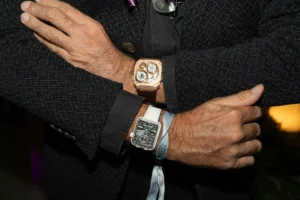
The youthful-looking executive, who was only 35 when he was hired by the Knicks, recounted the story with a palpable sense of the sting from the 1999 loss. "It was a devastating loss," he reiterated, before producing his own watch from off-camera.

The timepiece revealed was not the classic Movado Museum Watch, which had been the initial assumption. Based on Herring’s description, the expectation was a round case with a minimalist dial, perhaps in Knicks blue, featuring the iconic Museum Dot at the 12 o’clock position, with all inscriptions relegated to the caseback. The Museum Watch was indeed highly popular in the late 1990s and early 2000s, enjoying significant marketing presence in the New York area.
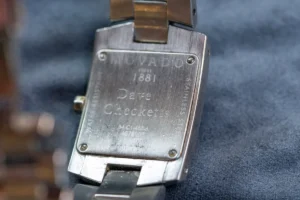
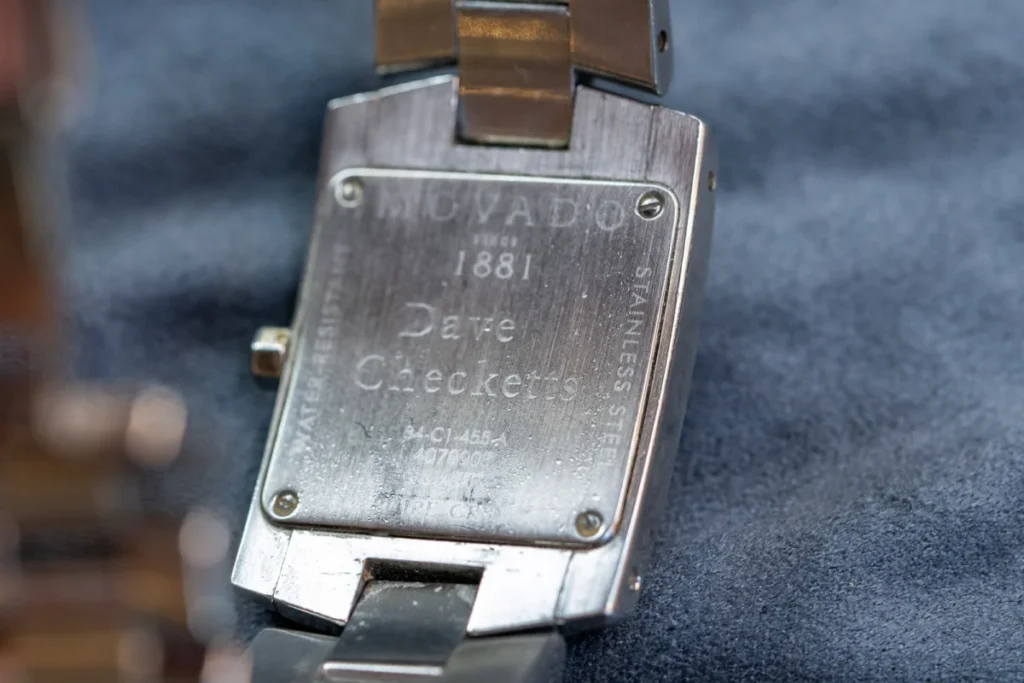
Instead, Checketts presented what was later identified as Movado’s Eliro model. This watch featured a distinctive rectangular, tank-style steel case with an integrated bracelet that was slightly narrower than the case sides. The dial, observed to be black rather than blue as initially described, bore the inscriptions "1999 / NBA / Eastern Conference / Champions" stacked above and below faceted dauphine hands. The Movado logo was positioned at the top of the dial, just below the Museum dot. Engraved on the upper surfaces of the blocky case sides, "New York" and "Knick" were subtly etched. Checketts’ example, clearly well-worn, showed these engravings only faintly visible in a photograph he shared post-interview.
The Eliro: A Watch for an Organization-Wide Tribute
The Movado Eliro, chosen for this commemorative purpose, offers an interesting perspective when considered in the context of the 1999 Knicks. Its slim, rectangular, quartz-powered steel design might seem out of step with today’s NBA player fashion or the dominant hip-hop influenced aesthetic of the late 1990s. However, its understated styling and modest luxury presentation likely made it a fitting choice for a team-wide commemorative piece.

Checketts could not recall the exact distribution list but emphasized his directive to his staff to be as inclusive as possible. "It wasn’t just players and coaches," he recalled. "People like the scoring crew… I think if you worked for the Knicks in any capacity." This inclusive approach suggests that the choice of the Eliro model and its specific execution were partly driven by the desire to create a gift that could be distributed broadly across the organization. The exact number produced remains uncertain, but the intention was clearly to honor the collective effort.
Remarkably, the evidence suggests that recipients of these watches have held onto them as cherished artifacts rather than cashing in on their potential secondary market value. This is particularly noteworthy given that the 1999 Knicks, a team that won only 27 games in a strike-shortened season and entered the playoffs as an eight seed, defied all expectations to reach the NBA Finals. Their improbable run is a testament to their resilience and determination, making the watch a symbol of a story worth remembering and a trophy worth holding onto.
Timing is Everything: The Renewed Interest in the 1999 Knicks and Movado
Several factors appear to be converging to elevate the status of these 1999 Knicks Movado watches. In recent years, there has been a discernible trend in the watch collecting world towards the collectability of early Movado pieces, particularly those featuring in-house movements, meticulous craftsmanship, and steadily increasing auction prices. The brand itself seems to be experiencing a resurgence, with new releases drawing inspiration from its esteemed historical designs.

Simultaneously, a broader cultural fascination with the 1990s and early 2000s has taken hold. This nostalgia is evident in fashion and popular culture, with a noticeable increase in younger demographics embracing "neo-vintage" timepieces over more contemporary smartwatches. This trend suggests a growing appreciation for the design aesthetics and historical significance of watches from these earlier eras.
Furthermore, the New York Knicks’ recent championship victory in 2026 has reignited the city’s passion for the team. The "Knicks in Five Summer" phenomenon has shown signs of extending into the fall, and the prospect of another deep playoff run led by Jalen Brunson could further amplify this enthusiasm. As the article suggests, securing tickets for future games is advisable, and keeping an eye on the sidelines might reveal Dave Checketts, who has been seen attending recent playoff games. Should one be fortunate enough to spot him, a glimpse of his well-worn Movado Eliro might offer a tangible connection to a significant chapter in Knicks history. The watch, a quiet witness to a near-championship, has become a powerful symbol of enduring legacy, timing, and the indomitable spirit of a beloved team.