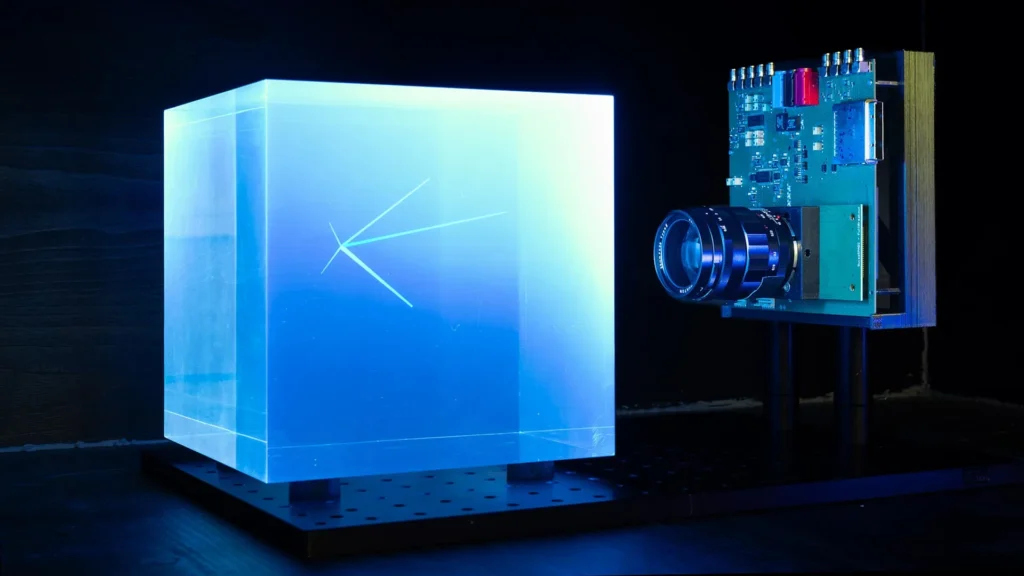
Breakthroughs in physics often emerge from diverse origins: entirely new inventions, groundbreaking theories, or, as demonstrated by a recent innovation, the ingenious combination of existing technologies to achieve unprecedented capabilities. This latter approach is precisely what researchers at ETH Zurich and EPFL have accomplished with the development of a novel detector system, dubbed PLATON, which promises to fundamentally alter how scientists track elusive subatomic particles and could profoundly impact medical imaging. Their work, detailed in a recent publication in Nature Communications, introduces a radical shift from the traditional, complex, and costly segmented particle detectors to a more streamlined, efficient, and scalable imaging solution.
The quest to understand the universe’s most enigmatic constituents, such as neutrinos and hypothetical dark matter candidates, hinges on the ability to detect their exceedingly rare interactions with ordinary matter. These "weakly interacting particles" are notoriously difficult to observe, necessitating detectors of immense size and exquisite spatial resolution. Historically, achieving such sensitivity has involved constructing colossal instruments composed of millions of individual, meticulously manufactured components, leading to substantial technological and financial burdens. PLATON, however, offers a compelling alternative by adapting sophisticated light field photography to reconstruct particle paths in three dimensions within a large, unsegmented block of scintillator material, effectively creating something far more powerful than its constituent parts.
The Intricate Landscape of Current Particle Detectors
Most high-energy particle physics experiments are designed to meticulously reconstruct the three-dimensional (3D) trajectories of elementary particles as they traverse vast volumes of dense detector material. A cornerstone of this endeavor is the scintillator, a material that emits tiny flashes of visible light when a charged particle passes through it. Scientists then use these light flashes to deduce the particle’s path and its interactions within the detector.
To pinpoint a particle’s location with high precision, conventional scintillators are typically divided into an extensive array of small, active sections. Optical fibers are then employed to collect the photons produced in each section, channeling this light to photomultiplier tubes (PMTs) or silicon photomultipliers (SiPMs) for counting. This segmented approach, while highly precise, faces significant challenges in terms of scalability and cost-effectiveness.
Illustrative examples of this complexity abound in major international collaborations. The T2K neutrino-oscillation experiment in Japan, for instance, utilizes a detector containing approximately two tons of sensitive material, meticulously assembled from around two million individual scintillator cubes and interwoven with 60,000 optical fibers. Similarly, at CERN and the Paul Scherrer Institute, experiments like LHCb and Mu3e push the boundaries of spatial resolution, achieving sub-millimeter precision by deploying millions of thin scintillating optical fibers. While these systems undeniably demonstrate the extraordinary capabilities of segmented detectors, they simultaneously underscore a growing problem. As the demand for larger and more sensitive detectors increases, the sheer scale of manufacturing, assembling, and reading out millions of discrete components becomes an escalating technological and financial bottleneck, impeding future advancements in fundamental physics. The logistical overhead, from supply chain management to calibration and maintenance, can consume a significant portion of project resources.
A Radical Reimagining of Particle Tracking: The PLATON Project
In response to these burgeoning challenges, researchers at ETH Zurich and EPFL have embarked on a very different strategic path. The team, spearheaded by PhD student Till Dieminger, senior scientist Dr. Saúl Alonso-Monsalve, and Professor Davide Sgalaberna from ETH Zurich, in collaboration with members of the Advanced Quantum Architecture Lab at EPFL in Lausanne led by Professor Edoardo Charbon, has successfully developed and tested the first prototype of a detector designed to perform ultrafast, high-resolution 3D particle imaging within a single, large, unsegmented block of scintillator material. This innovative concept, funded by the Swiss National Science Foundation through the PLATON project, promises to bypass the inherent limitations of segmentation.
Instead of fragmenting the detector into millions of minute units, the PLATON system leverages advanced camera technology to reconstruct the precise origin of the emitted light. The core inspiration for this breakthrough comes from plenoptic cameras, commonly known as light field cameras. Unlike conventional cameras, which primarily record the intensity of incoming light, a light field camera captures additional information about the direction from which the light arrived. This crucial distinction allows it to recover depth and reconstruct a scene in three dimensions, a capability perfectly suited for the task of mapping particle trajectories.
The technology hinges on a micro-lens array (MLA), strategically positioned between the camera’s main lens and its imaging sensor. Each microscopic lens within the array functions akin to a tiny individual camera, recording the same scene from a slightly different perspective. By combining the data from all these lenses, the system can reconstruct a "light field," a comprehensive description encompassing the intensity, position, and direction of the incoming light. For particle detection, where the scintillation light can be exceedingly faint, this ability is particularly invaluable. When plenoptic cameras are coupled with single-photon avalanche diode (SPAD) array sensors, they gain the capacity to detect individual photons. This synergy allows PLATON to potentially reconstruct intricate particle tracks even when very little light is available, a critical advantage for detecting weakly interacting particles. Despite its profound promise, light field camera technology had not previously been explored for particle tracking until now.
Inside the PLATON Prototype: Engineering Elegance
The proof-of-concept detector built by the ETHZ-EPFL team ingeniously combines a micro-lens array with a SPAD imaging sensor. The sensor, named SwissSPAD2, is a proprietary development of the EPFL team, showcasing their expertise in advanced photon detection. Raytrix GmbH, a specialist in light field technology, designed the MLA and meticulously mounted it directly onto the SwissSPAD2 sensor, creating a seamlessly integrated plenoptic imaging system.
A key feature of the SwissSPAD2 sensor is its capability for gated photon detection. This means the sensor can be programmed to record photons only within precisely defined time windows. This sophisticated timing control is instrumental for researchers, enabling them to focus on periods when genuine scintillation light is most likely to be present, while effectively filtering out random background signals and other spurious counts that would otherwise degrade the signal-to-noise ratio. This targeted detection dramatically enhances the clarity and accuracy of the collected data, a significant step forward in distinguishing true particle interactions from environmental noise.
Rigorous Testing and Validation: Proving the Concept
The researchers subjected the PLATON prototype to a series of rigorous laboratory experiments to assess its spatial resolution. These tests spanned a wide range of light levels, from several hundred detected photons down to an astonishingly low count of just five photons. This comprehensive evaluation demonstrated the detector’s robustness even under extreme low-light conditions, which are characteristic of weak particle interactions.
Beyond mere light detection, the team also evaluated the prototype’s ability to detect actual electrons and reconstruct their positions within a block of plastic scintillator. These electrons were generated using a strontium-90 source, providing a controlled and repeatable experimental setup. Crucially, across all the diverse test conditions, the results from the laboratory measurements showed a remarkable concordance with the extensive simulations performed by the team. This close match provided the researchers with high confidence that their theoretical models accurately describe the detector’s performance, laying a solid foundation for future development and scaling. The successful demonstration of the first prototype has already provided invaluable insights, directly shaping the team’s plans for the next, even more advanced, version of PLATON.
Charting the Future: Enhancements and Advanced Capabilities
The trajectory for PLATON’s evolution is clearly defined, focusing on two key areas: enhanced timing precision and greater sensitivity, coupled with intelligent data analysis. The researchers are actively developing a new generation of SPAD array sensors designed to significantly improve photon detection efficiency. Crucially, this upgraded sensor will provide sub-nanosecond timing for individual photons. Unlike the current system, where photons are assigned to fixed time windows, the future version will assign a precise, individual time stamp to each detected photon. This added temporal information is expected to dramatically improve the system’s ability to determine the exact origin of each photon, thereby refining the reconstruction of particle tracks with unprecedented accuracy.
Concurrently, the plenoptic camera itself is undergoing optimization to expand its field of view and enhance its light collection capabilities. Simulations presented in the research paper strongly suggest that these optical improvements, combined with the advancements in timing, should further elevate PLATON’s spatial resolution, pushing the boundaries of what is currently achievable.
Perhaps one of the most exciting developments is the integration of artificial intelligence into the data analysis pipeline. The team is employing simulations to estimate the performance of an upgraded PLATON system in detecting neutrinos, utilizing a novel image-processing method based on a neural network (NN). This system employs a Transformer architecture, a sophisticated design adapted from the type commonly used in large language models. However, instead of analyzing linguistic patterns, this specialized Transformer examines the intricate spatiotemporal patterns among the scintillation photons recorded by the detector. It is meticulously designed to identify subtle correlations in where and when photons appear, enabling it to reconstruct the original particle interaction with remarkable precision.
The simulations are highly encouraging, indicating that an unsegmented PLATON detector with a volume of (10x10x10) cm³ could realistically achieve a spatial resolution below 1mm. Furthermore, the simulations suggest that the system could identify neutrino interactions that produce final-state low-momentum protons with both high purity and high efficiency. This means the detector would not only be highly effective at selecting the desired events but also exceptionally adept at rejecting a multitude of unrelated background signals, a critical capability for discerning rare physics phenomena amidst experimental noise.
Scaling Up: Towards a New Era of Large-Scale Detectors
The potential for PLATON’s technology extends beyond tabletop prototypes to truly large-scale applications. The researchers also explored how the technology might perform in significantly larger detectors. While full neutrino simulations for a one-cubic-meter block of unsegmented scintillator were beyond current computing resources, they modeled a simplified point-like source of photons within such a volume. The results of these simulations are particularly striking: they suggest that a detector of this size could achieve a spatial resolution of a few millimeters, placing it squarely on par with existing state-of-the-art segmented plastic scintillator detectors.
This achievement is especially noteworthy because PLATON would attain this performance without the need for dividing the scintillator into millions of individual pieces, thus bypassing the manufacturing, assembly, and readout bottlenecks that plague current designs. The authors express strong confidence that further improvements to the optical design and other systemic components could eventually enable sub-millimeter resolution in PLATON-type detectors with volumes exceeding 1m³. This scalability represents a paradigm shift, offering a pathway to construct more powerful and cost-effective detectors for next-generation particle physics experiments, which are increasingly demanding larger detector volumes to compensate for the elusive nature of the particles they seek.
Beyond the Collider: Broadening Horizons in Science and Medicine
The ramifications of the ETH Zurich and EPFL researchers’ work extend far beyond the specialized realm of neutrino experiments and particle colliders. Given PLATON’s fundamental design principle—to reconstruct the precise 3D position of faint light signals—the technology holds immense potential to enhance a wide array of imaging systems across various scientific and medical disciplines.
Indeed, the immediate applicability of PLATON’s core technology is already being explored in medical imaging. Dieminger, Alonso-Monsalve, and Sgalaberna have proactively filed three separate patents related to the use of PLATON technology in positron emission tomography (PET). PET is a critical medical imaging method that tracks radioactive tracers introduced into the body, providing detailed insights into metabolic activity and blood flow within organs and tissues. The patents cover both innovative scanner designs and advanced image-processing techniques, including the sophisticated neural network developed by Alonso-Monsalve. This suggests that PLATON could lead to PET scanners that are not only more precise in localizing tracer activity but potentially also more cost-effective to manufacture, offering significant benefits for patient diagnosis and treatment monitoring.
The history of particle physics is replete with examples of fundamental research yielding transformative technologies with broader societal applications. The World Wide Web, for instance, was originally conceived at CERN to facilitate information sharing among physicists. Similarly, proton therapy, a highly precise form of cancer treatment, evolved directly from advances in particle accelerators and radiation physics. PLATON stands poised to become another compelling illustration of how cutting-edge physics experiments can serve as fertile ground for the development of technologies with profound scientific and medical implications, potentially ushering in a new era of high-resolution imaging that benefits both our understanding of the universe and human health.






