Researchers at the U.S. Department of Energy’s Oak Ridge National Laboratory (ORNL) have unveiled a groundbreaking automated system designed to detect and correct errors in real-time during the large-scale 3D printing of composite materials. This innovative technology promises to significantly enhance the efficiency and reliability of additive manufacturing for producing large, custom parts, thereby bolstering domestic manufacturing capabilities and competitiveness. The system’s ability to autonomously monitor and adjust printing parameters addresses a long-standing challenge in the industry, potentially leading to reduced waste, lower production costs, and faster development cycles for critical components.
Advancing Large-Scale Additive Manufacturing
Large-scale additive manufacturing (LFAM), often referred to as large-format 3D printing, involves extruding heated thermoplastic materials, frequently reinforced with continuous or discontinuous fibers, through a robotic nozzle. This process meticulously builds objects layer by layer, enabling the creation of substantial components such as building structures, aerospace components like aircraft wings, and automotive parts like bumpers. A critical aspect of LFAM is maintaining a delicate balance between ensuring layers adhere effectively to one another while remaining rigid enough to support subsequent material deposition. This intricate process traditionally demands constant human oversight to manage numerous printing variables.
The newly developed system from ORNL acts as an intelligent supervisor, automating this crucial monitoring and adjustment process. By freeing human operators from continuous vigilance, the technology allows them to focus on more complex aspects of design, quality control, and process optimization.
The Technological Backbone: Sensors and AI
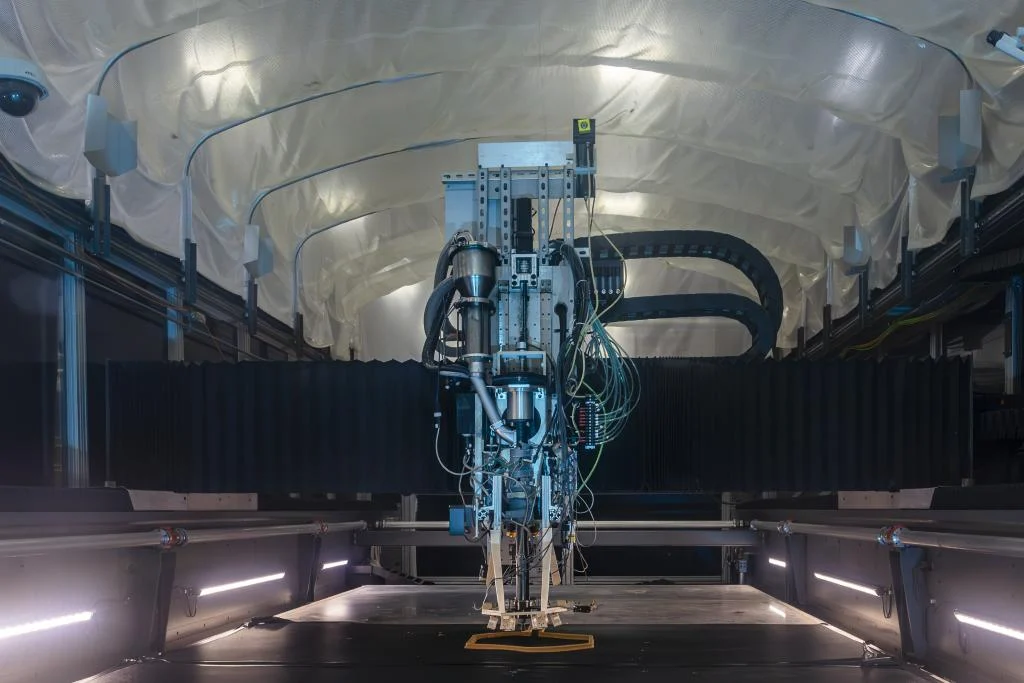
At the core of ORNL’s innovation is an advanced controller integrated with a suite of sensors. These sensors meticulously track the precise position of the robotic nozzle, the speed at which material is being deposited, and the temperature of the molten plastic as it is dispensed. To augment this data, the research team incorporated a ring of low-cost thermal cameras strategically positioned around the printing nozzle. These cameras provide continuous thermal imaging of the deposited plastic as it cools, offering a detailed, real-time temperature profile.
The system leverages computer vision, a sophisticated branch of artificial intelligence that empowers machines to interpret and understand visual information. This AI capability enables the ORNL-developed controller to analyze the live-streamed thermal images, precisely identifying the location and temperature of the molten material. When the controller detects any deviation from the target temperature—a critical factor for ensuring proper layer adhesion and structural integrity—it automatically intervenes. The system dynamically adjusts the printing speed, allowing each layer to reach the optimal cooling temperature before the next layer is applied. This precise control over the cooling process is essential for maintaining the intended shape of the printed part and ensuring robust bonding between successive layers, thereby minimizing the likelihood of print failures and material waste.
A Chronology of Innovation: From Fault Detection to Autonomous Correction
This latest advancement builds upon a rich history of research in additive manufacturing at ORNL. A foundational study, conducted in collaboration with Purdue University and the University of Maine (UMaine), demonstrated the efficacy of combining thermal imaging with statistical modeling to enhance fault detection in large-scale 3D printing. This earlier work laid the groundwork for identifying potential issues by analyzing temperature patterns during the printing process.

More recently, researchers from the University of Tennessee-Knoxville and ORNL further validated this approach, proving its capability to reliably detect deviations in print speeds as small as 15% from programmed settings. While these earlier projects focused on automated fault recognition, the new system represents a significant leap forward by integrating real-time error correction. This evolution signifies a transition from passive monitoring to active, intelligent intervention, fundamentally transforming the reliability and autonomy of LFAM processes.
The development of this real-time correction system involved several key stages:
- Initial Research and Concept Development: Building on prior work in thermal imaging for fault detection.
- Sensor Integration and Calibration: Equipping the robotic nozzle with a comprehensive array of temperature and positional sensors, including the thermal camera array.
- AI Algorithm Development: Creating the computer vision algorithms to interpret thermal data and identify deviations.
- Controller Design: Developing the sophisticated controller capable of processing sensor data and issuing real-time commands to adjust printing parameters.
- System Testing and Validation: Conducting rigorous tests with progressively larger and more complex print jobs to demonstrate the system’s effectiveness. This included printing a hexagon larger than a truck tire to simulate real-world, full-scale applications.
- Refinement and Optimization: Iteratively improving the system’s responsiveness and accuracy based on testing results.
Demonstrating Real-World Performance
The effectiveness of the new system was vividly demonstrated during a recent test. Researchers initiated a print job for a large hexagonal component at a deliberately low print speed. This initial setting resulted in the deposited material being approximately 30% cooler than the optimal temperature required for proper fusion with the next layer. Crucially, the ORNL controller detected this significant temperature drop through its thermal imaging system. In response, the system automatically increased the print speed to ensure that subsequent layers maintained the ideal temperature for correct fusion. This real-time adjustment showcased the system’s ability to proactively manage printing parameters and prevent potential defects before they manifest.
Kris Villez, the lead researcher on the project, described the system’s operation as akin to human intuition: "It controls the process almost like a human would: by observing and nudging the setting until it reaches the desired outcome." This analogy highlights the adaptive and responsive nature of the automated controller.
Chris O’Brien, a graduate student at the University of Tennessee who collaborated on the project, emphasized the system’s precision and versatility. He stated that the tool can detect and correct temperature variations of just a few degrees, a level of accuracy that is paramount given that temperature fluctuations are a primary cause of ruined 3D printed parts. Furthermore, O’Brien noted a significant advantage over some existing monitoring systems: "Unlike some monitoring systems, ORNL’s controller does not need retraining for every new design, saving time and computing power while increasing flexibility." The system is designed to be universally compatible with any large-area composite printer, any type of plastic, and any shape, underscoring its broad applicability.
Implications for U.S. Manufacturing and Beyond
The implications of this technological breakthrough for American manufacturing are substantial. By automating error detection and correction in LFAM, the system directly addresses critical challenges that have historically limited the widespread adoption of large-scale additive manufacturing for complex, high-value parts.
Enhanced Efficiency and Reduced Waste
The ability to prevent print failures in real-time translates directly into significant reductions in material waste and production time. In traditional LFAM, a single failed print can represent hundreds or thousands of dollars in wasted materials and hours of lost production time. The ORNL system’s proactive approach minimizes these losses, making large-scale 3D printing a more economically viable option for serial production and custom manufacturing.

Strengthened Domestic Competitiveness
As U.S. manufacturers increasingly look to additive manufacturing for producing everything from infrastructure components to advanced aerospace parts, the reliability and cost-effectiveness of these processes become paramount. This new system enhances domestic competitiveness by enabling the production of high-quality, custom parts more efficiently and affordably. It reduces reliance on offshore manufacturing for complex components and fosters innovation within the U.S. industrial base.
Enabling New Applications
The enhanced reliability and precision offered by the ORNL system open doors for new applications previously deemed too risky or costly for large-scale 3D printing. This could include advanced aerospace structures, customized medical implants, complex architectural elements, and resilient components for defense applications. The flexibility of the system, which does not require retraining for new designs, further accelerates the adoption of AM for rapidly evolving product development cycles.
Digital Twin Technology for Risk-Free Innovation
The model also incorporates machine learning to create a "digital twin" of the physical printing process. A digital twin is a virtual replica that mirrors the real-world system, allowing for risk-free experimentation with new shapes and materials. This capability enables researchers and manufacturers to simulate and optimize printing parameters in a virtual environment before committing to physical production, further accelerating innovation and reducing development costs.
Official Reactions and Future Vision
The U.S. Department of Energy, through its Advanced Materials and Manufacturing Technologies Office, has recognized the significance of this work. Funding for the project underscores the government’s commitment to advancing domestic manufacturing capabilities through cutting-edge research and development.
Looking ahead, lead researcher Kris Villez articulated an ambitious vision for the future of automated manufacturing: "There is a vast opportunity space to make these machines more intelligent and more responsive. In the end, we’d love this to work like baking bread: You set the oven temperature, put in your dough, and return when the timer goes off to see if it’s done. You don’t have to monitor the oven temperature in real time throughout the baking." This aspiration highlights the ultimate goal of achieving fully autonomous, set-and-forget manufacturing processes, freeing human ingenuity for higher-level problem-solving and innovation.
Other key contributors to this project include ORNL researchers Katie Copenhaver and Alex Roschli, whose expertise was instrumental in bringing this advanced system to fruition. Their collective efforts, supported by federal funding, signal a significant step forward in the quest for highly intelligent and responsive additive manufacturing solutions. The successful integration of sophisticated sensing, artificial intelligence, and real-time control mechanisms marks a pivotal moment in the evolution of large-scale 3D printing, promising to reshape manufacturing landscapes across various industries.