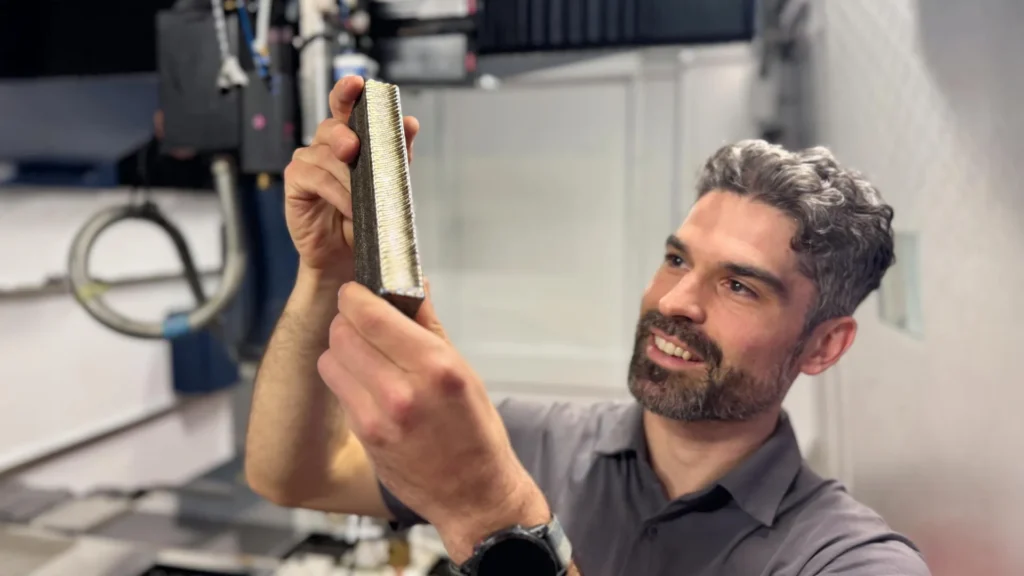
Engineers from RMIT University in Melbourne, Australia, have achieved a significant breakthrough in additive manufacturing with the development of a novel 3D-printable titanium alloy that promises to be approximately one-third cheaper than currently utilized titanium alloys. This innovation, detailed in a provisional patent application and a recent publication in the esteemed journal Nature Communications, has the potential to revolutionize industries ranging from aerospace to medical devices by addressing critical cost and performance barriers.
A Paradigm Shift in Titanium Alloying for Additive Manufacturing
The core of this groundbreaking development lies in the RMIT team’s ingenious approach to alloy composition. Traditionally, high-performance titanium alloys, particularly those used in additive manufacturing, rely on elements like vanadium. However, the increasing cost and fluctuating availability of vanadium have presented a persistent challenge for widespread adoption. The RMIT engineers have successfully circumvented this issue by substituting vanadium with more readily available and cost-effective alternative materials. This strategic alteration not only drives down production costs but, as research indicates, also enhances the mechanical properties of the resulting printed components.
Ryan Brooke, a PhD candidate at RMIT’s Centre for Additive Manufacturing (RCAM) and lead author of the study, highlighted the limitations of existing titanium alloys in the context of advanced manufacturing techniques. "3D printing allows faster, less wasteful, and more tailorable production," Brooke explained. "Yet, we’re still relying on legacy alloys like Ti-6Al-4V that don’t allow full capitalization of this potential. It’s like we’ve created an aeroplane and are still just driving it around the streets." He emphasized that the development of new alloy formulations is crucial to fully unlock the transformative capabilities of 3D printing. "New types of titanium and other alloys will allow us to really push the boundaries of what’s possible with 3D printing, and the framework for designing new alloys outlined in our study is a significant step in that direction."
The Science Behind the Innovation: A New Framework for Alloy Design
The research outlines a novel methodology for the selection of alloying elements, meticulously designed to optimize for both time and cost savings while leveraging the unique advantages of emerging 3D printing technologies. This systematic approach has yielded an alloy that not only reduces production expenses but also exhibits superior printing characteristics. Crucially, the new alloy avoids the formation of undesirable columnar microstructures – elongated, column-shaped grains that can lead to uneven mechanical properties and compromised performance in 3D-printed parts. Instead, it prints more uniformly, contributing to enhanced structural integrity and predictable performance.
"By developing a more cost-effective formula that avoids this columnar microstructure, we have solved two key challenges preventing widespread adoption of 3D printing," stated Brooke. He recently completed market validation through CSIRO’s ON Prime program, engaging directly with representatives from the aerospace, automotive, and MedTech industries. "What I heard loud and clear from end users was that to bring new alloys to market, the benefits have to not just be minor incremental steps but a full leap forward, and that’s what we have achieved here," he asserted. The RMIT team’s alloy not only boasts a uniform grain structure and reduced costs but also demonstrates improved strength and ductility – a combination of properties that represents a substantial leap forward.
Quantifiable Benefits and Industry Impact
The economic implications of this discovery are substantial. While the specific alloy composition remains undisclosed for commercial reasons, testing has confirmed that it is approximately 29% cheaper to produce than standard titanium alloys. This cost reduction, coupled with enhanced performance, positions the new alloy as a highly attractive option for industries where material costs and component reliability are paramount.
The aerospace sector, for instance, is a prime candidate for this innovation. The demand for lightweight yet incredibly strong materials is constant, driven by the need for fuel efficiency and enhanced payload capacity. 3D printing offers the ability to create complex, optimized geometries that are difficult or impossible to achieve with traditional manufacturing methods. By making high-performance titanium more accessible and predictable for 3D printing, RMIT’s alloy could enable the production of lighter, stronger, and more intricate aerospace components, from engine parts to structural elements.
Similarly, the medical device industry stands to benefit immensely. Titanium is widely used in implants and prosthetics due to its biocompatibility and strength. The ability to 3D print customized medical devices with enhanced mechanical properties at a lower cost could lead to more affordable and effective healthcare solutions. This includes patient-specific implants, surgical instruments, and even advanced prosthetics that offer improved functionality and comfort.
A Foundation for Future Innovations
The RMIT study not only presents a new alloy but also establishes a valuable framework for the design of future metallic alloys for additive manufacturing. This framework provides a clearer pathway for predicting the printed grain structure of metallic alloys, a critical factor in determining their mechanical behavior. By understanding and controlling the microstructural evolution during the printing process, engineers can more effectively tailor alloys for specific applications, pushing the boundaries of what is achievable with additive manufacturing.
The Path Forward: Commercialization and Collaboration
RMIT University has taken the crucial step of filing a provisional patent for its innovative approach, signaling its commitment to commercializing this technology. The university is actively exploring commercial opportunities and is seeking strategic partnerships to further develop and scale up the production of this low-cost, high-performance titanium alloy.
Professor Mark Easton, the corresponding author of the study and a key figure at RCAM, expressed enthusiasm for the alloy’s prospects while emphasizing the need for collaborative development. "We are very excited about the prospects of this new alloy, but it requires a team from across the supply chain to make it successful," Professor Easton stated. "So, we are looking for partners to provide guidance for the next stages of development." This call for collaboration underscores the university’s strategic vision to move beyond laboratory research and translate scientific discovery into tangible industrial applications.
Samples of the new alloy were produced and rigorously tested at RMIT’s state-of-the-art Advanced Manufacturing Precinct, a facility equipped with cutting-edge technology and expertise in additive manufacturing. This infrastructure has been instrumental in validating the alloy’s properties and demonstrating its potential.
Addressing Industry Demands: A Leap Forward
The development aligns perfectly with the expressed needs of industry end-users. As highlighted by Brooke’s market validation efforts, the demand is for innovations that offer significant, rather than incremental, improvements. The RMIT titanium alloy appears to meet this criterion by simultaneously addressing cost, performance, and manufacturing challenges. The ability to produce stronger, more ductile titanium with a uniform grain structure at a reduced cost represents a substantial leap forward in additive manufacturing capabilities.
The implications of this research extend beyond the immediate benefits of the new alloy. The established framework for alloy design could accelerate the development of a new generation of advanced materials tailored for 3D printing across a wide spectrum of metallic alloys. This could lead to a broader transformation in how complex components are designed and manufactured, fostering greater efficiency, sustainability, and innovation across multiple sectors. As the additive manufacturing landscape continues to evolve, RMIT’s pioneering work in titanium alloy development stands as a testament to the power of scientific ingenuity in shaping the future of industry.