Machine-tool provider CNC Solutions has unveiled a groundbreaking "Technology Package," an integrated solution designed to revolutionize complex CNC-class robot applications by overcoming the long-standing limitations of traditional teach-in methods. This innovative system, built upon the synergistic integration of ENCY Robot offline programming software, Beckhoff Automation’s advanced motion controllers, and Stäubli’s high-precision industrial robots, empowers manufacturers to tackle highly intricate tasks like multi-axis milling, abrasive sanding, and high-speed laser or plasma cutting with unprecedented accuracy and efficiency. The launch marks a significant stride in bridging the gap between flexible robotics and the demanding precision of Computer Numerical Control (CNC) machinery, allowing robots to function with the consistency and control previously reserved for dedicated machine tools.
The Evolving Landscape of Industrial Automation and the Challenge of Complexity
For decades, industrial robots have been indispensable in manufacturing, primarily excelling in repetitive, often simpler, tasks such as pick-and-place operations. These applications typically rely on "teach-in" methods, where operators manually guide a robot through a sequence of points, recording each position for subsequent playback. While effective for basic automation, this approach quickly becomes impractical and inefficient when confronted with the exponential complexity of modern CNC-class workloads. Processes like milling, grinding, deburring, and intricate cutting operations demand the management of millions of discrete motion points, far exceeding the capacity for manual teaching and adjustment.
The advent of Computer-Aided Manufacturing (CAM) software transformed traditional CNC machine tools, enabling engineers to design complex geometries and automatically generate precise toolpaths. However, integrating this level of CAM-driven precision with the inherent flexibility of industrial robots has historically presented a significant hurdle. Robots, designed for versatility, often lacked the rigid control architecture and trajectory planning capabilities required for true CNC precision. This disparity meant that many advanced manufacturing applications, particularly those requiring continuous path control over complex surfaces, remained out of reach for robotic automation, leading to bottlenecks, inconsistent quality, and substantial downtime during programming and commissioning.
CNC Solutions’ Vision and the Genesis of the "Technology Package"
CNC Solutions, a prominent machine-tool provider with a rich history of supporting increasingly complex projects, recognized this growing disparity. Over the years, their engagements spanned multi-axis milling, abrasive sanding, and high-speed trimming, consistently pushing the boundaries of what traditional automation could achieve. They observed that conventional controller-centric methods, which typically involved proprietary robot programming languages and limited CAM integration, were proving inadequate for the sophisticated demands of today’s production environments. The vision was clear: a workflow that seamlessly connected CAM design, comprehensive cell simulation, and the precise, high-speed control of a robot, essentially enabling the robot to perform like a CNC machine tool.
The development of the "Technology Package" was an evolutionary process, reflecting years of accumulated expertise and a deep understanding of manufacturing challenges. The CNC Solutions team embarked on a journey to create a solution where offline programming could translate directly into reliable robot instructions, eliminating the costly and time-consuming practice of online programming. This involved meticulously refining robot axis motions and control algorithms until the commissioning process achieved the consistency and predictability of a dedicated CNC machine. The objective was to provide integrators and end-users with a standardized, robust solution that minimized setup time, reduced delivery risk, and maximized operational efficiency.
The Tripartite Foundation: Software, Motion Control, and Robotics

The "Technology Package" is engineered around three meticulously integrated core components, each contributing a vital layer of functionality and precision:
-
ENCY Robot: The Brains of Offline Programming and Simulation
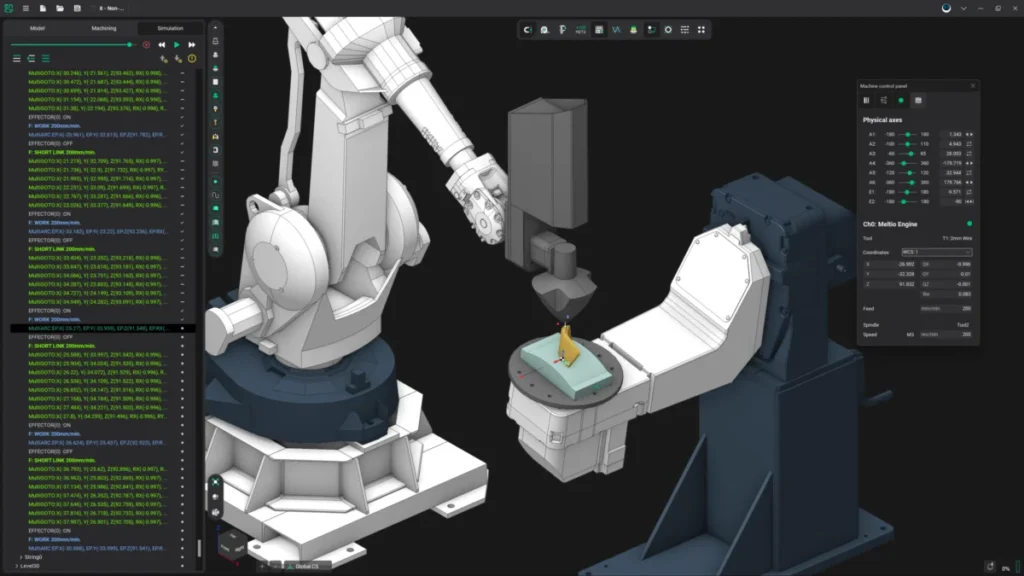
At the heart of the solution is ENCY Robot, a sophisticated offline programming software developed by ENCY. This platform serves as the central intelligence for path calculation and cell simulation, effectively moving the entire programming and validation process away from the production floor. Instead of dedicating valuable robot uptime to online programming, ENCY allows engineers to design, simulate, and optimize robot movements in a virtual environment.ENCY’s capabilities are extensive, covering:
- Toolpath Calculation: Generating precise trajectories from CAM data, ensuring optimal material removal or processing.
- Full Cell Simulation: Creating a digital twin of the entire robotic cell, including the robot, workpiece, fixtures, and periphery. This allows for comprehensive testing of movements and interactions.
- Axis Limit Checks: Ensuring that robot movements remain within their physical operational envelopes.
- Singularity Avoidance: Proactively identifying and resolving kinematic singularities, which can cause unpredictable robot behavior and damage.
- Full Collision Control: Detecting potential collisions between the robot, tools, workpiece, and cell components, preventing costly accidents and downtime.
- Zero-Code Digital-Twin Builder: Facilitating the rapid creation of accurate digital twins without requiring extensive programming expertise.
- Extensive Libraries: Providing access to a vast array of robot models, tools, and processing strategies, accelerating setup.
ENCY’s ability to manage code paths and models internally ensures transparent system behavior and reliable translation of CAM strategies into precise robot instructions. This robust simulation environment converts what was traditionally commissioning time into productive, validated preparation time, significantly reducing the "time to first good part." The software was specifically chosen for its broad functionality, capable of handling everything from simple two-axis tasks to highly complex multi-axis cells, providing a scalable and versatile programming layer.
-
Beckhoff Automation: Precision Motion Control at the Core
The second critical component is the Beckhoff motion controller, which translates the complex trajectories generated by ENCY into real-time, high-precision robot movements. Beckhoff Automation is renowned for its PC-based control technology, offering a powerful, open, and scalable platform for industrial automation. In this solution, the Beckhoff controller operates the Stäubli robot with standard CNC commands, mirroring the familiar control paradigms of traditional machine tools.This integration provides:
- CNC-Level Precision and Speed: The Beckhoff controller executes trajectories with the accuracy and dynamic performance expected from high-end CNC machines, crucial for demanding applications like precision milling and laser cutting.
- Standard CNC Commands: Utilizing familiar G-code and M-code equivalents, including feeds, modes, and frames, simplifies programming and operation for those accustomed to CNC environments.
- Open Architecture: Beckhoff’s TwinCAT automation software provides a unified platform for control, motion, and robotics, allowing for flexible integration with other systems and external axes.
- Real-time Performance: The controller’s deterministic real-time capabilities ensure precise synchronization of all robot axes and external equipment, critical for maintaining path accuracy at high speeds.
The Beckhoff motion cabinet, complete with a CNC-style Human-Machine Interface (HMI) and a handheld pendant, offers operators an intuitive and familiar interface, further blurring the lines between robotic and traditional CNC operation.
-
Stäubli Robotics: The Robotic Arm of Precision and Reliability
Executing the precise paths generated by ENCY and controlled by Beckhoff are Stäubli industrial robots. Stäubli is globally recognized for its high-performance, high-precision robotic arms, particularly suited for demanding industrial environments. Their robots contribute several critical attributes to the "Technology Package":- Exceptional Precision and Repeatability: Stäubli robots are engineered for extreme accuracy and consistent performance, essential for applications requiring tight tolerances and reproducible results. This characteristic is paramount for achieving CNC-level quality.
- Sealed Construction: The robots feature robust, sealed designs that resist dust, debris, and liquids. This is particularly vital for abrasive applications like grinding, sanding, and deburring, where environmental contaminants can compromise robot longevity and performance.
- Seamless Integration: Stäubli robots are designed for tight integration with external control systems, allowing the Beckhoff controller to manage their trajectory execution flawlessly. This "CNC-style motion layer" enables the robot to follow complex paths with smooth, continuous movements.
- Compact Design and High Payload-to-Weight Ratio: Stäubli robots offer a powerful combination of reach, payload capacity, and agility, making them versatile for a wide range of applications while maintaining a relatively small footprint.
The combination of Stäubli’s mechanical excellence with the sophisticated control from Beckhoff and the intelligent programming from ENCY forms a robust and high-performing system capable of handling the most challenging manufacturing tasks.

Bridging the Gap: Overcoming Traditional Limitations and Enabling New Applications
The core innovation of CNC Solutions’ "Technology Package" lies in its ability to effectively bridge the gap between flexible robotics and rigid CNC precision. By integrating these three powerful technologies, the solution addresses several critical limitations of previous approaches:
- Eliminating Online Robot Teaching: The most significant bottleneck in complex robotic applications has traditionally been the need for extensive online programming. This involves stopping production, bringing a programmer to the robot, and manually teaching points or writing code, leading to significant idle time for expensive machinery. ENCY’s comprehensive offline programming and simulation capabilities entirely eliminate this need, converting commissioning time into productive design and validation time.
- Managing Millions of Motion Points: Traditional teach-in methods are simply incapable of handling the sheer volume of data required for intricate CNC paths. The integrated stack, leveraging CAM-driven toolpaths and Beckhoff’s powerful motion controller, can manage and execute millions of precise motion points, enabling complex surface finishing, intricate cutting, and multi-axis machining operations.
- Ensuring Consistency and Quality: Manual teaching often results in inconsistencies due to human variability. The automated, CAM-to-robot workflow ensures highly repeatable and consistent execution, leading to superior product quality and reduced scrap rates.
- Democratizing Complex Robotic Tasks: By providing a CNC-like motion layer and a user-friendly programming environment, the solution lowers the barrier to entry for integrators and manufacturers who may have previously shied away from high-precision robotic applications due to their complexity. Expertise can now be focused on process knowledge, fixturing, and end-effectors, rather than mastering vendor-specific robot languages.
Key Features and Benefits for Integrators and End-Users
The "Technology Package" is designed for seamless integration and immediate productivity, offering a comprehensive suite of features:
- Plug-and-Play Wiring: A streamlined single-cable connection links the Stäubli robot to the Beckhoff controller, simplifying installation and reducing wiring complexity.
- Predefined and Machine-Tuned Processes: The package comes with validated starting points for common applications such as milling, grinding, deburring, polishing, blasting (wet/dry), plasma and laser cutting/welding, waterjet cutting, cladding, painting, cleaning, and gluing. These pre-configured processes significantly reduce setup and optimization time.
- Standard CNC-Style Controls: Operators benefit from familiar CNC-style modes (Auto, Manual, Home), feed overrides for real-time speed adjustments, and integrated emergency-stop logic, ensuring safe and intuitive operation. Manual moves using encoder-wheel controls are also supported, providing fine-tuned control when needed.
- Robust I/O and Communication: The system provides comprehensive process I/O and communication interfaces for seamless integration into plant networks, including OPC UA connectivity for secure, vendor-independent data exchange, aligning with Industry 4.0 principles.
- Advanced Calibration and Compensation: Recognizing that real-world cells often deviate from ideal specifications, the package includes critical features that typically require extensive manual setup:
- Absolute, TCP, and Frame Calibration: Ensuring accurate spatial alignment of the robot, tool center point, and workpiece coordinate systems.
- Singularity Management: Proactively avoiding kinematic singularities that can cause unpredictable robot behavior.
- Real-time Path Adjustments: Allowing for minor, dynamic modifications to the robot path based on sensor feedback or process variations.
- Tool-Wear Compensation: Automatically adjusting toolpaths to account for tool degradation, maintaining consistent process quality over time.
These features collectively contribute to a dramatically reduced "time to first good part," allowing teams to concentrate on process optimization, fixturing, and tooling, rather than struggling with robot programming and calibration.
Industry Impact and Future Outlook
The commercial availability of CNC Solutions’ "Technology Package" marks a pivotal moment for industrial automation. By offering a stable, proven solution that enables robots to operate like machine tools, it unlocks higher-value applications that many integrators previously avoided due to the limitations of traditional teach-in methods. Precision milling, intricate trimming, and high-quality sanding operations can now be reliably automated, expanding the scope of robotic applications across diverse industries, from aerospace and automotive to medical devices and general manufacturing.
The implications are far-reaching:
- Increased Productivity and Efficiency: Reduced commissioning time, higher robot uptime, and consistent process quality lead to significant gains in overall productivity.
- Enhanced Quality and Precision: The CNC-level accuracy and repeatability ensure superior product quality, meeting the stringent demands of modern manufacturing.
- Reduced Project Risk and Warranty Exposure: The standardized, pre-validated solution minimizes the need for custom development, lowering project risks, reducing delivery timelines, and decreasing warranty claims. Integrators can reuse validated project elements rather than developing from scratch.
- Acceleration of Industry 4.0 Adoption: The integration of digital twins, offline programming, real-time data exchange via OPC UA, and advanced control capabilities aligns perfectly with the principles of Industry 4.0, fostering smart factories and connected manufacturing ecosystems.
- Empowering the Workforce: By abstracting away the complexities of robot-specific programming languages, the solution allows engineers and technicians to leverage their existing CNC and process knowledge more effectively, fostering a more skilled and adaptable workforce.
In conclusion, the "Technology Package" from CNC Solutions, powered by ENCY, Beckhoff, and Stäubli, represents a paradigm shift in robotic automation. It not only addresses the immediate needs of manufacturers facing increasingly complex workloads but also paves the way for a future where industrial robots seamlessly integrate into high-precision production environments, driving innovation and competitiveness across the global manufacturing landscape. This integrated approach is set to redefine the capabilities of industrial robotics, making advanced manufacturing more accessible, efficient, and precise than ever before.