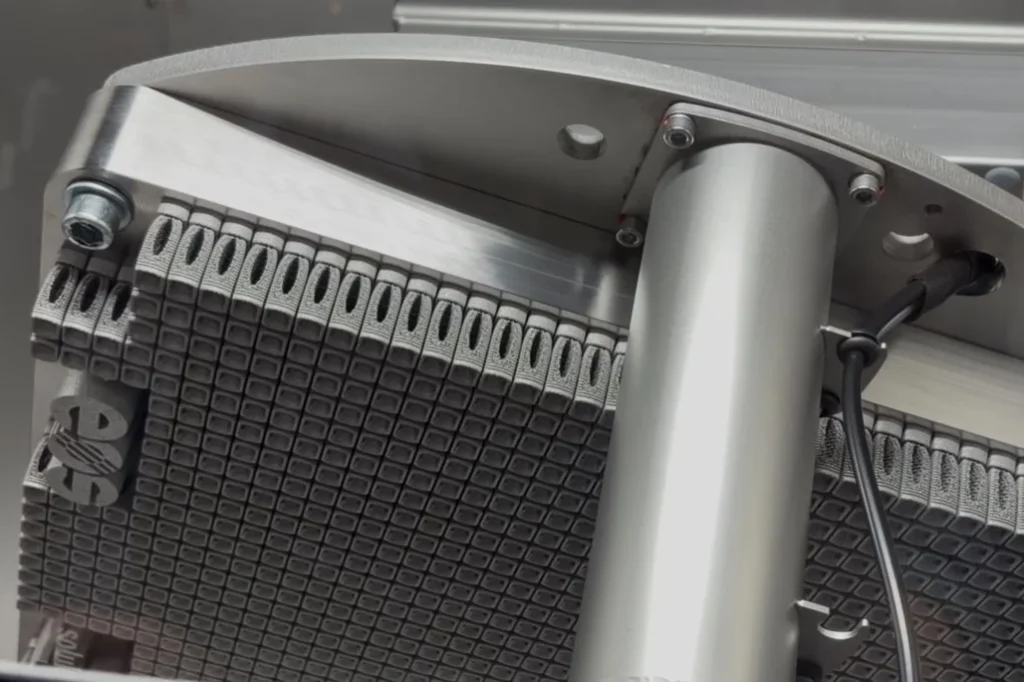
This week’s featured image showcases a significant advancement in additive manufacturing post-processing, with 1,100 meticulously arranged titanium spinal cages undergoing precise powder removal on an EOS M4 Onyx build plate. This operation is facilitated by a specially adapted version of Solukon’s SFM-AT350-E depowdering system, a testament to the growing synergy between leading AM hardware manufacturers and specialized post-processing solution providers. The pictured system has been ingeniously reconfigured to seamlessly integrate with the EOS M4 Onyx 3D printer, a machine boasting an impressive build volume of 17.7 x 17.7 x 15.7 inches, including the build plate. This development marks a crucial step forward in streamlining the production workflow for high-precision, complex metal components, particularly within the demanding medical device sector.
Solukon, a globally recognized authority in automated depowdering solutions for additive manufacturing, unveiled this specialized iteration of its SFM-AT350-E system at the prominent RAPID + TCT 2026 trade show, held in Boston, Massachusetts. The SFM-AT350-E, in its standard configuration, is specifically engineered to handle smaller parts with a Z-height under 250 mm and weighing up to 100 kg. The titanium spinal cages featured in this demonstration perfectly align with these specifications, highlighting the system’s capability to efficiently process intricate, high-value medical implants. These spinal cages were manufactured using Laser Powder Bed Fusion (LPBF) technology, a cornerstone of metal additive manufacturing known for its ability to create complex geometries with excellent material properties, making it ideal for orthopedic applications where precise fit and biocompatibility are paramount.
The core of the SFM-AT350-E system’s efficacy lies in its sophisticated use of high-frequency, self-regulating ultrasonic vibration. This advanced method is instrumental in dislodging and removing residual powder from intricate internal channels and complex external surfaces of the 3D printed parts. Ultrasonic vibration is achieved through a process known as piezoelectric excitation. This phenomenon involves the conversion of electrical energy into mechanical energy. When a voltage is applied across a piezoelectric material, it undergoes deformation, resulting in precise and rapid vibrations. In the context of the SFM-AT350-E, these vibrations are carefully calibrated to agitate the powder particles without causing any damage to the delicate structures of the spinal cages. While the exact cleaning time is inherently dependent on the specific geometric complexity and density of a given part, the depowdering of these 1,100 titanium spinal cages was completed in approximately 30 minutes. This rapid turnaround time is a critical factor in accelerating production cycles and reducing overall lead times for medical device manufacturers.
The Significance of Integrated Depowdering Solutions
The integration of Solukon’s depowdering system with the EOS M4 Onyx printer is more than just a logistical upgrade; it represents a strategic move towards a more holistic and efficient additive manufacturing ecosystem. Traditionally, post-processing steps like depowdering have often been a bottleneck, requiring manual intervention, specialized equipment, and significant labor. By reconfiguring the SFM-AT350-E to directly accommodate the build plate and dimensions of the EOS M4 Onyx, Solukon has effectively bridged a critical gap in the production chain. This seamless integration minimizes the need for manual transfer of parts, reducing the risk of contamination, damage, or loss. It also allows for a more streamlined workflow, where parts can be depowdered immediately after printing, potentially even while the next build is in progress, thereby maximizing machine utilization and overall throughput.
The EOS M4 Onyx itself is a powerful industrial metal 3D printer known for its robustness and advanced capabilities. Featuring a multi-laser architecture (often referred to as a "six-laser architecture" in some contexts, although the exact number can vary by specific model and configuration), it offers high power density and rapid build speeds, crucial for producing complex metal components efficiently. Its sophisticated design also incorporates advanced features such as a new filtration system designed to capture and neutralize hazardous condensate, ensuring a safer operating environment. The printer’s substantial build volume makes it suitable for a wide range of applications, from aerospace components to intricate medical implants. The ability of Solukon’s depowdering system to be adapted to this platform underscores the growing demand for specialized post-processing solutions that can keep pace with the advancements in 3D printing hardware.
The Role of Ultrasonic Vibration in Advanced Depowdering
The technical underpinnings of Solukon’s depowdering technology are rooted in a deep understanding of material science and mechanical engineering. Ultrasonic vibration, as employed by the SFM-AT350-E, offers several distinct advantages over conventional depowdering methods. Traditional methods might involve compressed air jets or manual brushing, which can be time-consuming, labor-intensive, and prone to leaving residual powder in hard-to-reach areas. Furthermore, these methods can sometimes lead to surface damage or deformation of delicate parts.
Ultrasonic vibration, on the other hand, generates high-frequency oscillations that create localized cavitation and micro-jetting effects within the powder bed. This action effectively loosens and fluidizes the unbound powder, allowing it to be easily drawn away by a vacuum system. The piezoelectric excitation, the process by which electrical energy is converted into mechanical vibration, allows for precise control over the frequency and amplitude of the vibrations. This level of control is essential for tailoring the depowdering process to the specific material and geometry of the parts being processed, ensuring both thorough cleaning and component integrity. For medical implants like spinal cages, where surface finish and freedom from residual powder are critical for biocompatibility and patient safety, this precision is non-negotiable. The ability to achieve such a high level of cleanliness in a relatively short timeframe significantly impacts the overall efficiency and cost-effectiveness of producing these vital medical devices.
Background Context: The Evolving Landscape of Medical AM
The application of additive manufacturing in the medical field has been steadily growing over the past decade, driven by the technology’s ability to create patient-specific implants, complex surgical instruments, and anatomical models for pre-surgical planning. Titanium alloys, due to their excellent biocompatibility, high strength-to-weight ratio, and corrosion resistance, are among the most widely used materials for orthopedic implants, including spinal cages. The ability to design and manufacture these implants with highly customized geometries tailored to individual patient anatomy is a major advantage of AM.
However, the intricate lattice structures and internal channels often incorporated into these designs present significant challenges during the post-processing phase, particularly in ensuring complete removal of the uncured or unbound powder. Inadequate powder removal can lead to several problems:

- Biocompatibility Issues: Residual powder particles can act as foreign bodies within the human body, potentially triggering inflammatory responses or infections.
- Mechanical Failure: Trapped powder can compromise the structural integrity of the implant, leading to premature failure or fracture.
- Sterilization Challenges: Powder trapped within internal voids can hinder effective sterilization processes, posing a risk of microbial contamination.
The development and deployment of advanced depowdering solutions like Solukon’s SFM-AT350-E are therefore not merely about efficiency; they are critical for ensuring the safety, efficacy, and reliability of AM-produced medical devices. The timing of this announcement at RAPID + TCT 2026, one of the largest and most influential additive manufacturing trade shows globally, underscores the industry’s focus on addressing these post-processing challenges and advancing the maturity of AM as a viable production method for critical applications.
Supporting Data and Industry Trends
The market for additive manufacturing in the healthcare sector is experiencing robust growth. According to recent industry reports, the global medical 3D printing market size was valued at USD 2.0 billion in 2022 and is projected to expand at a compound annual growth rate (CAGR) of over 20% from 2023 to 2030. This growth is fueled by increasing demand for personalized medicine, advancements in 3D printing materials and technologies, and growing acceptance of AM in clinical settings.
Within this broader market, metal additive manufacturing for implants and surgical tools represents a significant segment. The demand for titanium implants, in particular, remains high due to their proven track record and desirable properties. The ability to produce these implants at scale and with consistent quality is essential for meeting market demand. The efficiency gains offered by integrated depowdering solutions directly contribute to scaling up production. For instance, if a traditional manual depowdering process for 1,100 spinal cages took several hours per batch, and this new automated system completes it in 30 minutes, the potential increase in throughput is substantial. This translates to shorter lead times for patients awaiting critical surgical procedures and increased competitiveness for manufacturers.
Furthermore, the increasing sophistication of 3D printer designs, such as the EOS M4 Onyx with its advanced laser systems and build volume, necessitates equally sophisticated post-processing solutions. The trend is clearly moving towards fully integrated and automated production lines where each step is optimized for speed, precision, and quality. Solukon’s proactive approach in reconfiguring its systems to align with leading printer platforms is a strategic move that positions the company as a key enabler of this integrated manufacturing future.
Official Responses and Industry Reactions (Inferred)
While direct quotes from Solukon or EOS representatives regarding this specific configuration might not be publicly available in the initial announcement, the development itself speaks volumes about their collaborative approach and commitment to addressing industry needs.
From Solukon’s perspective (inferred): This reconfigured SFM-AT350-E represents a significant product evolution, demonstrating Solukon’s dedication to providing tailored solutions for specific printer platforms. The company likely views this as a strategic partnership, enabling them to better serve users of high-end industrial metal printers like the EOS M4 Onyx. Their focus on ultrasonic technology underscores their belief in its superiority for delicate and complex geometries, a critical factor for medical applications.
From EOS’s perspective (inferred): EOS, as a leading provider of industrial 3D printing solutions, likely welcomes such integrations that enhance the overall value proposition of their machines. By working with specialized partners like Solukon, EOS can assure its customers that their advanced printing capabilities are complemented by equally advanced post-processing solutions. This integration simplifies the adoption of metal AM for critical applications, as it addresses a key pain point in the production workflow. The company’s emphasis on quality and efficiency in its printers is mirrored by the advancements in depowdering offered by Solukon.
From the Medical Device Manufacturing Community (inferred): Manufacturers of titanium spinal cages and similar orthopedic implants would likely view this development with great interest. The promise of faster, more consistent, and more reliable depowdering for complex parts produced on high-end machines like the EOS M4 Onyx directly addresses their operational challenges. The reduction in manual labor, improved part quality, and potential for increased throughput are significant economic and quality drivers. This innovation contributes to the broader trend of industrializing metal additive manufacturing for serial production of high-value components.
Broader Impact and Implications
The successful integration of Solukon’s SFM-AT350-E with the EOS M4 Onyx has several far-reaching implications for the additive manufacturing industry, particularly in the medical sector:
- Accelerated Adoption of Metal AM for Medical Devices: By streamlining the depowdering process, a crucial and often challenging step, this development helps to reduce the barriers to entry and scale-up for medical device manufacturers looking to leverage metal AM. This could lead to a faster adoption rate for complex implants and instruments.
- Enhanced Quality and Safety of Medical Implants: The precision and thoroughness of ultrasonic depowdering, coupled with the high accuracy of LPBF printing on machines like the EOS M4 Onyx, contribute to the production of safer, more reliable, and higher-quality medical implants. This directly benefits patient outcomes.
- Increased Production Efficiency and Cost-Effectiveness: Automation and integration of post-processing steps lead to significant reductions in labor costs, processing times, and potential for errors. This makes metal AM a more economically viable option for serial production of medical components.
- Paving the Way for Future Integrations: This successful collaboration sets a precedent for further integration between AM hardware manufacturers and specialized post-processing solution providers. As AM technologies continue to evolve, the demand for seamless, end-to-end production workflows will only increase.
- Technological Advancement in Depowdering: The continuous refinement of ultrasonic vibration technology, as demonstrated by Solukon’s adaptations, pushes the boundaries of what is possible in automated powder removal, enabling the processing of increasingly complex and delicate geometries.
In conclusion, the reconfigured Solukon SFM-AT350-E system, designed to work in tandem with the EOS M4 Onyx 3D printer, represents a significant leap forward in the post-processing of metal additive manufactured parts. The efficient depowdering of 1,100 titanium spinal cages in just 30 minutes underscores the power of integrated solutions and advanced technologies like ultrasonic vibration. This development is not just a technical achievement; it is a crucial step in enabling the wider adoption of additive manufacturing for critical applications, promising to enhance the quality, safety, and accessibility of advanced medical devices. The future of additive manufacturing is increasingly defined by such synergistic collaborations that optimize the entire production lifecycle.