Breguet, a name synonymous with horological innovation and historical significance, has unveiled the Classique Tourbillon 7357, a contemporary iteration of a timepiece that redefined precision in the late 18th century. This new release marks a significant moment for the brand, coinciding with the 225th anniversary of Abraham-Louis Breguet’s patenting of the tourbillon, a complication designed to counteract the effects of gravity on the accuracy of pocket watches. The ref. 7357 is not merely a reissue; it is a thoughtful evolution, incorporating modern engineering and refined aesthetics while remaining deeply rooted in the spirit of its illustrious predecessors.
A Legacy Reimagined: The Genesis of the 7357
The story of the Breguet Classique Tourbillon 7357 is intrinsically linked to the brand’s pioneering work in the late 20th century. In the 1980s, under the creative direction of Daniel Roth, Breguet introduced a series of tourbillon wristwatches that were groundbreaking for their time. The ref. 3350 and its successor, the ref. 3357, were particularly noteworthy. These watches, often rendered in precious metals like white gold, featured a distinctive tourbillon bridge design and intricate guilloché work, setting a new standard for elegant, complicated timepieces. However, like many watches from that era, they possessed certain characteristics that, with the benefit of hindsight and evolving consumer preferences, could be improved.
The ref. 7357 emerges as Breguet’s direct response to these considerations. Addressing collector feedback and embracing advancements in watchmaking technology, the brand has sought to create a tourbillon that is both a faithful homage and a superior modern timepiece. At its core, the ref. 7357 honors the compact dimensions of its vintage counterparts. It boasts a modest 35mm diameter, an 8.9mm thickness, and a 43mm lug-to-lug measurement, dimensions that speak to a preference for classic proportions in an era often dominated by larger watches. Furthermore, the inclusion of 30 meters of water resistance offers a practical enhancement for everyday wear.
Design Evolution: A Harmonious Blend of Tradition and Modernity
The visual narrative of the Breguet Classique Tourbillon 7357 is one of subtle yet impactful evolution. The dials showcase a meticulous craftsmanship, featuring a "Clous de Paris" guilloché pattern at the center of the chapter ring and a radiating barleycorn pattern around the edge, emanating from the tourbillon at six o’clock. The circular brushed areas for the indications are adorned with raised Breguet numerals, meticulously pad-printed to achieve a refined, almost painted appearance.

A significant departure from earlier models is the reimagined tourbillon bridge. Instead of the full-length, symmetrical bridge that spanned the dial in the ref. 3350 and 3357, the 7357 features a more organically shaped bridge that gracefully curves with the dial and case. While the author of the original article expresses a nostalgic preference for the older design, the new configuration offers a more integrated aesthetic that aligns with contemporary haute horlogerie trends. The tourbillon cage itself is designed to display time intervals, with three hands rotating within the cage to indicate 20-second increments, adding a layer of functional artistry.
The case construction also sees notable enhancements. The introduction of downturned lugs, which slope elegantly into the case, is a direct response to a frequently cited critique of vintage Breguets. The straight, slender lugs of earlier models, while historically accurate, could lead to a flatter, less comfortable fit on the wrist. The new lugs, soldered into the case on production models, promise a more ergonomic and secure wearing experience, a sentiment echoed by the brand’s previous release, the Souscription Anniversary piece.
However, this evolution is not without its points of contemplation. The return of the iconic coin-edge midcase, a hallmark of Breguet’s classic designs, is a welcome addition for many. Yet, the author expresses a personal reservation regarding the combination of the new lugs and the coin edge, suggesting that the former design, with its straight lugs, offered a more potent evocation of the "Empire" style Breguet watches. This divergence highlights the subjective nature of aesthetic appreciation in the realm of haute horlogerie, where historical fidelity and modern comfort can sometimes present a delicate balance.
Mechanical Prowess: An Updated Heartbeat
Beneath the exquisite dialwork lies a significantly re-engineered movement. While the caliber 558.1T served as the foundation for its predecessors, the new ref. 7357 is powered by the revamped caliber 187. This updated movement incorporates 41% new parts, reflecting a commitment to enhancing performance and reliability. Despite the upgrades, the fundamental beat rate of 2.5Hz remains, a characteristic that contributes to the characteristic cadence of the tourbillon’s rotation.
The ref. 7357 is a manually wound timepiece, and the act of winding it is described as a pleasant experience, though not a primary selling point. However, the enhanced features are substantial. The power reserve has been extended to a more practical 60 hours, a significant improvement over older iterations. Furthermore, the watch benefits from improved antimagnetism, a crucial consideration in modern horology. This is achieved through the integration of a Breguet Nivachron balance spring and a silicon pallet lever, materials chosen for their inherent resistance to magnetic fields and their stability under varying conditions.

A Study in Finishes and Materials
Breguet offers the Classique Tourbillon 7357 in two distinguished material variants: Breguet gold and platinum. The proprietary Breguet gold, an alloy comparable to Lange’s Honeygold or AP’s Sand Gold, is used not only for the case but also extends to the tourbillon bridge, plates, cage, dial ring, and nameplates. This homogenous application of the alloy lends a unique warmth and continuity to the aesthetic. The Breguet gold dial itself is finished with an opaline treatment, adding a subtle sheen.
The platinum version offers a different, cooler allure. Here, the platinum is used throughout the case and components, complemented by an anthracite dial finish. This provides a sophisticated and understated presentation. The prices reflect the precious materials and the complexity of the movement: $184,800 for the Breguet gold version and $203,300 for the platinum model. While these figures place the ref. 7357 at the pinnacle of luxury watchmaking, they are positioned competitively within the market for such exclusive complications.
The "Dent de Vaulion" Guilloché: A Nod to the Jura Landscape
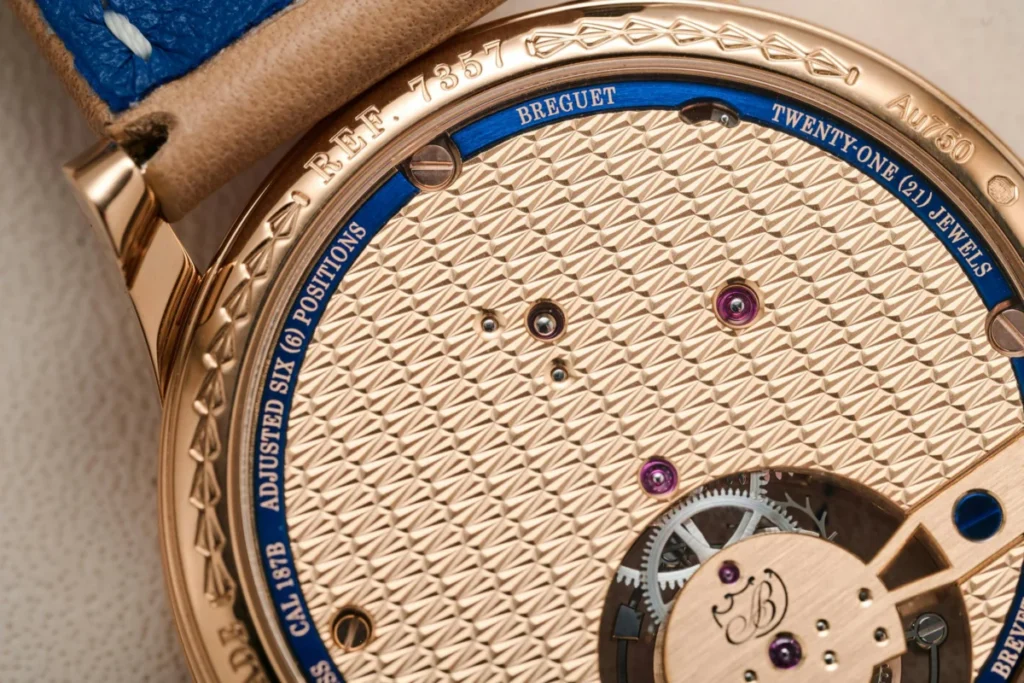
A particularly captivating detail of the ref. 7357 lies in its movement finishing, specifically the unique guilloché pattern on the rear. This intricate engraving, named "Dent de Vaulion," draws inspiration from the mountain overlooking Breguet’s headquarters in the Vallée de Joux. The pattern is said to represent the rippling effect of wind on the Lac de Joux, as viewed from the summit of the mountain. This detail underscores Breguet’s mastery of guilloché work, a craft where the brand continues to be a leading practitioner, capable of creating new and intricate patterns. The bridge at the rear is horizontally brushed, a refined contrast to the earlier models where a thin mainplate section supported the cage. Engraved on the movement’s edge are the historical "Brevet du 7 Messidor An 9" (referencing the French Revolutionary Calendar date of the tourbillon patent) and "Tourbillon 225e Anniversaire," further cementing the watch’s commemorative significance.
Market Context and Comparative Analysis
The introduction of the Breguet Classique Tourbillon 7357 prompts a comparative analysis with other high-end tourbillons and its own historical predecessors.
Daniel Roth Tourbillon
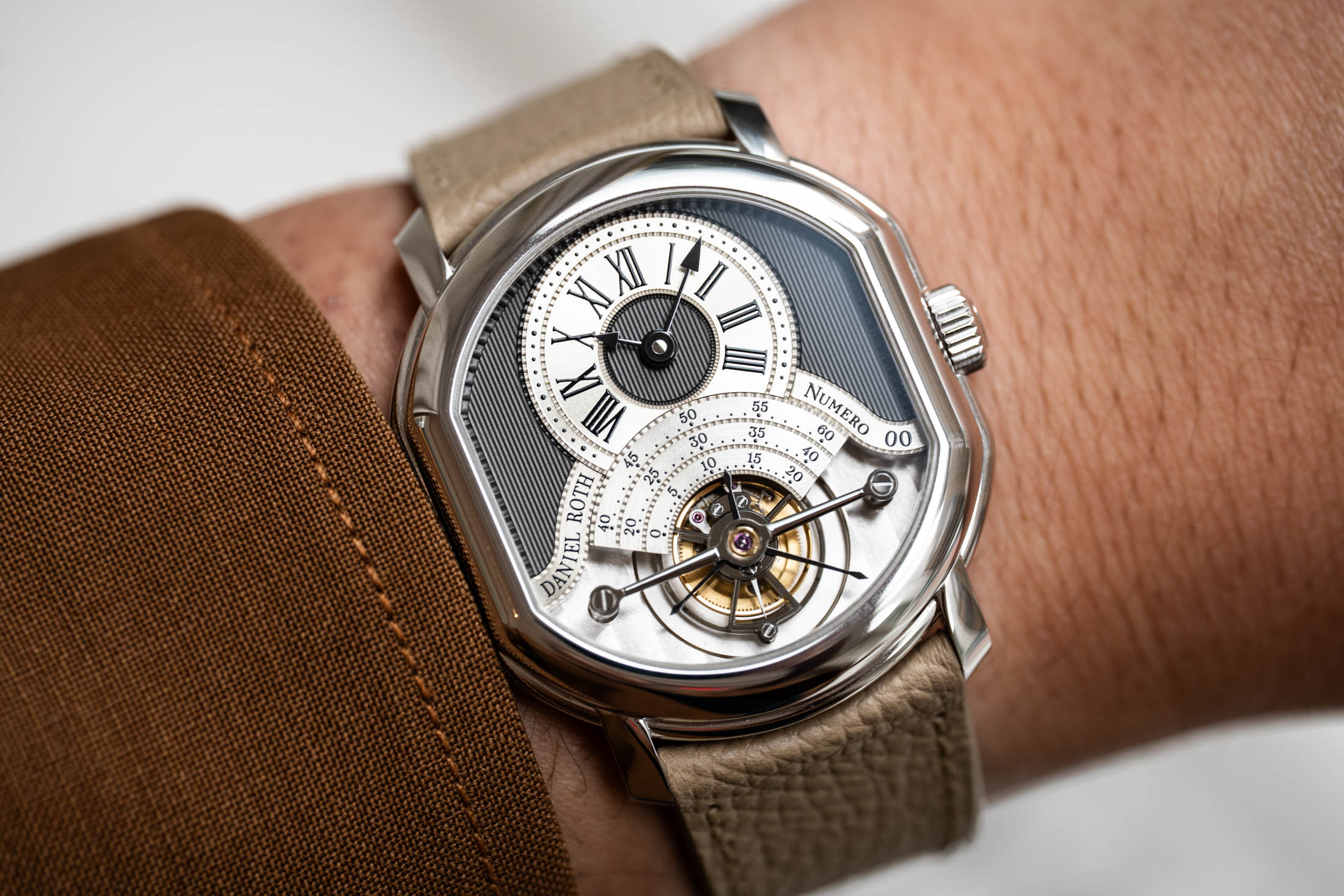
The Daniel Roth Tourbillon, a brand also deeply connected to the legacy of Abraham-Louis Breguet through its founder, presents a compelling comparison. Roth’s recent offerings in rose gold and platinum share a common horological ancestor with the Breguet 7357. While the Breguet measures 35mm, the Daniel Roth is slightly larger at 38.6mm x 35.5mm and an equally slim 8.9mm thickness. However, the rectangular/elliptical shape of the Roth offers a distinct wearing experience, often perceived as smaller on the wrist than a round watch of similar dimensions. The platinum Daniel Roth Tourbillon is priced around $230,000, placing it above the Breguet 7357, though availability might be more limited for the Roth.
Vacheron Constantin Traditionnelle Tourbillon
Vacheron Constantin’s Traditionnelle Tourbillon represents another significant player in the dress tourbillon segment. While its 41mm diameter and 10.4mm thickness make it larger than the Breguet, it offers an automatically wound movement with a peripheral rotor, enhancing convenience. The shared movement with the Overseas version adds a layer of practicality, and the three-day power reserve is another advantage. The Vacheron Constantin Traditionnelle Tourbillon is priced at approximately $173,000 in rose gold and $200,000 in platinum, making it a competitive option in terms of value for its specifications.
The Original Breguet 3350/3357
The most direct comparison remains with the original Breguet ref. 3350 and 3357. These vintage pieces offer a significant cost advantage, with examples available for under $70,000 for the ref. 3350 and even less for the ref. 3357. For collectors prioritizing historical authenticity and a lower entry price point, these vintage models are undoubtedly attractive. However, the ref. 7357 offers tangible improvements in modern watchmaking: enhanced accuracy, a longer power reserve, improved antimagnetism, greater water resistance, and a more comfortable case design with downturned lugs. The older models, with their straight lugs, wear flatter on the wrist, which some may find less comfortable for extended periods.
Broader Implications: A Strategic Move for Breguet
The release of the Breguet Classique Tourbillon 7357 is more than just the introduction of a new watch; it signifies a strategic direction for the brand. In an era where many luxury watch brands are chasing market share with larger, sportier, and trend-driven designs, Breguet’s decision to revisit and refine a classic dress tourbillon speaks to a commitment to its heritage and a deep understanding of its discerning clientele.
The "sticker shock" associated with the pricing is acknowledged, but the article posits that this is a broader industry challenge, exacerbated by currency fluctuations. Breguet’s approach demonstrates a willingness to listen to collector feedback, a crucial element in maintaining brand loyalty and relevance. By offering a modern interpretation of an iconic timepiece that addresses the perceived shortcomings of its predecessors, Breguet is not merely reinventing the wheel; it is enhancing a masterpiece. This approach, characterized by quiet confidence and a focus on intrinsic quality rather than ephemeral trends, positions Breguet as a brand that prioritizes enduring value and horological excellence. The ref. 7357 stands as a testament to this philosophy, a watch that can confidently sit apart, occupying a space at the pinnacle of refined watchmaking.