From the monumental astronomical clocks adorning Tudor English palaces to the delicate pendant watches favored by Victorian queens, the intricate art of timekeeping has long served as a potent symbol of power, prestige, and technological prowess within Europe’s royal courts. This exploration delves into the captivating evolution of clocks and watches meticulously crafted for monarchs, charting their journey as reflections of royal tastes, imperial ambitions, and groundbreaking innovations. Through the lens of masterful craftsmanship, artistic expression, and profound historical significance, we uncover how these regal timepieces not only measured the hours but also chronicled the passage of dynasties and the rise and fall of empires.

King George III, who reigned from 1760 to 1820, stands as a compelling figure in this narrative. Far from being solely defined by his later struggles with mental illness, he was a monarch deeply immersed in the intellectual currents of his time, possessing a profound interest in science, particularly astronomy, horology, mathematics, and natural philosophy. Recognized as one of Britain’s most scientifically inclined monarchs, George III commissioned significant horological instruments and actively supported scientific institutions throughout his reign, a testament to his enlightened patronage.
While his grandfather, King George II, also commissioned notable horological pieces, George III’s own fascination appears to have been nurtured through his upbringing. His father, Frederick, Prince of Wales, was keen to imbue his son with a comprehensive education in astronomy, mathematics, and the natural sciences, enlisting esteemed tutors such as John Stuart, Earl of Bute. Although Frederick tragically died before ascending to the throne, his dedication to his son’s intellectual development laid crucial groundwork. The magnificent Grand Orrery, crafted by the renowned London maker Thomas Wright in 1733, predates George III’s reign but exemplifies the sophisticated astronomical instruments that were already integral to royal collections and likely influenced the young prince. This intricate orrery, a mechanical model of the solar system, served not only as a scientific tool but also as a grand display of understanding and mastery over the cosmos, a fitting object for a future monarch.

The Enlightenment era, a period of intellectual ferment that swept across Europe during the 18th century, provided the fertile ground for George III’s scientific inclinations. This epoch celebrated reason, empirical observation, and scientific discovery as the paramount drivers of human progress. Visionary thinkers challenged established dogmas, pushing the boundaries of astronomy, mathematics, and physics, and emphasizing precise measurement and meticulous observation as the keys to unlocking the universe’s secrets. George III wholeheartedly embraced this spirit, becoming a notable patron of astronomy, notably supporting figures like William Herschel, the discoverer of Uranus. His personal commitment extended to establishing his own observatory at Kew, which commenced operations in 1769, a tangible symbol of his dedication to celestial observation and scientific inquiry.
Within this broader cultural milieu, George III’s passion for horology and the science of timekeeping found a natural and essential place. Accurate clocks were no longer merely exquisite objects of craftsmanship; they were indispensable tools for navigation, crucial for astronomical calculations, and vital for the expanding global ambitions of the British Empire. The era of George III’s reign coincided with the twilight of "The Golden Age of English Clockmaking," a period when London, in particular, stood as the undisputed global leader in horological innovation and production.

This period saw the royal family utilizing their connections to leading artisans to bestow prestigious gifts upon those who served them faithfully. A poignant example of this practice is the miniature table clock, often referred to as the Barnard Tompion clock. Believed to have been crafted for Queen Anne around 1708, it was later presented by King George II to Andrew Stone, a significant figure who served as Royal Secretary and was also a tutor to the future King George III. This act of gifting underscores the intricate web of patronage, education, and royal favor that characterized the era.
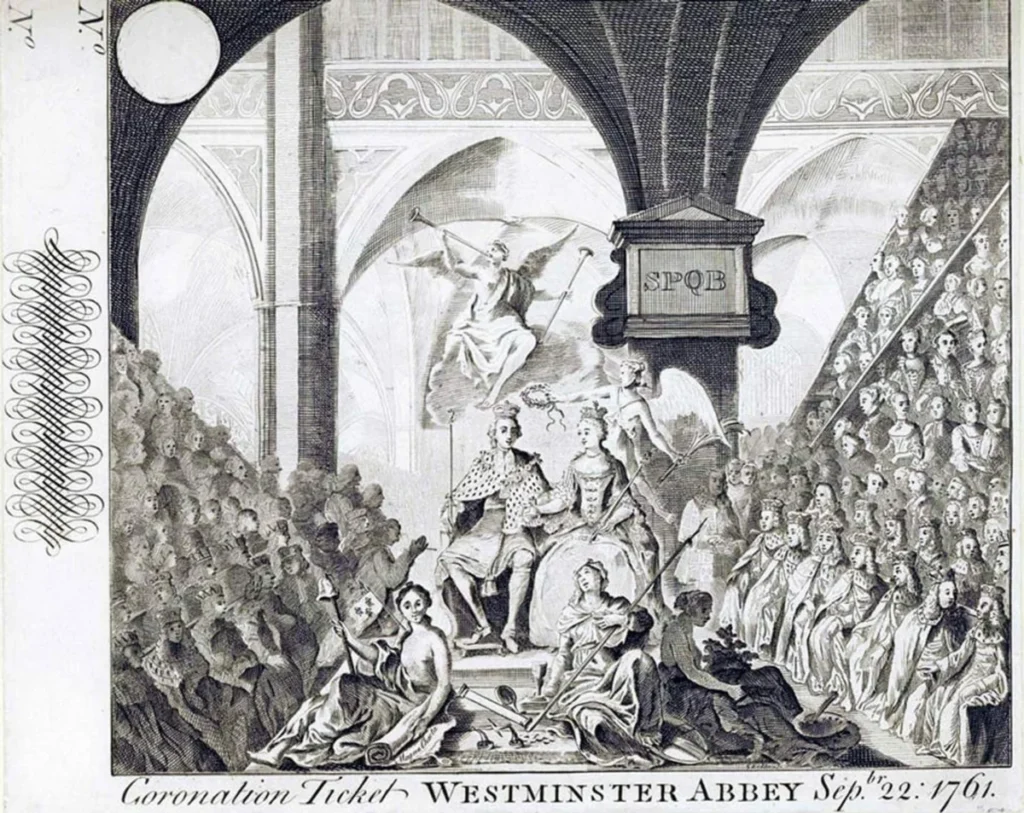
George III’s coronation on September 22, 1761, alongside his bride, Queen Charlotte of Mecklenburg-Strelitz, whom he had married just two weeks prior, was a spectacle of unparalleled grandeur. The ceremony, estimated to have cost approximately £70,000 (equivalent to roughly £13 million today), was a meticulously orchestrated display of royal power and legitimacy. It featured elaborate processions through London, lavish feasts, and magnificent pageantry, drawing immense crowds and becoming one of the most significant state events in living memory. While it captivated many, the sheer extravagance and occasional disorganization, including reports of unruly behavior and seating chaos within Westminster Abbey, also drew criticism from some contemporaries, highlighting the complex reception of such grand public displays.

The exceptional regulator clock, created in 1780 for King George III by Royal Clockmaker Benjamin Vulliamy (1747-1811), exemplifies the pinnacle of horological achievement during this period. Housed in a polished mahogany case with a glass top and side plate for viewing the mechanism, this clock was destined for the King’s Observatory at Kew. A regulator clock is characterized by its extreme accuracy, designed for precise measurements, particularly in conjunction with astronomical observations. This Vulliamy clock incorporated cutting-edge technologies of its time, including rollers acting as low-friction bearings for the wheelwork, minimizing the need for lubrication. Furthermore, it featured John Harrison’s pioneering grasshopper escapement, a design renowned for its efficiency and minimal friction, and Harrison’s ingenious gridiron pendulum, engineered to compensate for temperature fluctuations and maintain unparalleled timekeeping accuracy.
Complementing the Vulliamy regulator clock, the impressive eight-foot radius Mural Arc, crafted by Jeremiah Sisson in London in 1770, was another vital instrument for King George III’s private observatory. This substantial brass and iron instrument, fixed to the observatory wall, was used to precisely measure the altitude of celestial bodies, such as stars and the sun, a fundamental practice in astronomical research. The arc is meticulously divided with a 142-degree scale, bearing the signature "J. Sisson. London. 1770," signifying its origin and purpose.

George III’s intellectual pursuits extended beyond astronomy and horology. He was affectionately known as the "Farmer King" or "Farmer George" due to his profound personal interest in agriculture and rural life. This fascination was deeply intertwined with the broader Agricultural Revolution sweeping Britain, a period of significant advancements in farming techniques. He actively promoted innovations such as crop rotation, soil improvement strategies, and the selective breeding of livestock, demonstrating a commitment to practical scientific application and the betterment of his kingdom.
His patronage extended to the Royal Observatory at Greenwich, influencing the establishment of Greenwich Mean Time, and supporting scientific societies, which in turn fostered new inventions. Among these was a magnificent philosophical table, crafted for the King by George Adams of Fleet Street, London, between 1761 and 1762. This table served as the centerpiece for a sophisticated mechanics apparatus designed for the King shortly after his accession to the throne. It featured a sectional pillar, wooden rings, and an ivory-scaled vertical board for pendulum experiments, accompanied by a range of attachments for diverse scientific demonstrations. These included apparatus for studying the isochronous pendulum, collisions, and central forces, embodying the Enlightenment’s emphasis on empirical investigation and the understanding of physical principles. George III’s genuine passion for knowledge fueled his correspondence with leading scientists and his support for the Royal Society, underscoring his active role in advancing British technological achievements. He understood that a nation governed by precise timekeeping was a nation poised for progress and prosperity, and his patronage was instrumental in cultivating horology as a cornerstone of his vision for a modern, enlightened monarchy.

George III’s foresight extended to the critical challenge of navigation and empire-building, recognizing the paramount importance of accurate timekeeping at sea. He became a staunch advocate for the development of marine chronometers and their crucial role in solving the longitude problem. This support accelerated technological advancements with significant geopolitical implications. The quest to determine longitude at sea, a challenge that had vexed mariners for centuries, ultimately revolutionized global navigation. John Harrison dedicated nearly forty years of his life to this endeavor, developing a series of increasingly sophisticated marine timekeepers, culminating in his H1 through H5 models. Despite sea trials proving the efficacy of his H4 chronometer in accurately determining longitude, Harrison faced persistent skepticism and delays in receiving recognition and the promised prize money from the Board of Longitude.
It was King George III’s personal intervention that ultimately ensured Harrison received his due. In 1772, Harrison, then in his late seventies, presented his H5 timekeeper to the King at his private Kew Observatory. George III personally oversaw rigorous testing of the H5’s accuracy over a ten-week period. The trials confirmed its extraordinary precision, with the clock losing a mere third of a second per day, a feat unparalleled at the time. Outraged by the Board of Longitude’s treatment of Harrison, the King famously declared, "By God, Harrison, I shall see you righted!" This royal endorsement compelled the government to award Harrison a significant portion of the prize money before his death in 1776 at the age of 82, marking a pivotal moment in the history of navigation and horology.

Beyond his scientific pursuits, George III possessed a discerning eye for exquisite craftsmanship and artistry. His appreciation for the finest horological work is evident in the beautiful watch he gifted to his wife, Queen Charlotte. This "cylinder escapement ‘dumb repeater’" watch, created by Conyers Dunlop and featuring an enamelled gold case signed by George Michael Moser, dates from the period 1740-1760. A "dumb repeater" watch is a sophisticated mechanism that indicates the time by striking hammers against the inside of the case, creating a tactile vibration rather than an audible chime, a subtle precursor to modern silent notifications. This exquisite piece, a testament to both technical ingenuity and refined aesthetics, is a cherished item within the Clockmakers’ Museum at the Science Museum in South Kensington.
Perhaps one of the most historically significant and technically advanced timepieces of its era was Breguet No. 1297, a remarkable pocket watch owned by King George III. Crafted by the legendary Swiss watchmaker Abraham-Louis Breguet around 1808, this timepiece was among the earliest tourbillon watches ever created. The tourbillon mechanism, invented by Breguet, was designed to counteract the effects of gravity on the watch’s escapement, thereby enhancing its accuracy. This particular four-minute tourbillon watch’s carriage completed a full rotation every four minutes, a deviation from the more common one-minute rotation, adding to its uniqueness. It also incorporated a rare Robin escapement, a thermometer calibrated to indicate "Heat, Temperate, Cold," a stop-slide for timing seconds, and a power reserve indicator, all indicative of its exceptional complexity and functionality.

During the Napoleonic Wars, when trade between Britain and France was severely restricted, Breguet had to sell the watch discreetly to avoid arousing suspicion due to its French origin. Consequently, the watch bears no visible maker’s signature on its dial or movement, a rare precaution for such a masterpiece, though it is signed "No. 1297 Recordon, London." Louis Recordon, a Swiss-born watchmaker, served as Breguet’s agent in London, representing his interests. It is believed that while in England, the watch may have been signed by Recordon and housed in an English case possibly crafted by Louis Comtesse. Upon its return to Paris, Breguet likely installed the tourbillon carriage, which he personally signed. The engine-turned decoration of the case, coupled with English inscriptions on the dial, would have conferred an authentic English identity upon the watch, facilitating its discreet return to London. Celebrated as "a masterpiece fit for a king," this watch is distinguished by its royal patronage, technical ambition, inclusion of a thermometer, English inscriptions, rare escapement, and exquisite decorative work. Acquired by King George III in 1808 for 4,800 French francs (equivalent to approximately £200,000 today), it was later sold at Sotheby’s in 2020 for £1.6 million, a testament to its enduring value and historical significance.
King George III is widely acknowledged as the progenitor of the modern Royal Collection. His acquisitions were not solely for personal gratification but were intended as invaluable national and educational resources, encompassing major works of art, scientific instruments, horological pieces, books, and furniture. He established the Royal Library and championed the systematic cataloging and preservation of these items, laying the foundational principles for the esteemed Royal Collection Trust that exists today.

In the subsequent century, Queen Victoria and Prince Albert significantly expanded and developed this collection, transforming it into a publicly accessible national treasure. Their efforts, particularly through displays at royal residences like Windsor Castle and Buckingham Palace, continue to be enjoyed by the public. George III’s enduring legacy in the fields of science and horology stems from his genuine intellectual curiosity and his unwavering commitment to precision. His patronage and scientific engagement played a pivotal role in positioning Britain as a leading nation in scientific investigation and horological excellence during the late 18th and early 19th centuries, a period of profound innovation and imperial expansion.