In a groundbreaking discovery that is rewriting our understanding of galactic evolution and the behavior of cosmic giants, NASA’s Neil Gehrels Swift Observatory has captured definitive evidence of a supermassive black hole, seemingly adrift from its usual celestial harbor, violently tearing apart and consuming a star. This rare event, observed far from the typically crowded galactic center, has led astronomers to dub the black hole an "orphan," a designation that highlights its unusual and profound displacement. The observation marks the first time such a cataclysmic stellar demise has been witnessed at such an extreme distance from a galaxy’s core, offering unprecedented insights into the dynamic lives and potential migration of these enigmatic cosmic entities.
A New Technique for Unveiling Hidden Giants
The significance of this discovery extends beyond the spectacle of a stellar meal. It validates a novel technique for identifying supermassive black holes that have strayed from their expected positions within galaxies. "We were looking for these star-shredding events as a way to find otherwise invisible supermassive black holes wandering away from the galactic cores where they usually reside," explained Robert Stein, a research fellow at The University of Maryland, College Park, and NASA’s Goddard Space Flight Center in Greenbelt, Maryland. "With this discovery, which is one of just a couple that have been confirmed so far, we’ve validated a new technique and can use it to hunt for more." This breakthrough, detailed in a paper led by Stein and published on July 27th in The Astrophysical Journal Letters, opens a new frontier in the search for these elusive gravitational behemoths.
The Cosmic Catastrophe: A Star’s Violent End
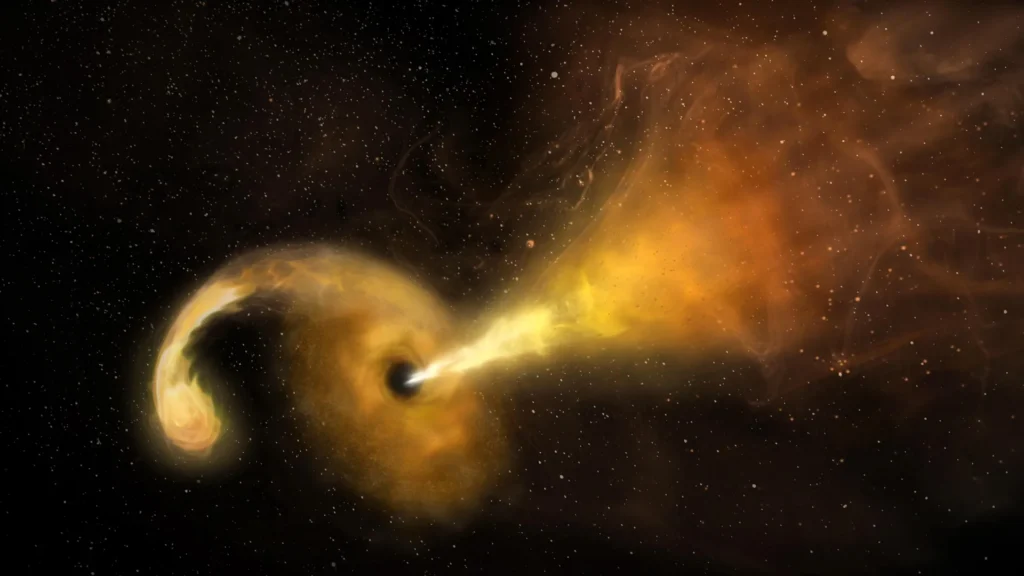
The spectacular event began as an exceptionally bright flare of light, a cosmic siren call that alerted astronomers to a stellar disaster unfolding. A star, venturing too close to the immense gravitational pull of a supermassive black hole, was ripped apart in a phenomenon known as a tidal disruption event (TDE). This destructive process, where the black hole’s gravity overwhelms the star’s own self-gravity, results in the star being stretched and torn into streams of plasma that then spiral into the black hole, releasing immense amounts of energy.
The black hole at the heart of this cosmic drama possesses a mass approximately one million times that of our Sun. Its presence was first hinted at in November 2025 when the Zwicky Transient Facility (ZTF), a wide-field sky survey operated by the Palomar Observatory in Southern California, detected an anomalous burst of light. This unusual optical signature emanated from a galaxy located approximately 750 million light-years from Earth.
The ZTF survey is a relentless observer of the night sky, cataloging hundreds of thousands of transient events each evening. Amidst this constant barrage of cosmic signals, a new artificial intelligence algorithm developed for the ZTF project flagged the event. "Out of the half million flashes ZTF detects each night, our new artificial intelligence algorithm automatically recognized a flare that looked a lot like a tidal disruption event, despite its unusual location in the outskirts of a galaxy," Stein remarked. This AI-driven detection was crucial, as the flare’s off-center location would have likely caused it to be overlooked by traditional search methods that focus on galactic nuclei.
For several months following its initial detection, the flare continued to dominate the electromagnetic spectrum, outshining its host galaxy in ultraviolet light. At its zenith, the event radiated with an astonishing brilliance equivalent to approximately 10 billion suns, a testament to the sheer power unleashed as the star was consumed.
Swift’s Crucial Role in Confirmation
Following the initial detection by ZTF, a global network of observatories was mobilized to scrutinize the extraordinary cosmic flare. The Southern Astrophysical Research (SOAR) telescope in Chile played a vital role by studying the spectrum of the light emitted. Its observations revealed characteristic signatures consistent with a tidal disruption event, providing crucial spectroscopic evidence.
However, the true confirmation came from NASA’s Neil Gehrels Swift Observatory, a space-based observatory uniquely equipped to observe in wavelengths inaccessible from the ground, particularly in the ultraviolet spectrum. Swift’s Ultraviolet/Optical Telescope (UVOT) was instrumental in measuring the flare’s temperature, which was estimated to be around 54,000 degrees Fahrenheit (30,000 degrees Celsius). This temperature is typical of the superheated plasma generated during a TDE.
Jonathan Carney, a doctoral student at the University of North Carolina at Chapel Hill, who obtained some of the first spectral data supporting the TDE interpretation, emphasized the collaborative nature of the discovery. "The combination of all this data helped us rule out other explanations and confidently say it’s a tidal disruption event, despite its strange location," Carney stated. The synergy between ground-based and space-based observatories, coupled with advanced analytical tools, was essential in piecing together the puzzle of this peculiar cosmic phenomenon.
The Unseen Architects: Supermassive Black Holes at Galactic Centers
Supermassive black holes, entities with masses ranging from millions to billions of times that of the Sun, are believed to reside at the heart of nearly every galaxy in the universe. These colossal gravitational anchors play a pivotal role in shaping their host galaxies. While the precise mechanisms are still under investigation, it is understood that they influence star formation and the overall structure of galaxies.
Tidal disruption events, though dramatic, are relatively infrequent within a single galaxy. Astronomers estimate that a star may stray too close to a galaxy’s central supermassive black hole to be torn apart roughly once every 100,000 years. Despite this rarity on a galactic scale, astronomers monitor millions of galaxies worldwide in an effort to capture these fleeting cosmic dramas. Current surveys are capable of detecting approximately 30 TDEs across the observable universe each year.
Prior to 2024, every confirmed TDE had been observed originating from within a galactic core. This observational bias was largely due to astronomers concentrating their search efforts in these central regions, as all known supermassive black holes were believed to be situated there. Furthermore, the sheer mass of the central black hole is critical; lighter black holes simply do not possess the gravitational might to tear apart an entire star.
The Shifting Paradigm: Black Holes on the Move
The paradigm began to shift with earlier, less extreme detections of TDEs occurring at distances of thousands of light-years from galactic centers. These discoveries encouraged astronomers to broaden their observational horizons beyond the immediate vicinity of galactic nuclei. The latest discovery, however, represents a significant leap, with the black hole observed actively consuming a star at an astounding distance of over 30,000 light-years from its galaxy’s center. This distance is comparable to the radius of the Milky Way’s galactic disk, placing the black hole firmly in the galaxy’s stellar halo.
Unraveling the Mystery: How Did the Black Hole Get There?
The unprecedented location of this supermassive black hole raises profound questions about its origin and history. How did it become so dislodged from its presumed birthplace at the galactic core? "It must have originated in a galaxy’s center, but not the one it’s in the outskirts of now," Stein posited. "We think the host galaxy’s supermassive black hole is still at its core, but the one eating the star could have started off in a small galaxy that merged with the big one we see today."
Astronomers have proposed two primary hypotheses to explain this peculiar displacement:
Scenario 1: Galactic Mergers and Gravitational Ejection
One compelling theory suggests that the supermassive black hole was once the central engine of a smaller galaxy that subsequently merged with the larger host galaxy observed today. During the chaotic process of galactic mergers, the supermassive black holes at the centers of the colliding galaxies can engage in a complex gravitational dance. In a scenario involving three or more merging galaxies, the supermassive black holes can become gravitationally locked in a struggle. This intense gravitational interaction could have ultimately ejected the lightest of these central black holes from the core of the newly formed, larger galaxy, sending it hurtling towards the galactic outskirts.
Scenario 2: The Slow Assimilation of Dwarf Galaxies
Another plausible explanation involves the ongoing process of a dwarf galaxy merging with the larger system. As the smaller galaxy is gradually assimilated into the larger one, its constituent stars and its own central supermassive black hole are drawn into the gravitational embrace of the larger galaxy. If a star from this infalling dwarf galaxy happened to stray too close to its dwarf galaxy’s own supermassive black hole, it could have triggered the observed tidal disruption event. In this scenario, the "orphan" black hole would have been the central engine of a dwarf galaxy that is still in the process of being absorbed by its larger neighbor.
These theories underscore the dynamic nature of galaxies and the intricate interplay of gravitational forces that govern their evolution. The discovery of this "orphan" black hole provides tangible evidence for these proposed mechanisms of black hole migration. "Further discoveries could reveal the origin of this apparent ‘orphan’ black hole," Stein added. "The key science question we want to answer is: How common are wandering black holes?"
Swift’s Orbital Maneuver: A Boost for Future Discoveries
The quest to answer this fundamental question and to identify more such displaced black holes may soon receive a significant boost from the Swift Observatory itself. Currently, pointed science observations with Swift’s UVOT and X-ray Telescope (XRT) instruments are temporarily suspended. The observatory is awaiting an orbital boost, a maneuver planned for this summer. "Atmospheric drag is now gradually pulling it closer to Earth. Raising Swift into a higher orbit could keep it operating for even longer," explained S. Bradley Cenko, Swift’s principal investigator at NASA Goddard.
Swift’s primary mission concluded in 2006, but its extended mission has allowed it to continue observing the universe for over two decades. This orbital adjustment is crucial for extending its operational lifespan, ensuring that it can continue its vital work. "Once it resumes normal operations, Swift could continue searching for more examples of out-of-place black holes," Cenko confirmed.
A New Era of Black Hole Hunting: Rubin and Roman Telescopes
Looking ahead, astronomers are poised to leverage the capabilities of next-generation observatories to expand the search for wandering black holes. The Vera C. Rubin Observatory, a joint project funded by the U.S. Department of Energy and the National Science Foundation, and NASA’s upcoming Nancy Grace Roman Space Telescope, are set to revolutionize this field.
The Rubin Observatory, situated in Chile, will conduct wide and deep surveys of the sky, capturing an unprecedented volume of data. Its advanced survey capabilities are expected to reveal a far larger sample of tidal disruption events than current observatories can collect, including those occurring off-center. "Rubin’s wide, deep surveys will reveal a much larger sample of tidal disruption events than current observatories are capable of collecting, including ones that are off-center," Carney stated.
Complementing Rubin’s survey power, the Roman Space Telescope, an infrared space observatory, will extend the search zone even further by observing objects at greater distances and looking back through billions of years of cosmic history. "And Roman’s space-based surveys will extend the current search zone by seeing ones that are farther away, looking back through 9 billion years of cosmic history," Carney elaborated.
By integrating data from these powerful new instruments with ongoing observations from Swift and existing ground-based observatories, scientists anticipate identifying a significant number of wandering black holes. This cumulative effort promises to build the most comprehensive census yet of the universe’s colossal black holes, offering profound insights into their formation, evolution, and distribution throughout the cosmos. The discovery of this "orphan" black hole is not just a singular event but a harbinger of a new era of astronomical exploration, where the universe’s most enigmatic inhabitants are being revealed in ever-increasing detail.