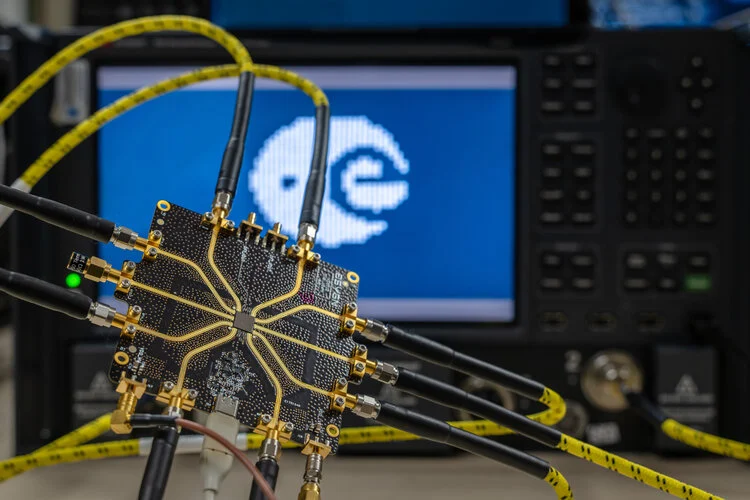
A revolution is quietly unfolding within the intricate world of electronic circuits, spearheaded by a minuscule component that promises to redefine the capabilities of satellite communication and beyond. At the heart of modern electronic circuit boards lies a miniature black chip, deceptively small yet possessing the profound ability to steer radio beams with unparalleled precision. This seemingly unassuming microchip is the linchpin for the development of phased array antennas, a technology poised to usher in an era of faster, more reliable, and more ubiquitous connectivity.
The Dawn of Electronic Beam Steering
For decades, the reliable establishment of communication links between satellites and ground terminals has been a complex engineering challenge. Traditional antennas, characterized by their bulky mechanical dishes, have relied on a physically cumbersome process of tilting and rotating to maintain a connection with their intended targets. This mechanical approach, while functional, inherently introduces limitations: slower response times, increased susceptibility to wear and tear, and a higher overall system complexity and cost.
The advent of phased array antennas has fundamentally altered this paradigm. Instead of relying on the physical movement of large antenna dishes, these advanced systems leverage the power of specialized microchips to electronically steer radio beams. The core principle behind this electronic steering lies in the precise control of the signal’s phase and amplitude. By orchestrating these fundamental properties across an array of antenna elements, a phased array antenna can effectively shape and direct a radio beam in any desired direction, all without a single moving part. This process, known as beamforming, allows for near-instantaneous redirection of communication signals, opening up a vast array of new possibilities.
Beamforming Integrated Circuits: Miniaturization Fuels Innovation
The miniaturization of these critical beamforming components has been a direct consequence of advancements in modern silicon semiconductor technologies. These sophisticated microchips, specifically designed for beamforming applications and referred to as beamforming integrated circuits (ICs), have become progressively smaller, more powerful, and more energy-efficient. This remarkable evolution has, in turn, rendered phased array antennas more compact, significantly enhancing their reliability and driving down their cost. The result is a technology that has transitioned from niche, high-cost applications to a position where it is affordable and practical for widespread deployment across a diverse spectrum of uses.
The applications of this transformative technology are far-reaching. In satellite communications, phased array antennas enable higher data throughput and more robust connections, crucial for everything from global internet access to remote sensing. For navigation systems, they offer enhanced precision and reliability. Earth observation satellites benefit from the ability to rapidly target specific regions for data collection, while ambitious space missions can utilize these advanced antennas for improved communication with deep-space probes.
Europe’s Enduring Leadership in Beamforming Technology
The European Space Agency (ESA) has long recognized the strategic importance of beamforming technology. For decades, ESA has been at the forefront of research and development in this field, consistently exploring innovative methods for electronically steering radio beams for both space-based and terrestrial applications. This sustained commitment has fostered a deep well of expertise and a proven track record of pushing the boundaries of what is technologically achievable.
"For decades, ESA has been at the forefront of beamforming technology, exploring innovative ways to electronically steer radio beams for space and terrestrial applications," stated Václav Valenta, an ESA engineer and a recognized expert in phased array technology. "Today, the focus is increasingly shifting towards highly integrated analogue and digital beamforming chips both designed and manufactured in Europe. These developments combine cutting-edge performance with the strategic advantage of a secure European supply chain."
Valenta’s statement underscores a critical shift in the industry: the growing emphasis on highly integrated solutions that combine both analog and digital functionalities on a single chip. This approach promises even greater performance gains and efficiency. Furthermore, the strategic imperative of ensuring a secure and independent European supply chain for these vital components is becoming increasingly prominent. This focus on domestic design and manufacturing not only bolsters economic sovereignty but also ensures greater control over the technology’s development and deployment, mitigating potential geopolitical risks.
Asygn: A New Generation of Beamforming Innovation
A recent and compelling demonstration of this European innovation took place at ESA’s RF Active Technology Laboratory at ESTEC, the agency’s technical heart. Here, the French company Asygn presented its latest generation of beamforming integrated circuits, showcasing a tangible leap forward in the capabilities of these miniature marvels.
To vividly illustrate the sophisticated level of control Asygn’s microchips afford over the beamforming process, the company’s engineers devised a visually striking demonstration. They presented a meticulously rendered ESA logo, composed entirely of hundreds of individually controlled dots. Each of these dots was precisely positioned by the beamformer through specific amplitude and phase settings, creating a dynamic and impactful visual representation of the technology’s fine-tuned capabilities. This artistic yet technically profound display served as a powerful testament to the precision and adaptability of Asygn’s advanced ICs.
Clement Jany, Radio Frequency business unit co-director at Asygn, elaborated on the company’s strategic approach and its impact on the industry. "By designing single-chip solutions dedicated to specific frequency bands – notably X and Ka – we achieve the very high levels of performance required for mission-critical satellite communication applications," Jany explained. The X-band (8-12 GHz) and Ka-band (26-40 GHz) are particularly important for satellite communications due to their capacity for high data rates and relatively narrow beamwidths, enabling more focused and efficient transmission.
Jany further emphasized Asygn’s commitment to simplifying the integration process for antenna manufacturers. "Our objective is to simplify system integration for phased array antenna manufacturers by delivering high-precision phase and amplitude control and an ultra-low noise figure on a single chip," he added. An ultra-low noise figure is paramount in satellite communications, as it minimizes signal degradation, ensuring clearer and more reliable data transmission, especially over vast distances.
Supporting Data and Technological Advancements
The performance metrics of these next-generation beamforming ICs are critical indicators of their potential impact. While specific figures are often proprietary, industry trends point towards significant improvements in several key areas:
- Increased Bandwidth and Frequency Agility: Modern beamforming chips are increasingly designed to operate across broader frequency ranges, offering greater flexibility for diverse communication needs and accommodating future spectrum allocations.
- Enhanced Digital Control: The integration of advanced digital signal processing capabilities allows for more complex beamforming algorithms, enabling features like adaptive beam steering, interference mitigation, and simultaneous multi-beam operation.
- Reduced Power Consumption: As the demand for mobile and compact satellite terminals grows, energy efficiency becomes paramount. New designs focus on minimizing power draw without compromising performance.
- Improved Linearity: Higher linearity in the RF signal path reduces signal distortion, which is crucial for maintaining signal integrity and maximizing data throughput, especially in congested spectral environments.
- Smaller Form Factors: The relentless drive towards miniaturization allows for the integration of phased array antennas into increasingly smaller and more constrained form factors, opening up applications on smaller satellites, drones, and even personal devices.
The development of these advanced ICs is not an isolated event but rather a culmination of years of dedicated research and development, building upon foundational principles of RF engineering and semiconductor physics. The journey from early, bulky beamforming components to the highly integrated solutions of today represents a significant technological evolution.
Broader Impact and Future Implications
The advancements showcased by Asygn and supported by ESA have profound implications for the future of connectivity and space exploration.
Enhanced Satellite Communication Networks: The widespread adoption of phased array antennas powered by these advanced ICs will lead to more robust, higher-capacity satellite communication networks. This translates to improved internet access in underserved regions, more reliable connectivity for maritime and aeronautical applications, and the enablement of new services like global IoT (Internet of Things) connectivity.
The New Space Era: The miniaturization and cost reduction of phased array antennas are critical enablers for the burgeoning "New Space" sector. Small satellites (smallsats) and constellations of satellites can now be equipped with highly capable communication systems, facilitating more frequent launches, faster data downlink, and a wider range of scientific and commercial missions.
National Security and Defense: The ability to rapidly and precisely steer radio beams has significant implications for defense applications, including secure communication, advanced radar systems, and electronic warfare capabilities. A secure European supply chain for these critical components enhances national and collective security.
Technological Sovereignty: The emphasis on designing and manufacturing these chips within Europe is a strategic move towards technological sovereignty. It reduces reliance on external suppliers, fosters domestic innovation, and creates high-value jobs within the European technology sector.
Earth Observation and Scientific Research: Faster and more agile data acquisition capabilities will revolutionize Earth observation, allowing for more timely monitoring of environmental changes, disaster response, and resource management. Similarly, space missions will benefit from more efficient and reliable communication channels for transmitting scientific data.
Chronology of Advancements
While the specific timeline for Asygn’s latest product launch is recent, the underlying technological progression can be viewed within a broader context:
- Mid-20th Century: Theoretical foundations of phased arrays are established.
- Late 20th Century: Early, large-scale phased array systems are developed, primarily for military and specialized scientific applications. These systems are often complex and expensive.
- Early 21st Century: Advances in semiconductor technology enable the miniaturization of beamforming components, leading to more compact and affordable phased array antennas. ESA begins significant investment in beamforming research.
- 2010s: Increased integration of analog and digital functions on single chips, driving down costs and improving performance. Development of dedicated beamforming ICs for specific frequency bands becomes more common.
- Present: The emergence of highly integrated, high-performance beamforming ICs designed and manufactured in Europe, exemplified by Asygn’s new generation, signifies a new era of capability and strategic independence. ESA continues to foster these developments through laboratories and technology programs.
Official Responses and Industry Perspectives
The endorsement from ESA, as articulated by Václav Valenta, highlights the agency’s strategic vision and its role as a catalyst for innovation. The successful demonstration of Asygn’s technology within ESA’s advanced laboratory environment serves as a powerful validation of the company’s capabilities and the broader European ecosystem’s strength in this domain.
Industry analysts anticipate that the availability of such advanced, European-sourced beamforming ICs will significantly accelerate the adoption of phased array antennas across various sectors. The combination of high performance, reduced integration complexity, and a secure supply chain presents a compelling proposition for antenna manufacturers and system integrators worldwide.
The journey from a miniature chip on a circuit board to a world connected by sophisticated radio beams is a testament to human ingenuity and persistent technological advancement. The developments in European beamforming technology, spearheaded by entities like ESA and companies like Asygn, are not merely incremental improvements; they represent a fundamental shift that will shape the future of communication, exploration, and our understanding of the world around us.