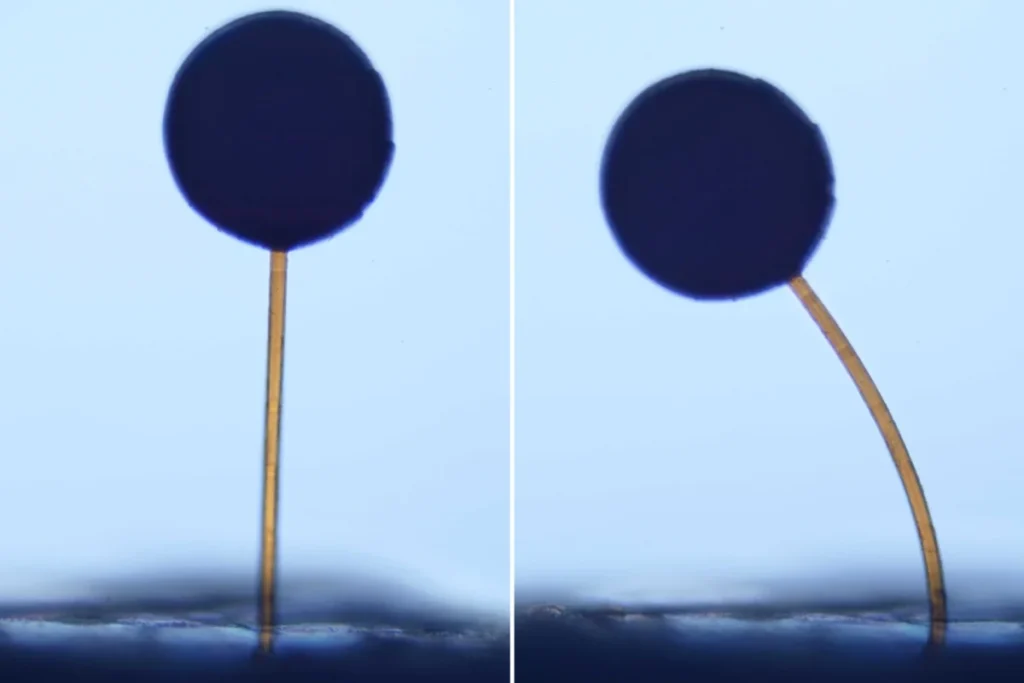
Under the precise gaze of a microscope, a delicate bouquet of lollipop-shaped structures, each diminutive speck smaller than a grain of sand, appears to sway gently within a petri dish filled with liquid. The scene shifts dramatically as a scientist maneuvers a small magnet over the dish. In an instant, these previously passive entities coalesce, snapping together with the swift, decisive action of a Venus flytrap. What began as a collection of inert components has been instantaneously transformed into an active, dexterous robotic gripper. This captivating demonstration is a testament to a novel class of soft magnetic hydrogels, meticulously developed by a collaborative team of engineers from the Massachusetts Institute of Technology (MIT), the École Polytechnique Fédérale de Lausanne (EPFL) in Switzerland, and the University of Cincinnati. Their groundbreaking research, published today in the esteemed journal Matter, details an innovative method for printing and fabricating these gels, enabling the creation of complex, three-dimensional structures that respond to magnetic fields.
A New Era of Microscopic Manipulation
The implications of this soft magnetic hydrogel are far-reaching, paving the way for the development of an entirely new generation of soft, microscopic, and magnetically responsive robots and materials. These "magno-bots," as they could be colloquially termed, hold immense potential for revolutionary applications, particularly within the medical field. Imagine microscopic robots, guided by external magnetic fields, navigating the human circulatory system to precisely deliver therapeutic drugs to targeted cells or to delicately retrieve tiny tissue samples for biopsies. This level of precision and minimally invasive intervention has long been a goal in medical robotics, and this new material brings that vision closer to reality.
The principle of using magnets to induce movement in objects is well-established, particularly at the macroscopic scale. We observe this phenomenon daily with simple experiments like a refrigerator magnet influencing a trail of paper clips. At the microscopic level, scientists have already engineered various magnetic "micro-swimmers" – components less than a millimeter in size that can be remotely steered by magnets, allowing them to navigate confined spaces. However, most existing micro-swimmer designs operate by embedding magnetic particles within a printable resin and then applying an external magnetic field to pull the entire structure. While effective for linear motion, this approach often limits the complexity of achievable shapes and the intricacy of movement.
In stark contrast, the material developed by the MIT team offers unprecedented control over the architecture and deformability of microscopic structures. The ability to create intricate, three-dimensional forms with micron-scale precision means that future magnetic micro-robots, or "millibots" as they might be called, could not only move but also manipulate individual features and execute far more sophisticated maneuvers.
"We can now engineer soft, intricate 3D architectures with components that can move and deform in complex ways within the same microscopic structure," stated Carlos Portela, the Robert N. Noyce Career Development Associate Professor of Mechanical Engineering at MIT and a lead author on the study. "For soft microscopic robotics, or stimuli-responsive matter, that could be a game-changing capability."
The research team’s publication in Matter follows years of foundational work in metamaterials and programmable matter. Portela’s group at MIT is renowned for its expertise in designing materials with unique, microscopic architectures that bestow properties beyond those found in naturally occurring substances. Their previous innovations include developing metamaterials that exhibit exceptional toughness and stretchability, as well as designs capable of manipulating sound waves and withstanding extreme impacts.
The Genesis of Instantaneous Magnetic Response
The latest endeavor by Portela’s lab has focused on expanding their research into "programmable" materials – substances engineered to alter their properties in response to specific external stimuli, such as chemical agents, light, or electric and magnetic fields. Among these various stimuli, magnetic fields possess distinct advantages from the researchers’ perspective.
"With a magnetically responsive material, we have control at a distance and the response is instantaneous," explained Andrew Chen, a co-lead author on the study and a graduate student in Portela’s lab. "We don’t have to wait for a slow chemical reaction or physical process, and we can manipulate the material without touching it." This immediacy and non-contact manipulation are critical for applications requiring rapid and precise control, especially in dynamic environments like the human body.
The objective for this specific study was to engineer a magnetically responsive metamaterial that could be fabricated into structures at the sub-millimeter scale. The prevailing technique for creating such microstructures is two-photon lithography, a high-resolution 3D printing method that utilizes a laser to selectively solidify a liquid resin. This process builds microscopic structures layer by painstaking layer. However, adapting this technique to produce magnetic structures has presented significant challenges. Traditional methods involve mixing magnetic nanoparticles directly into the resin before printing. This approach often falters because magnetic particles, being metallic, can scatter laser light, leading to inconsistent solidification. Furthermore, these particles tend to clump together or settle out of the resin, compromising both the structural integrity and the magnetic performance of the final object.
"Directly 3D printing deformable micron-scale structures with a high fraction of magnetic particles is extremely difficult, often involving a tradeoff between magnetic functionality and structural integrity," noted Rachel Sun, another co-lead author on the paper and a graduate student. "Any magnetic particles in the resin can reduce the laser’s power at a given spot, weakening the resulting structure or preventing its printing altogether."
A Novel "Double-Dip" Fabrication Process
To overcome these limitations, the researchers devised an ingenious "double-dip" fabrication process that separates the structural printing from the magnetic particle infusion. Initially, they employed conventional resin printing to create a microstructure from a standard polymer gel, devoid of any magnetic additives. Once the intricate gel structure was formed, it was then immersed in a solution containing iron ions. The porous nature of the hydrogel allowed it to absorb these iron ions. In the subsequent step, the iron-infused structure was dipped into a second solution containing hydroxide ions. Within the gel matrix, the absorbed iron ions chemically reacted with the hydroxide ions, forming iron-oxide nanoparticles. These in-situ generated nanoparticles are inherently magnetic and are distributed throughout the gel structure.
This innovative two-step process offers a significant advantage: it allows for the printing of complex microstructures with high fidelity first, and then the introduction of magnetic properties without compromising the structural integrity. Moreover, the team discovered they could precisely control the magnetic responsiveness of individual features within the structure. By adjusting the laser’s power during the initial printing phase, they could alter the cross-linking density of the polymer gel – essentially controlling how "tightly" the gel is formed. A more tightly cross-linked gel can accommodate fewer magnetic particles, thereby yielding a less magnetic feature. Conversely, a more loosely cross-linked gel can absorb more iron ions, resulting in a more strongly magnetic feature. This capability provides unprecedented design freedom to create multifunctional structures at the microscale.
"This provides unprecedented design freedom to print multifunctional structures and materials at the microscale," Sun emphasized.
As a compelling demonstration of their technique, the researchers fabricated the aforementioned ball-and-stick structures, reminiscent of miniature lollipops, each less than a millimeter in height with balls smaller than a grain of sand. By carefully controlling the cross-linking density during printing, they infused each lollipop’s "ball" with varying amounts of magnetic particles, bestowing them with distinct magnetic strengths. Under microscopic observation, when an external magnet was brought near, the lollipops were observed to bend and pull towards the magnet with different degrees of force, arranged in a configuration that effectively mimicked the coordinated action of gripping fingers.
"You could imagine a magnetic architecture like this could act as a small robot that you could guide through the body with an external magnet, and it could latch onto something, for instance to take a biopsy," Portela envisioned. "That is a vision that others can take from this work."
Bistable Switches and Future Applications
Beyond gripping mechanisms, the team also engineered a magnetically responsive, "bistable" switch. This device, measuring approximately one millimeter in length, consisted of a rectangular polymer gel structure with four tiny, oar-like magnetic appendages attached to each side. Each oar measured a mere 8 microns in thickness – comparable to the diameter of a red blood cell. When a magnet was applied to one end of the rectangle, the oars on that side would flip towards the magnet, effectively pulling the entire rectangle in the same direction and locking it into that new position. Reversing the magnetic field caused the oars to flip to the opposite side, reorienting the rectangle and acting as a micro-scale switch.
"We think this is a new kind of bistable mechanism that could be used, for instance, in a microfluidic device, as a magnetic valve to open or shut some flow," Portela explained. "For now, we’ve figured out how to fabricate magnetic complex architectures at the microscale and also spatially tune their properties. That opens up a lot of interesting ideas for soft miniature robots going forward."
The development of these magnetically responsive soft hydrogels represents a significant leap forward in the field of micro-robotics and advanced materials. The ability to precisely control the magnetic properties and intricate 3D structures at the microscale opens a Pandora’s Box of possibilities. In medicine, beyond drug delivery and biopsy, these magno-bots could potentially be used for minimally invasive surgery, clearing blockages in blood vessels, or facilitating targeted gene therapy. In environmental applications, they could be employed for the precise capture and removal of microplastics or pollutants from water sources. In manufacturing, they might enable the precise assembly of micro-components or the creation of self-healing microscopic structures.
The research was bolstered by funding from the National Science Foundation and a MathWorks seed grant program, underscoring the broad interest and support for this pioneering work. Furthermore, the sophisticated fabrication and characterization were facilitated by the cutting-edge facilities at MIT.nano. This collaborative effort between leading academic institutions signifies a coordinated push towards unlocking the full potential of soft magnetic materials, promising a future where microscopic robots are not confined to science fiction but are integral tools for scientific advancement and technological innovation. The intricate dance of these tiny magnetic lollipops is merely the opening act in what promises to be a revolutionary performance in the realm of micro-scale engineering.