The enduring allure of gold has defined human civilization for millennia, serving as a cornerstone of currency, a symbol of divine status, and a primary material for artistic expression. From the funerary masks of ancient Egyptian pharaohs to the intricate circuitry of modern smartphones, the precious metal is prized above all others for its remarkable ability to resist the ravages of time. While other metals succumb to the dulling effects of oxidation—silver turning black and copper developing a green patina—gold remains brilliantly untarnished. For decades, the scientific consensus attributed this permanence to gold’s inherent chemical "nobility," suggesting the metal simply lacked the desire to interact with oxygen. However, groundbreaking new research from Tulane University has revealed that gold’s defense mechanism is far more sophisticated than previously understood. The study, published in the prestigious journal Physical Review Letters, demonstrates that gold’s resistance to tarnishing is not merely a byproduct of its chemical composition, but rather a result of a dynamic atomic-scale defensive maneuver.
Led by Matthew Montemore, an associate professor of Chemical Engineering at Tulane’s School of Science and Engineering, and postdoctoral fellow Santu Biswas, the research team utilized advanced computational modeling to peer into the subatomic interactions occurring at the surface of gold. Their findings indicate that gold atoms on the most common surface types do not remain static; instead, they spontaneously rearrange themselves into highly organized, protective patterns. This atomic restructuring acts as a physical and energetic barrier, making it nearly impossible for oxygen molecules to bond with or penetrate the metal. This discovery not only provides a definitive answer to a centuries-old mystery of materials science but also opens new frontiers in the fields of industrial catalysis and sustainable energy production.
The Atomic Architecture of Resistance
To understand why gold remains shiny while other metals fail, one must look at the behavior of atoms at the interface between the solid metal and the surrounding atmosphere. In most metals, surface atoms are "unhappy" because they have fewer neighbors than the atoms buried deep within the crystal lattice. This state of high energy makes them eager to bond with external elements, such as oxygen, to achieve stability. This process, known as oxidation, creates a layer of metal oxide that we perceive as tarnish or rust.
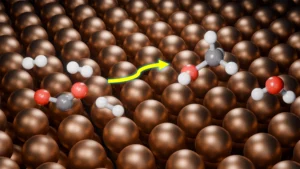
The Tulane study utilized high-fidelity computer simulations to model the behavior of electrons and atoms on two of the most prevalent gold surface configurations. These simulations revealed a phenomenon known as "surface reconstruction." When gold is exposed to certain conditions, the atoms on its surface shift their positions to form a more tightly packed and stable geometry. This self-organized shield drastically alters the energetic landscape for incoming oxygen molecules.
According to the researchers, if gold atoms remained in their standard, bulk-like positions at the surface, oxygen molecules would be able to split apart (dissociate) and react with the metal relatively easily. However, the reconstructed surface creates a barrier that reduces the rate of oxygen reactions by a staggering factor of one billion to one trillion. This means that while an oxygen molecule might successfully react with a copper surface in a fraction of a second, it could take centuries or even millennia to achieve the same result on a gold surface. This "atomic-scale protective barrier" is what allows a gold coin recovered from a thousand-year-old shipwreck to emerge from the ocean floor with its original luster intact.
A Paradigm Shift in Chemical Engineering
The implications of this discovery extend far beyond the jewelry industry. In the world of chemical engineering, gold is highly valued as a catalyst—a substance that speeds up chemical reactions without being consumed in the process. However, the very property that makes gold ideal for jewelry—its extreme resistance to oxygen—poses a significant challenge for industrial applications.
"People have generally thought gold doesn’t tarnish simply because it doesn’t interact strongly with oxygen," Professor Montemore explained. "What we show is that for two of the most common gold surface types, the surface atoms actually rearrange themselves in a way that makes the gold much more resistant to oxidation."
This resistance is a double-edged sword. For a catalyst to be effective in oxidation reactions, it must be able to "activate" oxygen—essentially grabbing oxygen molecules and breaking them apart so they can react with other chemicals. Because gold’s surface is so effectively "zipped up" by its atomic rearrangement, it is naturally poor at this task. Currently, industrial processes that use gold catalysts must employ complex workarounds, such as using gold in the form of nanoparticles or combining it with other metals like palladium.
By identifying the specific atomic structures that prevent oxygen dissociation, the Tulane researchers have provided a roadmap for "tricking" gold into becoming a more active participant in chemical reactions. If engineers can develop methods to prevent or reverse these surface rearrangements, they could potentially unlock a new generation of highly efficient gold-based catalysts.
Industrial Applications and Clean Energy
The potential for improved gold catalysts has direct implications for several multi-billion-dollar industries. One of the most prominent examples is the production of vinyl acetate monomer (VAM). VAM is a critical precursor for the production of polyvinyl acetate (PVA), which is used extensively in adhesives, paints, coatings, and packaging materials. Currently, the industry relies on gold-palladium catalysts to facilitate this production. A deeper understanding of gold’s surface behavior could lead to catalysts that are not only more efficient but also require less of the expensive precious metal, lowering production costs across the supply chain.
Furthermore, gold catalysts are at the forefront of environmental technology. They are used in specialized systems to remove carbon monoxide—a deadly and common pollutant—from vehicle exhaust and industrial emissions. Improving the efficiency of these catalysts could lead to cleaner air and more effective emission control technologies.
The research also aligns with the global push for clean energy. Scientists are currently exploring gold-based catalysts for use in fuel cells and for the production of propylene oxide, a chemical used in the manufacturing of polyurethane foams and biodegradable plastics. In the transition to a hydrogen economy, catalysts that can efficiently manage oxygen interactions are vital for the stability and longevity of energy conversion devices. The ability to manipulate gold’s surface geometry could be the key to making these green technologies commercially viable on a global scale.
Chronology of Gold Science and the Tulane Study
The Tulane discovery is the latest milestone in a long history of human fascination with gold’s physical properties.
- Ancient Era (c. 4000 BCE): Gold is first used by civilizations in Mesopotamia and Egypt. Its resistance to corrosion makes it the "metal of the gods."
- 19th Century: Early chemists identify gold as a "noble metal" due to its low reactivity on the Periodic Table.
- Mid-20th Century: The development of X-ray crystallography allows scientists to see the lattice structure of gold, but surface-level dynamics remain difficult to observe.
- 1980s-1990s: The rise of surface science and scanning tunneling microscopy reveals that gold surfaces can indeed reconstruct, though the exact impact on oxidation is not fully quantified.
- 2020-2023: Matthew Montemore and Santu Biswas at Tulane University initiate a project using modern supercomputing power to simulate the electronic environment of gold surfaces at unprecedented detail.
- 2024: The study is published in Physical Review Letters, quantifying the "billion-to-trillion" factor of reaction reduction caused by atomic rearrangement.
This timeline illustrates a shift from observing gold’s beauty to understanding its fundamental physics. The Tulane team’s use of computer simulations represents a modern "digital laboratory" approach, allowing researchers to test scenarios that would be impossible to observe in a physical lab due to the microscopic scales and extreme speeds of atomic movements.
Broader Scientific Context and Reactions
The scientific community has responded to the Tulane findings with significant interest, as the study challenges the traditional "static" view of metal surfaces. Materials scientists note that this research highlights the importance of "dynamic equilibrium"—the idea that a surface is a living, shifting entity rather than a fixed wall of atoms.
While the study focused on gold, the methodology used by Montemore and Biswas could be applied to other noble metals, such as platinum and iridium. These metals are essential for everything from chemotherapy drugs to spark plugs. If similar atomic-shielding behaviors are found in these elements, it could revolutionize how we design alloys and surface coatings for harsh environments, such as jet engines or deep-sea drilling equipment.
Experts in the field of nanotechnology have also weighed in, suggesting that this research could help explain why gold nanoparticles behave so differently than bulk gold. At the nanoscale, the ratio of surface atoms to interior atoms is much higher, and the ability of those surface atoms to rearrange themselves may be limited by the particle’s small size. This could explain why gold becomes more reactive when it is broken down into tiny clusters, a phenomenon that has puzzled scientists for years.
Conclusion: Refining the Future
The work of the Tulane University researchers serves as a reminder that even the most familiar materials still hold secrets. Gold has been studied for thousands of years, yet it required 21st-century computational power to reveal the true nature of its "eternal" shine. By proving that gold’s durability is a result of an active atomic defense rather than passive indifference, the study bridges the gap between ancient wonder and modern engineering.
As the global industry seeks more sustainable and efficient ways to produce chemicals and energy, the ability to control the atomic geometry of materials will become a vital tool. The strategy suggested by Professor Montemore—preventing or reversing surface rearrangements to "trick" gold into reacting—represents a new frontier in chemical design. Instead of simply accepting the natural properties of an element, scientists are now learning how to negotiate with its atoms.
Ultimately, the discovery of gold’s hidden atomic defense does more than explain why a wedding ring stays bright. It provides the foundational knowledge necessary to transform one of the world’s most inert substances into a powerful engine for technological progress. From cleaner air to more affordable plastics and advanced green energy, the future of industrial innovation may well be paved with the very same gold that has fascinated humanity since the dawn of time, now understood at a level of detail never before imagined.