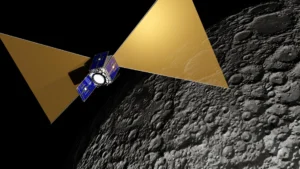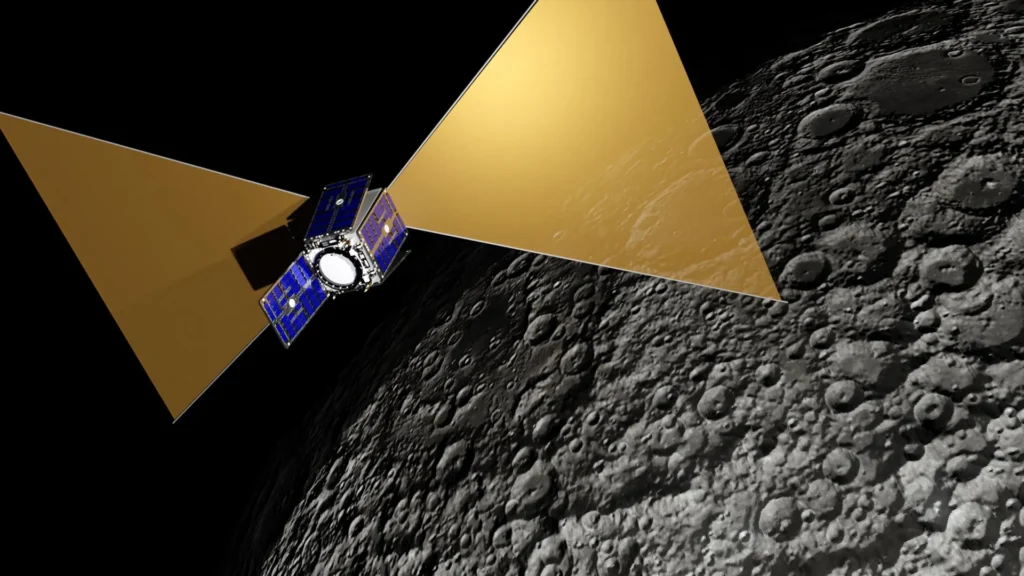
In an ambitious leap for small-scale space exploration, a United Kingdom-led research team is preparing to launch a satellite no larger than a standard carry-on suitcase to probe the most enigmatic era of our universe’s history. Known as CosmoCube, this compact spacecraft is designed to journey to the Moon and orbit its far side, seeking to capture signals from the "Cosmic Dark Ages"—a 150-million-year period following the Big Bang but preceding the birth of the very first stars. Led by the University of Cambridge and supported by a consortium of international partners and the UK Space Agency, the mission represents a shift toward high-impact, low-cost "New Space" initiatives capable of answering fundamental questions about the origins of the cosmos.
The Quest for the First Signal: Understanding the 21-Centimeter Line
The primary objective of CosmoCube is to detect a specific spectral signature known to astrophysicists as the 21-centimeter line. This signal is emitted by neutral hydrogen atoms that dominated the early universe before the "Cosmic Dawn"—the moment when the first generation of stars ignited and began to ionize the surrounding gas. While the Big Bang’s afterglow, the Cosmic Microwave Background (CMB), has been mapped in exquisite detail by missions like Planck and WMAP, the era immediately following it remains a "dark age" because there were no light-emitting sources.
The 21-centimeter signal acts as a unique tracer for this period. As the universe expanded over 13.5 billion years, these radio waves were stretched, or "redshifted," into much lower frequencies. To observe the Dark Ages, CosmoCube must tune into frequencies between 10 and 50 MHz. On Earth, these frequencies are nearly impossible to monitor. The planet’s ionosphere—a layer of the upper atmosphere filled with charged particles—acts as a shield, reflecting or distorting these low-frequency radio waves. Furthermore, the modern world is saturated with human-made radio frequency interference (RFI), including FM radio broadcasts, television signals, and satellite communications, which are orders of magnitude stronger than the faint cosmic whispers CosmoCube seeks to find.
The Lunar Far Side: A Natural Sanctuary for Radio Astronomy
To escape the "electronic smog" of Earth, CosmoCube will utilize the Moon as a massive physical shield. By entering a lunar orbit, the satellite will periodically pass behind the Moon’s far side. During these windows—lasting approximately 40 minutes out of every two-hour orbit—the bulk of the Moon will block all radio transmissions coming from Earth.
This "radio-quiet zone" is widely considered the most pristine environment in the inner solar system for low-frequency radio astronomy. In this silence, CosmoCube will deploy a specialized, lightweight radio antenna to listen for the hydrogen signal. Over the course of its planned two-year mission, researchers expect to accumulate roughly 1,000 hours of high-quality, interference-free data. This duration is critical, as the signal is so weak that it requires massive amounts of integration time to distinguish it from background noise.
Technical Innovation: High Performance in a Small Package
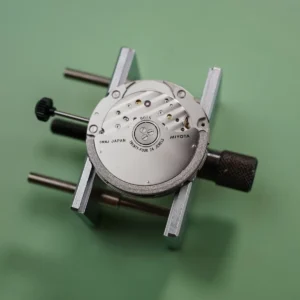
The mission’s feasibility rests on the "SSTL-21" spacecraft platform, developed by Surrey Space Technology Limited (SSTL), a world leader in small satellite manufacturing. Despite its small size, CosmoCube integrates cutting-edge technology typically reserved for much larger missions. Central to its design is a miniature radiometer utilizing Radio Frequency System on Chip (RFSoC) technology. This allows the satellite to combine complex analog and digital processing on a single, power-efficient chip, which is essential for a spacecraft with limited physical space and power reserves.
One of the greatest challenges in detecting the 21-centimeter line is ensuring that the spacecraft’s own electronics do not interfere with the measurements. To solve this, CosmoCube employs a "Dicke switched" calibrator. This system allows the instrument to rapidly alternate between looking at the sky and looking at internal reference sources of known temperature. By doing so, the team can identify and subtract any electronic noise or thermal fluctuations generated by the satellite itself, ensuring the data’s integrity.
Once the data is transmitted back to Earth, researchers will apply advanced Bayesian statistical techniques to process the results. These mathematical models are designed to separate the desired cosmological signal from "foreground" emissions—radio noise produced by our own Milky Way galaxy, which can be up to 10,000 times brighter than the signal from the Dark Ages.
Investigating the Role of Dark Matter
Beyond mapping the distribution of hydrogen, CosmoCube is poised to provide groundbreaking insights into the nature of dark matter. Although dark matter makes up about 27% of the universe’s mass-energy content, it does not emit, absorb, or reflect light, making it invisible to traditional telescopes. Its existence is inferred only through its gravitational pull on visible matter.
During the Cosmic Dark Ages, dark matter acted as a gravitational "scaffold." It began to clump together shortly after the Big Bang, creating gravitational wells that pulled in neutral hydrogen gas. Eventually, these gas clouds became dense enough to trigger nuclear fusion, birthing the first stars. By observing the 21-centimeter line, CosmoCube can reveal how hydrogen was being moved and heated by dark matter long before the first light appeared.
Professor Eloy de Lera Acedo of Cambridge’s Cavendish Laboratory, the mission’s lead author, emphasized the importance of this era: "This emission from hydrogen after the Big Bang will hopefully allow us to understand the role of dark matter in the early universe, how it worked to pull together hydrogen into the first stars and galaxies."
Development Timeline and Collaborative Framework
The development of CosmoCube is already well underway, with the project moving through critical design and testing phases. The mission recently gained visibility through the European Space Agency’s (ESA) "mini Fast missions" Call for Ideas, with a proposed budget of under 50 million Euros—a fraction of the cost of traditional deep-space missions.
Key milestones in the CosmoCube timeline include:
- Concept and Design (2022-2023): Publication of mission details in Nature Astronomy and initial design of the SSTL-21 platform.
- Prototyping and Environmental Testing (2024): Laboratory prototypes of the radiometer have been constructed. Researchers at STFC RAL Space are currently conducting thermal vacuum tests to ensure the satellite can survive the extreme temperature swings of lunar orbit.
- Collaborative Expansion: The mission has integrated expertise from the University of Portsmouth, STFC RAL Space, and international partners from EU nations, including Malta.
- Target Launch Window (2028-2029): The team aims for a launch within the next five years, potentially hitching a ride as a secondary payload on a larger lunar mission.
Dr. Will Grainger of STFC RAL Space noted the complexity of the engineering: "We’ve worked with the project partners to develop representative models of the satellite and its payload. These have been tested in our facilities to ensure the thermal performance allows the payload to operate and perform the required sensitive measurements under the different temperature conditions it will experience whilst in orbit around the Moon."
Broader Impact and the Future of Lunar Science
CosmoCube is part of a growing global interest in the lunar far side. NASA is currently developing the Lunar Surface Electromagnetics Experiment (LuSEE-Night), and India’s space agency, ISRO, has also expressed interest in radio astronomy from lunar orbit. However, CosmoCube’s unique selling point is its efficiency and focus on the deepest parts of the Dark Ages using a compact, low-cost platform.
If successful, the mission will prove that major cosmological breakthroughs do not always require "Flagship" class missions costing billions of dollars. It sets a precedent for "New Space" methodologies—where agility, integrated electronics, and specific environmental positioning allow small teams to conduct world-class science.
Furthermore, the mission highlights the UK’s strengthening position in the global space sector. By developing the hardware, software, and analytical frameworks domestically, the UK is positioning itself as a leader in the next generation of lunar exploration. The project is supported by the UK Space Agency, the Kavli Foundation, and the Science and Technology Facilities Council (STFC), underscoring a cross-disciplinary commitment to uncovering the history of our universe.
As we stand on the precipice of a new era of lunar activity, CosmoCube reminds us that the Moon is not just a destination for human footprints, but a vital scientific tool. By using the lunar body as a shield against our own noisy civilization, humanity may finally be able to "hear" the very beginning of cosmic history, transforming the Dark Ages from a theoretical mystery into a mapped reality. This "small suitcase" of technology could indeed carry the answers to some of the most profound questions ever asked about our existence in the vast, expanding universe.