When ice turns into water, the change happens almost instantly. As soon as the temperature reaches the melting point, the rigid structure of ice collapses into liquid water. This rapid switch from solid to liquid is typical for familiar three-dimensional materials, a fundamental process where both the orderly arrangement of atoms and the directional bonds between them are lost simultaneously. This abrupt transformation is observed across a vast range of substances, from metals and minerals to everyday compounds, marking a definitive boundary between two distinct states of matter. However, this conventional understanding of melting, deeply ingrained in our scientific perception, proves incomplete when materials are confined to the realm of two dimensions.
Extremely thin materials, reduced to mere atomic layers, behave very differently. Instead of melting all at once in a single, catastrophic event, they can pass through an unusual intermediate state that sits between a perfectly ordered solid and a completely disordered liquid. This rare and highly sought-after condition is known as the hexatic phase. In a groundbreaking study, scientists at the University of Vienna have now directly observed this phase in an atomically thin crystal of silver iodide (AgI), something that had never been confirmed before in a strongly bonded, real material. This achievement resolves a decades-old mystery and offers unprecedented insights into the fundamental physics governing phase transitions at the nanoscale.
By combining advanced electron microscopy with sophisticated neural networks, the interdisciplinary team recorded the silver iodide crystal as it underwent melting while carefully protected by layers of graphene. These ultra-thin, two-dimensional materials provided a unique environment, allowing researchers to watch the melting process unfold at the level of individual atoms. The unprecedented resolution and analytical power greatly improve scientific understanding of how phase transitions work in two dimensions. Crucially, the findings also contradict long-standing theoretical expectations regarding the nature of these transitions, suggesting a more complex reality than previously modeled. The full details of this significant discovery have now been published in the prestigious journal Science.
The Elusive Hexatic Phase: A Historical Perspective
The concept of the hexatic phase emerged from theoretical physics in the 1970s, primarily through the work of physicists David Kosterlitz, David Thouless, Bertrand Halperin, T.C. Lubensky, and John M. Kosterlitz. Their KTHNY (Kosterlitz-Thouless-Halperin-Nelson-Young) theory posited that melting in two-dimensional systems would not be a single first-order transition, but rather a two-step process. According to this theory, a 2D solid would first lose its positional order, transitioning into a hexatic phase, where particles are no longer fixed in a lattice but still maintain a quasi-long-range orientational order (i.e., their angular alignment with neighbors persists over significant distances). Only then would the hexatic phase transition into a true liquid, losing its orientational order as well.
This theoretical prediction offered a stark contrast to the familiar melting process in three dimensions, where both positional and orientational order are lost simultaneously. For decades, however, direct experimental confirmation of the hexatic phase in strongly bonded atomic crystals remained elusive. While it had been observed in simplified model systems, often referred to as "soft matter" systems—such as tightly packed polystyrene spheres or certain liquid crystals—these materials are held together by much weaker forces than atomic crystals. The question lingered: could this intricate two-step melting process truly exist in everyday materials bound by strong chemical bonds? Scientists were unsure whether the same behavior, predicted for ideal systems, could manifest under the more rigorous conditions of real atomic lattices.
The Vienna Breakthrough: Direct Observation in Atomic Crystals
The international research team led by the University of Vienna has now definitively answered that question. By meticulously studying atomically thin crystals of silver iodide (AgI), the researchers were able to observe the hexatic phase directly for the first time in a strongly bonded material. This achievement marks a pivotal moment in condensed matter physics, resolving a question that had remained open for decades and moving the hexatic phase from theoretical curiosity and model-system observation to a confirmed phenomenon in genuine atomic structures.
The choice of silver iodide was strategic. AgI is a material known for its superionic properties and interesting phase transitions, making it an excellent candidate for investigating melting phenomena. The discovery confirms that this elusive phase can indeed occur in real two-dimensional crystals, providing crucial empirical evidence that substantiates the theoretical framework of 2D melting. Furthermore, it reveals new and unexpected details about how melting works when materials are reduced to atomic thickness, offering a refined understanding that challenges parts of the established KTHNY theory.
Unveiling the Mechanism: A Graphene Sandwich and AI
To observe this fragile and transient process, the researchers designed a specialized experimental setup that pushed the boundaries of current microscopy techniques. A single, atomically thin layer of silver iodide was precisely placed between two sheets of graphene, forming a protective "sandwich" structure. This ingenious design was critical; the graphene layers served multiple vital purposes. Firstly, they prevented the delicate, single-atom-thick AgI crystal from collapsing or decomposing under the high temperatures required for melting. Graphene, being an incredibly strong and stable material, provided mechanical support while simultaneously allowing the AgI to melt naturally without external interference from its environment or substrate. Secondly, graphene’s atomic thinness and transparency to electron beams ensured that the melting process within the AgI layer could be observed with unparalleled clarity and resolution.
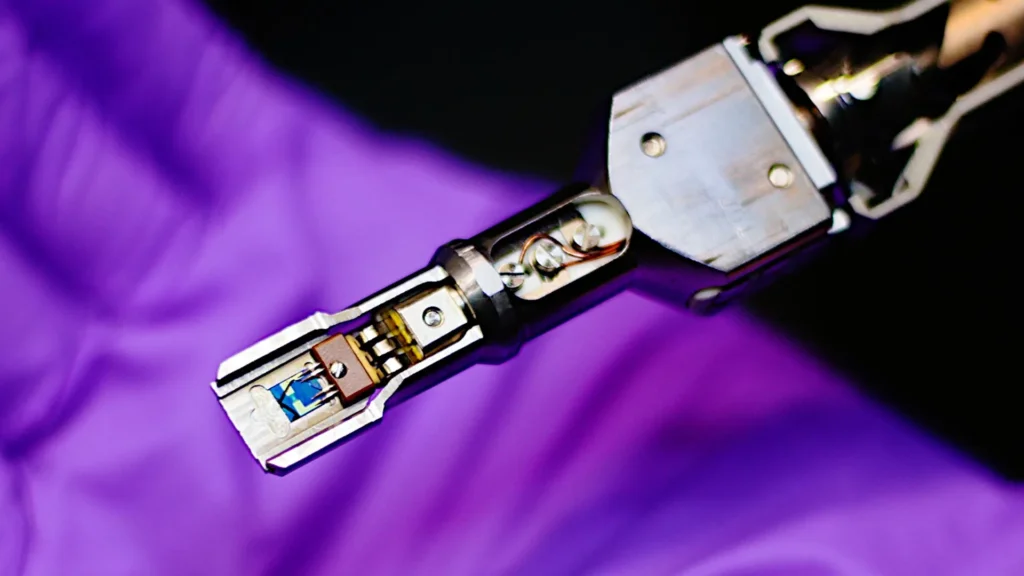
The team then employed a state-of-the-art scanning transmission electron microscope (STEM) equipped with a specialized heating holder. This advanced setup allowed them to gradually raise the temperature of the sample, exceeding 1100 °C (2012 °F), a temperature range where AgI would typically melt. The STEM’s capabilities are crucial here, as it can image individual atoms with picometer precision, making it possible to record the melting process in real time and at atomic resolution. The ability to directly visualize the rearrangement and movement of individual silver and iodide atoms as the material transitioned through different phases was unprecedented.
The sheer volume of data generated by tracking the motion of individual atoms during melting at such high resolution presented an enormous analytical challenge. According to Kimmo Mustonen from the University of Vienna, a senior author of the study, this monumental task would have been impossible without the integration of artificial intelligence. "Without the use of AI tools such as neural networks, it would have been impossible to track all these individual atoms and extract meaningful information from the vast datasets," he explains. The researchers meticulously trained their neural network using large sets of simulated data, teaching the AI to identify and track individual atoms within the complex electron microscope images. Once trained, the system analyzed thousands of high-resolution microscope images generated during the experiment, processing terabytes of data with speed and accuracy far beyond human capability. This synergy between cutting-edge experimental physics and advanced computational intelligence was fundamental to the success of the project.
Challenging Decades of Theory: A New Understanding of 2D Melting
The detailed analysis of the atomic movements, powered by AI, uncovered a striking and profoundly significant result. Within a small and clearly defined temperature range—approximately 25 °C (45 °F) below the bulk melting point of AgI—the crystal entered the hexatic phase. This was not a gradual blurring but a distinct, identifiable intermediate state characterized by a loss of positional order (atoms no longer fixed in a perfect lattice) but a persistent quasi-long-range orientational order (atoms still maintained angular alignment with their neighbors). Additional electron diffraction measurements, which provide information about the material’s overall atomic arrangement, independently confirmed this behavior, providing strong, multi-modal evidence that this intermediate state exists in atomically thin, strongly bonded materials.
Perhaps even more critically, the study also revealed behavior that directly challenges existing theoretical predictions, particularly the KTHNY theory. Earlier models suggested that both transitions—from solid to hexatic, and subsequently from hexatic to liquid—should occur gradually, as continuous phase transitions mediated by the unbinding of topological defects (like disclinations and dislocations). Instead, the researchers found a more nuanced reality: only the first transition, from solid to hexatic, followed this gradual, continuous pattern.
However, the subsequent change from the hexatic phase to a true liquid happened suddenly and abruptly, much like the familiar first-order transition of ice turning into water. This unexpected discontinuity in the hexatic-to-liquid transition suggests that the melting process in covalent two-dimensional crystals is far more complex and intricate than previously thought. "This suggests that melting in covalent two-dimensional crystals is far more complex than previously thought," says David Lamprecht from the University of Vienna and the Vienna University of Technology (TU Wien), one of the main authors of the study alongside Thuy An Bui, also from the University of Vienna. This finding implies that while the KTHNY theory correctly predicted the existence of an intermediate hexatic phase, the precise nature of the transitions into and out of this phase might need significant revision for strongly bonded materials. It opens up new avenues for theoretical modeling, potentially incorporating factors like specific defect interactions or the influence of quantum mechanics at these scales.
Reactions and Scientific Validation
The publication of these findings in Science has garnered significant attention within the condensed matter physics and materials science communities. The direct observation of the hexatic phase in a strongly bonded atomic crystal is a major experimental triumph, validating a theoretical prediction that has long been difficult to confirm. The subsequent challenge to parts of the KTHNY theory adds an even deeper layer of scientific significance, pushing the boundaries of fundamental understanding.
Jani Kotakoski, head of the research group at the University of Vienna, highlights the importance of the work, stating, "Kimmo and his colleagues have once again demonstrated how powerful atomic-resolution microscopy can be when combined with innovative experimental design and advanced data analysis." The consensus among peers is expected to be one of recognition for the meticulous experimental work and the bold application of AI, which enabled this breakthrough. This study serves as a benchmark for future research into low-dimensional materials, inspiring further investigations into the nuances of phase transitions.
Broader Implications for Materials Science and Beyond
Beyond improving our fundamental understanding of melting in two dimensions, this study carries profound implications across several scientific and technological domains.
Fundamental Physics: The discovery deepens our knowledge of phase transitions, particularly in low-dimensional systems where quantum effects and surface phenomena play increasingly dominant roles. It necessitates a re-evaluation and refinement of existing theoretical models, potentially leading to new frameworks that more accurately describe the behavior of matter at its thinnest. This could influence our understanding of other complex phenomena in 2D materials, such as superconductivity or magnetism.
Materials Science and Nanotechnology: The ability to precisely observe and characterize intermediate phases opens up new avenues for designing and engineering advanced 2D materials with tailored properties. Understanding how materials transition between solid, hexatic, and liquid states could be crucial for developing novel nanoscale devices. For instance, materials that can be precisely controlled through a hexatic phase might offer unique properties for sensors, actuators, or next-generation memory devices where subtle phase changes are exploited for data storage or processing. The controlled manipulation of these phases could lead to materials with tunable mechanical, electrical, or optical properties.
Technological Advancement: The study itself stands as a testament to the power of combining cutting-edge experimental techniques with artificial intelligence. The successful application of neural networks to analyze complex atomic-resolution data provides a powerful blueprint for future scientific endeavors across various disciplines. This approach, where AI augments human observation and analysis, is set to accelerate discoveries in fields ranging from biology and chemistry to materials science and engineering.
Looking Ahead: The Frontier of Low-Dimensional Materials
The findings from the University of Vienna team are not merely an end to a long-standing mystery but rather the beginning of a new chapter in the study of low-dimensional materials. Future research will likely focus on several key areas:
- Exploring Other 2D Materials: Investigating whether the hexatic phase and similar unexpected transition behaviors are common across a wider range of atomically thin materials, beyond silver iodide.
- Refining Theoretical Models: Developing new theoretical frameworks that can accurately predict and explain the observed first-order transition from the hexatic phase to the liquid, integrating factors specific to strongly bonded 2D crystals.
- Manipulating Phase Transitions: Exploring methods to control and exploit these unique phase transitions for specific technological applications, potentially leading to new classes of functional nanomaterials.
- Investigating Defect Dynamics: A deeper dive into the role of topological defects (dislocations, disclinations) in driving these phase transitions in 2D systems, especially in light of the unexpected abruptness of the hexatic-to-liquid transition.
This seminal work challenges decades of theoretical assumptions and opens new directions for studying matter at the smallest scales, paving the way for a deeper and more accurate understanding of the fundamental principles that govern the world at its most minuscule dimensions. The collaboration between advanced microscopy and artificial intelligence has once again proven its transformative potential, pushing the boundaries of scientific exploration.