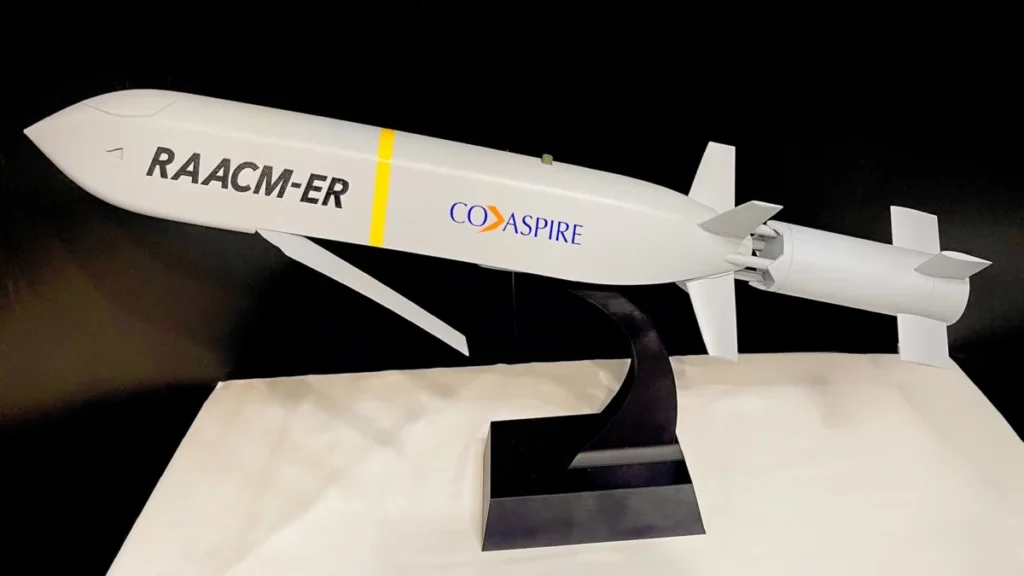
This pivotal development sees CoAspire, a privately owned small business, entering into a Prototype Other Transactional Agreement (OTA) with CMG Networks, acting on behalf of the Naval Aviation Systems Consortium. Under this agreement, CoAspire is tasked with the comprehensive design, construction, rigorous testing, and eventual delivery of its Rapidly Adaptable Affordable Cruise Missile-Extended Range (RAACM-ER) Ground-Launched system. This critical munition is destined for the Navy’s Program Acquisition Executive for Munitions and its specialized PMX-201 program office, signaling a concerted effort to accelerate the deployment of next-generation weaponry.
The RAACM-ER Ground-Launched system is being specifically developed for the Coalition Heterogenous Affordable Offensive Strike (CHAOS) program, an initiative designed to foster innovative and economical strike capabilities. The CoAspire solution integrates the advanced RAACM-ER cruise missile with a robust booster and a versatile launcher, creating a cohesive surface-launched weapon system. This system is engineered to possess dual-engagement capabilities, effectively targeting both fixed and mobile land objectives, as well as dynamic maritime targets, thereby offering unparalleled operational flexibility to naval and joint forces.
Beyond its immediate utility for the U.S. Navy, the CHAOS program carries a broader strategic objective: to support foreign military sales (FMS) to key U.S. allies and coalition partners. In an increasingly complex global security landscape, these partners are actively seeking lower-cost maritime strike capabilities that can be manufactured efficiently and at scale. This emphasis on affordability and mass production underscores a critical shift in defense procurement, moving away from bespoke, high-cost systems towards more accessible and widely distributable solutions that can bolster collective security.
Strategic Imperative: The Shift Towards Affordable Munitions
The selection of CoAspire comes at a critical juncture for the U.S. military, which is actively recalibrating its defense industrial base to meet the challenges of peer and near-peer competition. For decades, the focus has often been on developing highly sophisticated, technologically advanced, but often prohibitively expensive weapons systems produced in limited quantities. However, recent global conflicts, particularly the ongoing war in Ukraine, have starkly demonstrated the immense consumption rates of modern warfare, highlighting a pressing need for vast quantities of affordable, yet effective, munitions. This realization has spurred a strategic pivot within the Department of Defense (DoD) towards initiatives that prioritize "affordable mass" – the ability to produce large numbers of weapons quickly and economically.
This paradigm shift is driven by several factors. Firstly, adversaries such as China and Russia have significantly expanded their own military production capabilities, posing a challenge to U.S. and allied quantitative superiority. Secondly, the costs associated with traditional high-end munitions have made sustained engagement economically unsustainable for long durations. Thirdly, the imperative to deter aggression across multiple potential theaters, particularly in the Indo-Pacific region, necessitates a broad and deep arsenal that can absorb losses and sustain operations without depleting strategic reserves prematurely. The CHAOS program, and CoAspire’s RAACM-ER within it, directly addresses these concerns by aiming to provide a potent strike capability that is both economically viable and scalable.
The CoAspire Solution: RAACM-ER Ground-Launched System
CoAspire’s Rapidly Adaptable Affordable Cruise Missile (RAACM) family represents a modular and versatile approach to missile design, with variants tailored for air, surface, and ground launch platforms. The RAACM-ER Ground-Launched system specifically chosen for the CHAOS program is a testament to this adaptability. It combines the core RAACM-ER missile with a specialized booster and launcher, transforming it into a formidable surface-launched weapon. This configuration provides a critical mid-range strike capability, filling a potential gap in the current U.S. and allied arsenals, which often rely on longer-range, more expensive systems or shorter-range, less capable munitions.
Doug Denneny, CEO, owner, and founder of CoAspire, articulated the company’s enthusiasm for the project, stating, “CoAspire is thrilled to support the U.S. Navy with this much-needed, affordable, mid-range maritime strike weapon.” He further emphasized the collaborative nature of their approach: “We, and our 56 first-tier suppliers across almost every state, are excited to support PMX-201, NAVAIR, and our coalition partners with an affordable cruise missile solution.” This statement highlights not only CoAspire’s commitment but also the extensive domestic supply chain supporting the initiative, bolstering the U.S. industrial base.
The RAACM-ER system is designed to provide substantial operational advantages. Its capability to engage both land and moving maritime targets offers commanders significant flexibility in rapidly evolving combat scenarios. For instance, in a contested maritime environment, the ability to launch precision strikes against adversary vessels from coastal batteries or other surface platforms provides a robust deterrent and response option. Similarly, against land-based threats, the system offers a cost-effective alternative to more expensive air-launched or ship-launched cruise missiles for certain target sets, allowing for more efficient resource allocation.
Additive Manufacturing: Revolutionizing Defense Production
Central to CoAspire’s innovative approach and its ability to deliver affordable, rapidly producible munitions is its pioneering use of additive manufacturing, commonly known as 3D printing. This advanced manufacturing technique is not merely an incremental improvement; it represents a fundamental shift in how complex defense systems, particularly missiles, can be designed and produced. The company explicitly states that the RAACM-ER is designed around a manufacturing philosophy that leverages additive manufacturing to achieve several critical objectives:
Firstly, it significantly increases payload capacity. By optimizing designs for 3D printing, engineers can create complex internal geometries that are lighter yet stronger than traditionally manufactured components, allowing for more space or weight for warheads, sensors, or fuel. Secondly, additive manufacturing drastically reduces the need for traditional tooling. Conventional manufacturing often requires expensive, time-consuming molds, dies, and fixtures. 3D printing largely bypasses these requirements, accelerating the initial production phase and reducing setup costs.
Thirdly, this approach is intended to cut "touch labor" – the manual work involved in assembly and fabrication. Automated 3D printing processes minimize human intervention, leading to greater consistency, reduced error rates, and lower labor costs. Perhaps most critically, additive manufacturing allows for rapid design changes without the need to halt entire production lines for extensive retooling. This agility is revolutionary in defense procurement, where design iterations and upgrades often take years due to the complexities of reconfiguring traditional factories. CoAspire asserts that this manufacturing method could enable the development of new missile variants in months, a dramatic improvement over the years typically required by conventional processes. This speed is invaluable in adapting to evolving threats and integrating new technologies quickly.
The focus on manufacturing innovation is not limited to a single missile configuration. CoAspire is developing a family of cruise missiles, designed from the outset to be adaptable across various launch platforms and mission requirements. This modularity, enabled by additive manufacturing, ensures that the RAACM family can evolve alongside future operational needs without necessitating entirely new development cycles.
The CHAOS Program and Broader U.S. Defense Strategy
The Coalition Heterogenous Affordable Offensive Strike (CHAOS) program epitomizes the U.S. Navy’s strategic vision for future strike capabilities. The term "Heterogenous" in its name is particularly telling, suggesting a desire for a diverse mix of weapons systems—not a single, monolithic solution—to address a wide array of threats and operational scenarios. This aligns with the concept of "distributed lethality," where strike capabilities are spread across various platforms and domains, making it harder for an adversary to neutralize the entire force.
The CHAOS program, by focusing on "affordable offensive strike," seeks to provide robust deterrence and response options without breaking the bank. The $70 million program funding indicates a serious commitment from the Navy to invest in these next-generation, cost-effective solutions. Such investments are crucial as the U.S. military faces increasing budget pressures while simultaneously needing to modernize its forces.
The RAACM-ER Ground-Launched system’s comparability to CoAspire’s RAACM-ER GHOST variant is noteworthy. The GHOST variant is already being utilized in other U.S. military research and development programs, including the Low-Cost Containerized Munition program funded by the U.S. Army’s Program Executive Office for Fires. This cross-service adoption and validation of CoAspire’s core technology underscores its versatility and the broader military’s confidence in the company’s approach to affordable, modular munitions. It also suggests potential interoperability and commonality across different branches, which can lead to further efficiencies in logistics, training, and sustainment.
The Navy’s Program Acquisition Executive for Munitions and the PMX-201 program office play a critical role in guiding the development and acquisition of such systems. Their involvement ensures that the RAACM-ER Ground-Launched missile meets stringent performance, safety, and integration requirements, paving the way for its eventual deployment and widespread adoption.
CoAspire’s Role and Growth in the Defense Ecosystem
CoAspire’s journey as a privately owned small business based in Virginia provides an interesting counter-narrative to the traditional defense contractor model. The company emphasizes that it has achieved its growth without relying on outside investors, a rare feat in an industry often dominated by publicly traded giants or venture-capital-backed startups. This self-reliant growth model potentially grants CoAspire greater agility and freedom from external financial pressures, allowing it to prioritize long-term strategic objectives and innovative approaches.
The company’s reliance on a network of 56 first-tier suppliers spread across the U.S. is another significant aspect of its operational model. This decentralized supply chain not only contributes to the domestic economy by supporting jobs in numerous states but also potentially enhances resilience and redundancy in production. In an era where global supply chains face increasing disruptions, a geographically diverse and domestically focused supplier network can be a strategic asset, ensuring continuity of production even in challenging circumstances.
The CHAOS contract is a significant addition to CoAspire’s growing portfolio of involvement in U.S. military programs focused on lower-cost, rapidly produced munitions. This track record positions CoAspire as a key player in the DoD’s broader strategy for modernizing its arsenal. The company’s consistent focus on designing products for quick, scalable manufacturing, while simultaneously allowing for rapid adaptation of missile variants to different operational requirements, aligns perfectly with the military’s evolving needs. This philosophy is not just about making missiles cheaper; it’s about making them more responsive to dynamic threats and more readily available in the quantities needed for sustained operations.
Global Implications: Strengthening Alliances and Deterrence
The program’s explicit intention to support foreign military sales (FMS) adds a crucial geopolitical dimension to CoAspire’s RAACM-ER system. In an environment of heightened global tensions, U.S. allies and coalition partners are actively seeking to bolster their defensive and offensive capabilities. However, many nations face budgetary constraints that make acquiring high-end, extremely expensive munitions challenging. The RAACM-ER offers a compelling solution: a robust, mid-range strike capability that is both effective and affordable.
By providing allies with access to such a system, the U.S. can achieve several strategic objectives. Firstly, it strengthens alliances by enhancing the collective security posture of partner nations. A more capable ally is a more effective partner in deterrence and, if necessary, in conflict. Secondly, it fosters interoperability. Deploying a common, affordable cruise missile system across allied forces simplifies joint planning, logistics, and training, making coalition operations more seamless and effective. Thirdly, it acts as a deterrent. A widespread distribution of affordable, potent strike capabilities among U.S. partners sends a clear message to potential adversaries that any aggression would be met with a formidable and sustained response from a united front.
The ability to manufacture these missiles at scale is particularly attractive for FMS. Allies are not just looking for a few high-value units; they require sufficient quantities to build credible arsenals and sustain operations. CoAspire’s additive manufacturing-driven production model promises to meet this demand, ensuring that allied nations can acquire the necessary volume of munitions without prolonged waiting periods or excessive costs.
Looking Ahead: Milestones and Future Prospects
The selection of CoAspire for the CHAOS program marks the beginning of a multi-year development effort. Key milestones will include the detailed design phase, followed by the manufacturing of initial prototypes. Rigorous testing, encompassing both simulated environments and live-fire exercises, will be critical to validate the system’s performance, reliability, and safety. The delivery of the RAACM-ER Ground-Launched system to the Navy’s PMX-201 program office will signify the successful culmination of this initial phase.
Beyond the immediate development, the future prospects for CoAspire and the RAACM family appear bright. The company’s participation in other U.S. military R&D programs, coupled with its focus on modularity and rapid adaptation, positions it for continued involvement in the evolving landscape of defense procurement. The demonstration of its RAACM family, including the CHAOS Surface Launched system, at the 2026 Farnborough International Airshow in England, provides an early indication of the company’s intent to showcase its capabilities on a global stage, further promoting potential FMS opportunities.
This $70 million program is more than just a contract for a new missile; it represents a strategic investment in a new model of defense acquisition and manufacturing. By embracing companies like CoAspire and technologies like additive manufacturing, the U.S. Navy and the broader Department of Defense are striving to build a more agile, resilient, and quantitatively superior force capable of meeting the complex security challenges of the 21st century. The RAACM-ER Ground-Launched system stands as a testament to this transformative vision, promising to deliver critical strike capabilities that are both affordable and adaptable for both the U.S. and its global partners.






