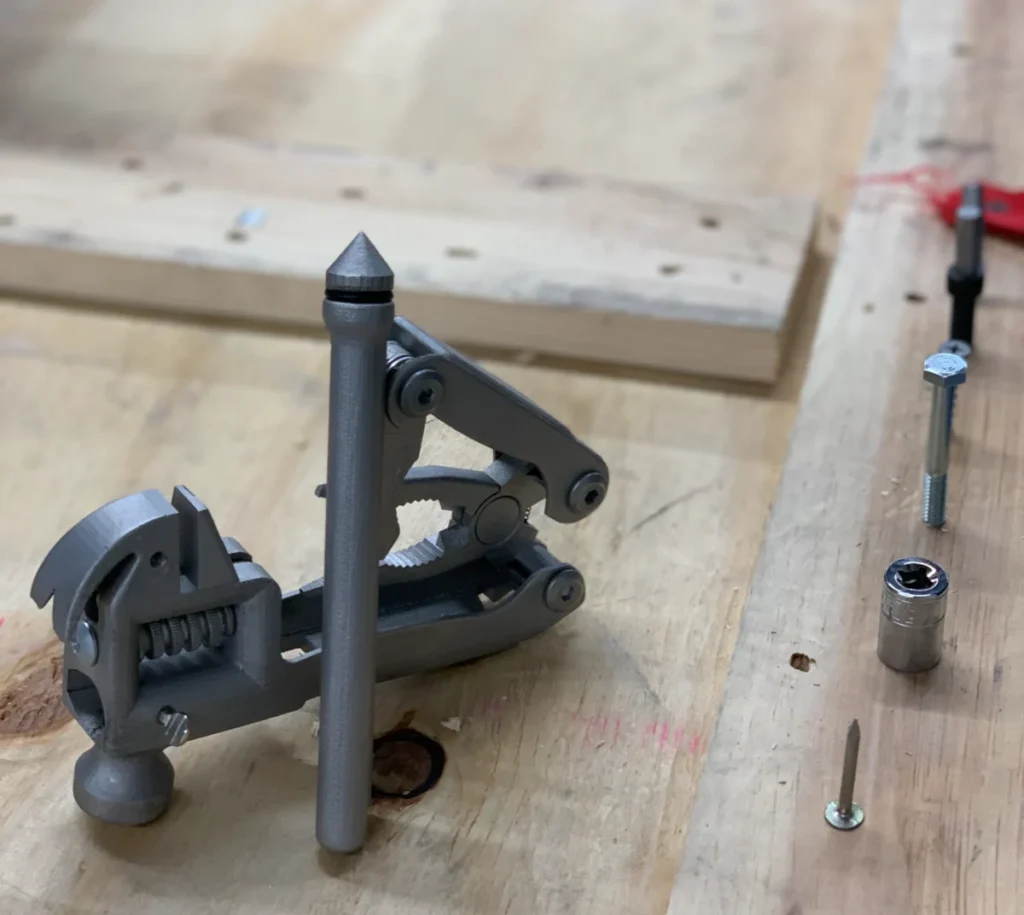
A team of ambitious students from The University of Texas at El Paso (UTEP), operating under the banner of Borderland Steel, has emerged victorious in the third annual America Makes Additive Manufacturing (AM) in Steel competition. Their triumph came with the creation of a sophisticated, fully functional stainless steel multi-tool, a testament to the power of cutting-edge 3D printing technology and innovative design. This accomplishment not only highlights the prowess of UTEP’s W.M. Keck Center for 3D Innovation but also underscores the growing significance of additive manufacturing in the creation of complex, everyday-use items.
The AM in Steel competition, a cornerstone event hosted by America Makes, the U.S. manufacturing innovation institute, challenges university student teams to conceive, design, and engineer robust, visibly 3D printed metal multi-tools. These tools, often categorized as everyday carry (EDC) items, are crucial components in diverse sectors, ranging from the intricate demands of the medical field to the robust requirements of industrial applications. The competition serves as a vital platform for nurturing the next generation of engineers and designers, pushing the boundaries of what is possible with metal additive manufacturing.
Borderland Steel’s winning multi-tool is a prime example of how the competition fosters practical application of advanced manufacturing techniques. The team’s journey began with extensive prototyping, utilizing readily available PLA desktop 3D printers to refine multiple design iterations. This initial phase allowed for rapid experimentation and validation of fundamental concepts before committing to more costly metal printing processes. The culmination of this iterative design process resulted in a final product manufactured using Laser Powder Bed Fusion (LPBF) technology with Stainless Steel 316L, a material renowned for its excellent corrosion resistance and mechanical properties, making it ideal for durable tools.
A key aspect of Borderland Steel’s success lay in their strategic approach to design consolidation. Initially, the team conceptualized twenty distinct parts for their multi-tool. However, through astute engineering and design optimization, they managed to reduce this number to approximately five integrated components. This feat was achieved by combining functionalities, standardizing interfaces between parts, and cleverly incorporating lattice structures. The use of lattices is a hallmark of additive manufacturing, enabling the reduction of material usage and weight without compromising the structural integrity or load-bearing capacity of critical components. This not only leads to cost savings but also contributes to a lighter and more efficient final product.
The commitment to perfection was evident in the team’s meticulous approach to 3D printing the final design. Borderland Steel printed multiple iterations of their multi-tool, continuously refining the process to enhance tolerances and improve the seamless movement of its various components. Achieving precise fit and function in 3D printed metal parts, especially those with moving elements like a multi-tool, requires a deep understanding of the printing process, material behavior, and post-processing techniques.
Following rigorous testing and essential post-processing steps, the Borderland Steel team presented their multi-tool at the AM in Steel competition. The event was held in conjunction with RAPID + TCT 2026, a premier trade show for additive manufacturing, in Boston, Massachusetts. The judges, comprised of industry experts and academics, evaluated the designs based on functionality, innovation, design for additive manufacturing principles, and the overall quality of the printed product. Borderland Steel’s innovative design and superior execution earned them the coveted first prize, a significant recognition of their technical expertise and creative problem-solving.
The technical specifications of the winning multi-tool highlight the advanced nature of its creation:
- Material: Stainless Steel 316L, chosen for its superior corrosion resistance, biocompatibility (making it suitable for potential medical applications), and robust mechanical properties.
- Design Software: Materialise Magics slicing software, a leading platform for preparing 3D models for printing, enabling precise control over build parameters and support structures.
- Process: Laser Powder Bed Fusion (LPBF), a metal additive manufacturing technique where a laser selectively fuses powdered material layer by layer to build a three-dimensional object.
- System: EOS M290, a widely adopted industrial 3D printing system known for its reliability and high-quality output in metal additive manufacturing.
- Postprocessing: Electrical Discharge Machining (EDM) and sandblasting were employed to achieve the desired surface finish, dimensional accuracy, and remove any residual support structures or unfused powder. EDM is particularly useful for precise finishing of intricate metal parts, while sandblasting provides a uniform surface texture.
The Genesis and Evolution of AM in Steel
The America Makes AM in Steel competition has steadily grown in prestige since its inception. The program was established to foster a deeper understanding and application of metal additive manufacturing among university students, a critical demographic for the future of the industry. The competition’s focus on multi-tools is deliberate; these items are complex assemblies of various tools, requiring precise engineering for each component’s function and for their collective integration. Successfully designing and printing a functional multi-tool demonstrates a comprehensive grasp of the entire additive manufacturing workflow, from conceptualization to final product.

The first annual AM in Steel competition, held at Forge Fair 2025 in Cleveland, Ohio, saw student teams put their 3D printed multi-tools to the test. This inaugural event laid the groundwork for future competitions, establishing the benchmarks for design innovation and manufacturing excellence. The second iteration, which also took place at Forge Fair, further refined the competition’s objectives, with a keen eye on practical functionality and the inherent advantages of additive manufacturing. The presence of experienced editors, such as Stephanie Hendrixson, who served as a judge, underscores the credibility and industry relevance of the event.
This year’s competition, hosted at RAPID + TCT 2026, marks a significant milestone, with UTEP’s Borderland Steel team rising to the top. The choice of Boston, Massachusetts, as the venue for RAPID + TCT 2026, a hub of technological innovation, provided an ideal backdrop for showcasing the cutting-edge advancements presented by the student teams.
UTEP’s Commitment to Advanced Manufacturing
The W.M. Keck Center for 3D Innovation at UTEP has established itself as a leading institution in additive manufacturing research and education. The center provides students with access to state-of-the-art equipment and faculty expertise, creating an environment conducive to pioneering innovation. The success of Borderland Steel is a direct reflection of the resources and mentorship available at the Keck Center, empowering students to tackle complex engineering challenges and achieve tangible results.
The university’s investment in advanced manufacturing facilities and programs is crucial for preparing students for the evolving demands of the global workforce. As industries increasingly adopt additive manufacturing for its speed, customization, and ability to create complex geometries, graduates with hands-on experience in these technologies are in high demand. UTEP’s approach ensures that its students are not just educated but are also industry-ready.
Broader Implications and Future Outlook
The achievement of Borderland Steel and the America Makes AM in Steel competition carries significant implications for the broader additive manufacturing landscape. Firstly, it highlights the growing maturity of metal 3D printing technologies like LPBF, demonstrating their capability to produce highly functional, durable parts for everyday use. This can inspire further adoption of these technologies across various industries seeking to optimize product design and manufacturing processes.
Secondly, the competition serves as a powerful recruitment tool for the additive manufacturing sector. By engaging students in hands-on projects, America Makes and institutions like UTEP are cultivating a pipeline of skilled professionals who can drive future innovation. The success of these student teams can also attract investment and attention to the potential of additive manufacturing, fostering a more robust ecosystem for research, development, and commercialization.
Furthermore, the emphasis on design for additive manufacturing (DfAM) principles within the competition encourages a shift in traditional engineering mindsets. Students are trained to think beyond the limitations of subtractive manufacturing, leveraging the unique capabilities of 3D printing to create lighter, stronger, and more integrated components. This approach can lead to breakthroughs in product performance and sustainability.
The future of additive manufacturing is intrinsically linked to the continuous development of new materials, processes, and applications. Competitions like AM in Steel play a pivotal role in accelerating this development by providing a platform for exploration and showcasing tangible advancements. As the technology continues to evolve, we can expect to see more complex and functional products emerging from 3D printing, transforming industries and everyday life. The UTEP Borderland Steel team’s multi-tool is a compelling preview of this exciting future, demonstrating that the intersection of advanced technology, innovative design, and dedicated talent can yield remarkable results.
The detailed coverage of this achievement, including previous years’ competitions, can be found on Additive Manufacturing Media. These resources offer valuable insights into the evolution of the AM in Steel competition and the innovative projects that have emerged from it. For instance, a previous article details Borderland Steel’s comprehensive multi-tool design and production journey, further illuminating the technical intricacies behind their victory. Additionally, recaps of earlier competitions, such as the one featuring the University of Louisville’s winning multi-tool on The Cool Parts Show, provide historical context and highlight the enduring appeal and educational value of this event. These past successes and ongoing efforts by America Makes and its partners are instrumental in shaping the future of metal additive manufacturing.