The world of advanced manufacturing and additive technologies continues its rapid evolution, marked this week by significant breakthroughs across diverse sectors. In Michigan, a new Advanced Manufacturing Center of Excellence has been launched, poised to revolutionize industry-academia collaboration. Meanwhile, in Israel, surgeons have successfully employed a custom 3D printed sternum and rib implant to save the life of a cancer patient, showcasing the life-altering potential of personalized medical devices. Complementing these advancements, researchers in Austria have developed a novel 3D printed ceramic wall utilizing evaporative cooling principles, offering a sustainable solution to combat rising urban temperatures. These developments underscore the expanding influence and multifaceted applications of 3D printing in shaping our future.
Automation Alley and Oakland University Forge New Frontier in Advanced Manufacturing
Michigan, a state historically synonymous with automotive innovation and manufacturing prowess, is further solidifying its position as a hub for advanced manufacturing with the establishment of the Advanced Manufacturing Center of Excellence (CoE). This ambitious initiative is a collaborative effort between Automation Alley, a leading statewide industry accelerator, and Oakland University, renowned for its robust engineering programs. The CoE is designed to create a dynamic ecosystem where manufacturers, students, and researchers can converge, fostering accelerated innovation in the advanced manufacturing sector.
The strategic alliance leverages Automation Alley’s extensive statewide network of manufacturers with Oakland University’s deep well of engineering expertise and a continuous influx of emerging talent. This synergy aims to bridge the gap between theoretical research and practical industrial application, a critical step in maintaining a competitive edge in the global manufacturing landscape. A cornerstone of this new Center will be the relocation and expansion of Automation Alley’s Project DIAMOnD (Distributed Independent Agile Manufacturing On Demand) Digital Transformation Center. Originally established in Auburn Hills two years ago, Project DIAMOnD represents one of the largest distributed additive manufacturing (AM) networks in the United States.
Since its inception, Project DIAMOnD has been instrumental in empowering manufacturers to adopt AM technologies, enhance production resilience, and bolster domestic supply chains. The network has a proven track record, having successfully produced over 50,000 parts for various industries. The move of Project DIAMOnD to the Oakland University campus signifies a crucial integration, placing this vital distributed manufacturing network in close proximity to cutting-edge research and development.
The Advanced Manufacturing CoE will serve as a state-of-the-art facility where industry partners can rigorously test and validate new technologies, develop novel AM applications, and access specialized technical support and comprehensive training programs. As the Center matures, Automation Alley and Oakland University plan to unveil a series of new research initiatives, forge strategic industry partnerships, and introduce comprehensive workforce development programs. These initiatives are expected to cultivate a highly skilled workforce and drive the adoption of next-generation manufacturing solutions across Michigan and beyond.
Pavan Muzumdar, the CEO of Project DIAMOnD, highlighted the significance of this relocation. "Moving our Digital Transformation Center into this facility is more than a change of address," Muzumdar stated. "It places our distributed manufacturing network next to the research that will define the next era of Smart Product Recipes and metal additive manufacturing. This is where research becomes real-world manufacturing capability, allowing us to scale what we’ve proven works." The implications of this CoE are far-reaching, potentially leading to job creation, increased economic competitiveness for Michigan, and the development of more agile and resilient manufacturing supply chains, particularly in critical sectors.
Life-Saving Innovation: Israeli Surgeons Employ 3D Printed Implant for Cancer Patient
In a remarkable demonstration of medical ingenuity, surgeons in Israel have successfully performed a complex reconstructive surgery using a custom-designed 3D printed sternum and rib implant. The patient, a woman in her twenties identified as Hadas, was diagnosed with a rare BRAF-altered mesenchymal tumor, a type of sarcoma with an exceptionally low incidence rate, with fewer than 20 cases reported globally. The aggressive nature of the tumor necessitated the removal of a significant portion of her chest wall, including her sternum and adjacent ribs, which Dr. Yury Peysakhovich, Head of Thoracic Surgery at Clalit-Beilinson Hospital, described as the "anchor of the whole chest."
The critical challenge lay in reconstructing the chest cavity with absolute precision to ensure both protection of vital organs and proper respiratory function. Traditional methods often struggle to achieve the intricate anatomical accuracy required for such complex reconstructions. In response, the surgical team opted for a state-of-the-art, customized 3D printed chest implant, meticulously designed to match Hadas’s unique anatomy.
The implant was fabricated using polyetherketoneketone (PEKK), a high-performance biomaterial renowned for its exceptional strength and flexibility, properties that closely mimic those of natural human bone. A key advantage of PEKK is its biocompatibility, which facilitates integration with surrounding tissues over time, promoting long-term healing and stability. The surgical procedure, which involved the two-hour removal of the diseased tissue and the precise implantation of the custom-made device, was a testament to the advancements in medical 3D printing and surgical collaboration. Hadas is reportedly recovering well at home, a testament to the success of this pioneering medical intervention.
Dr. Peysakhovich emphasized the inherent complexities of such procedures: "If reconstruction is not precise, both respiratory mechanics and protection of the heart and lungs can be compromised. Every breath, cough, or physical movement places significant stress on this area, making it one of the most complex reconstructions in thoracic surgery." He further elaborated on the impact of emerging technologies: "Rare cases require creative solutions. The combination of advanced 3D-printing technology and close collaboration between multiple surgical specialties allowed us to offer this patient a solution that simply wasn’t available only a few years ago." This case exemplifies the transformative potential of additive manufacturing in personalized medicine, offering hope and improved outcomes for patients facing life-threatening conditions. The ability to create patient-specific implants with such intricate detail and biocompatibility marks a significant leap forward in reconstructive surgery.
TU Graz Researchers Develop 3D Printed Ceramic Walls for Sustainable Urban Cooling
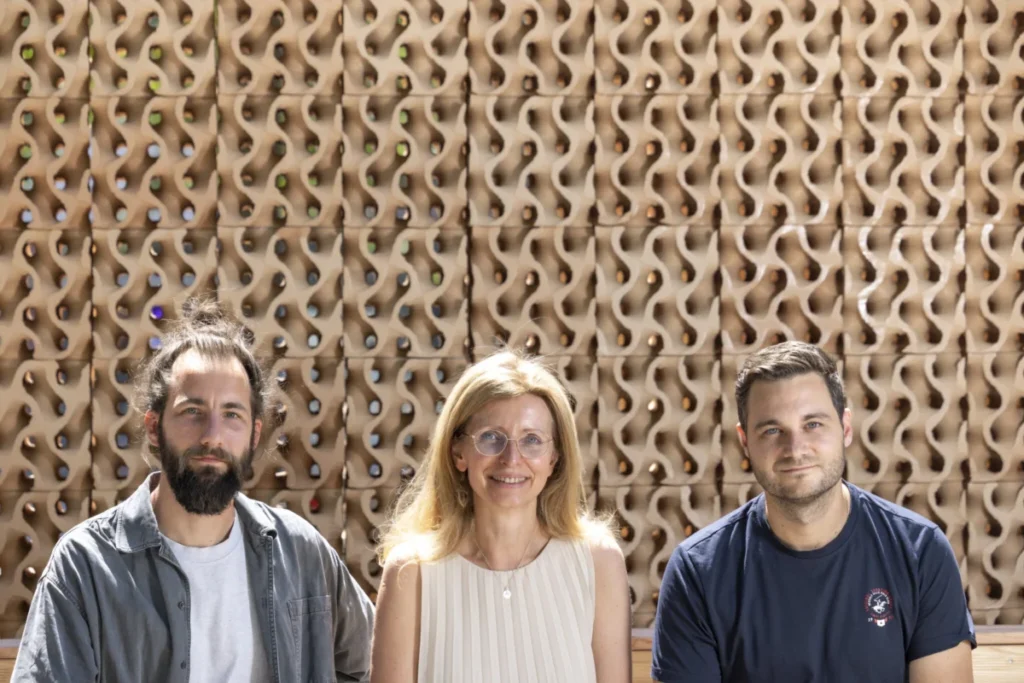
As global temperatures continue their upward trajectory, innovative solutions for urban cooling are becoming increasingly vital. A team from the Institute of Architecture and Media at Graz University of Technology (TU Graz) has developed an energy-efficient and sustainable approach to combat urban heat island effects: 3D printed ceramic walls designed for evaporative cooling. This novel technology leverages a fundamental scientific principle where the evaporation of water absorbs heat from its surroundings, thereby lowering ambient air temperatures.
The researchers have engineered modular cubes, approximately 23 centimeters on each side, 3D printed from a specialized ceramic clay mixture. These cubes are fired at low temperatures to achieve a highly porous structure, maximizing their capacity for water absorption and evaporation. A key design element incorporates minimal-surface geometry (TPMS) principles, a technique that optimizes material usage while simultaneously creating an expansive internal surface area for efficient water distribution and evaporation.
Capillary forces draw water into the porous ceramic structure, distributing it evenly across the large internal surface area. This continuous evaporation process effectively cools the air in direct contact with the material. The 3D printed ceramic cubes offer a more resource-efficient alternative to conventional, energy-intensive cooling systems, providing a passive cooling mechanism for both outdoor urban environments and indoor spaces.
The team is also exploring the integration of bio-inspired materials into the ceramic mixture, including sawdust and fungal cultures, and even sediment sourced from Lake Neusiedl. These experimental additions aim to further enhance the material’s properties and sustainability. The ultimate objective is to make natural, passive cooling solutions widely accessible in urban areas, mitigating the detrimental effects of heatwaves and reducing reliance on air conditioning.
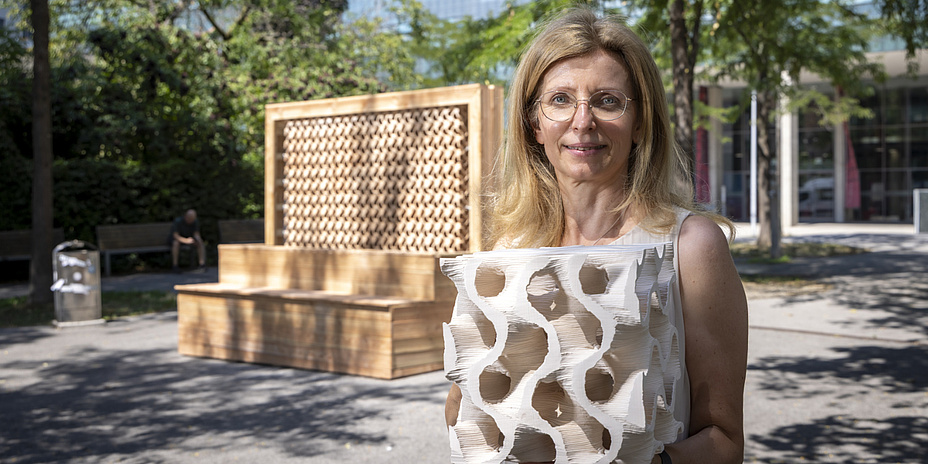
Milena Stavric from TU Graz explained the scientific basis and technological advancement: "This has been working for centuries, both in clay jugs and in traditional wind towers. The key technological advance here lies in the use of 3D printing, which enables us to produce highly complex, porous and functionally optimized geometries from clay mixtures. These special structures store water particularly efficiently and, despite their small volume, create an enormous evaporation surface." She further articulated the project’s societal impact: "Our aim is to provide cooling where people suffer particularly from the heat – for example, in cities where trees are sometimes unable to provide sufficient cooling. To achieve this, we rely on natural cooling principles rather than energy-intensive air-conditioning technology."
A functional prototype, measuring two by two meters, of the 3D printed ceramic cooling wall is currently on display at TU Graz’s Campus Neue Technik in Stremayrgasse, offering a tangible demonstration of this innovative approach to urban climate adaptation. The implications for urban planning and public health are significant, potentially leading to more comfortable and livable cities in the face of a warming planet. This development highlights the potential of additive manufacturing to contribute to sustainable urban development and climate change mitigation strategies.