ASTM International, a globally recognized leader in the development and dissemination of voluntary consensus standards, has announced the strategic rebranding of its Advanced Manufacturing Division to the Critical and Emerging Technologies (CET) Division. This significant organizational shift underscores the organization’s commitment to addressing the rapid pace of technological convergence and the increasing need for robust standards across a wider spectrum of cutting-edge fields. The move signals ASTM’s proactive approach to shaping the future of innovation by ensuring that essential standards keep pace with advancements in areas beyond traditional advanced manufacturing, including artificial intelligence, robotics, drones, and semiconductors.
The transformation of the Advanced Manufacturing Division into the CET Division is not merely a cosmetic change; it represents a fundamental evolution in ASTM’s strategy for standards development. Historically, the division focused primarily on additive manufacturing and other advanced manufacturing processes. However, with the accelerating interdependence of various technological domains, ASTM recognized the necessity of a more encompassing framework. The CET Division will now actively engage with technologies that are rapidly evolving and have the potential to reshape global economies and societies. This includes fostering collaboration across approximately 10 ASTM committees and working with partners in over 25 countries, operating in both pre- and post-standardization phases.
A Strategic Pivot Towards Convergent Technologies
The decision to rebrand is rooted in the recognition that critical and emerging technologies (CET) rarely develop in isolation. Instead, they advance interdependently, driven by the synergy between fields like artificial intelligence, advanced materials, and sophisticated automation. As over 40 national governments publish lists of CET, these lists are often dynamic and subject to change. Rather than attempting to chase these shifting definitions, ASTM’s new CET Division aims to engage with technologies at their points of convergence. This approach allows for the proactive development of standards that align with the organic growth of these technologies, ensuring their responsible and effective integration into industry and society.

"The launch of this division reflects where ASTM is heading as an organization, from developing standards to delivering standards solutions across the technologies reshaping the global economy," stated Andy Kireta, President of ASTM International. "We have proven this model in advanced manufacturing, where our community built a globally adopted framework jointly with international partners, and through Centers of Excellence that embed standards early in the research process. The CET Division scales that approach in partnership with industry, government, academia, and standards bodies around the world."
The CET Division’s mandate includes a comprehensive assessment of where standards are most critically needed within these rapidly evolving technological landscapes. It will focus on scaling development by defining clear roadmaps, establishing certification and training opportunities, and leveraging market intelligence to inform its efforts. While advanced manufacturing, including additive manufacturing, remains a cornerstone of the division’s work, its scope has been broadened to encompass other pioneering fields at various stages of maturity. This includes a dedicated focus on robotics, autonomous systems like drones, artificial intelligence and machine learning, and the rapidly advancing semiconductor industry, among others.
Revolutionizing Prosthetics with 3D-Printed Electronic Skin
In parallel with advancements in standardization, groundbreaking research continues to push the boundaries of what is possible with 3D printing. A notable development in this area comes from Washington State University, where researchers have engineered a customizable 3D-printed electronic skin designed to restore a sense of touch to prosthetic hands. This innovation addresses a significant limitation in current prosthetic technology, where a lack of tactile feedback can hinder dexterity and user experience.
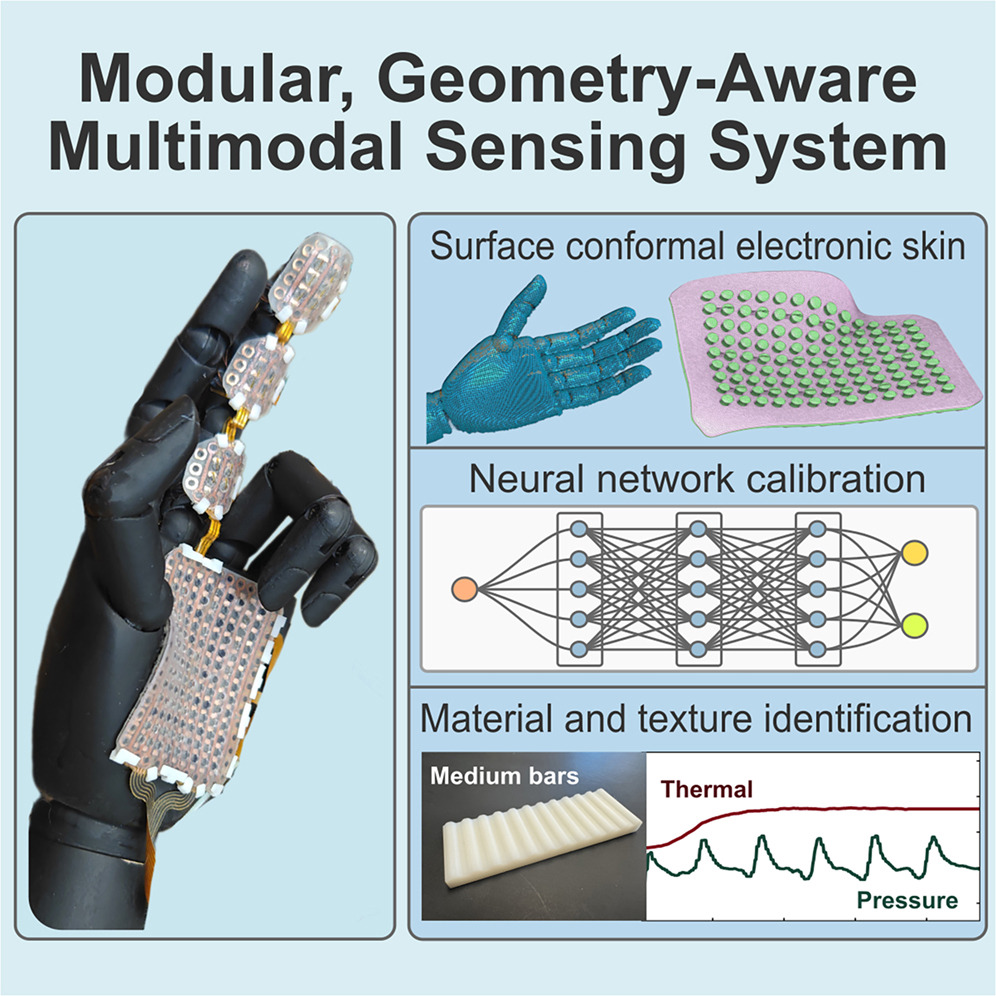
Existing electronic skin solutions often present a trade-off between a custom fit and effective sensing capabilities. The WSU team’s approach overcomes this challenge by employing a "scan-model-print" framework. The process begins with a high-resolution structured-light 3D scanner to capture the precise geometry of the prosthetic limb. This scan data is then used by specialized software to map the optimal layout of sensors onto the prosthetic’s surface.
The fabrication process utilizes Stereolithography (SLA) 3D printing to create custom structural layers that conform precisely to the prosthetic’s form. These printed layers serve as the foundation for modular sensing components. Flexible electrical layers, laser-cut to specific shapes, are then integrated into these sensor modules. These modules are designed to snap together seamlessly, allowing for easy assembly and maintenance.
Embedded within these multilayer modules are sophisticated sensing arrays capable of detecting both pressure and temperature. The dense integration of these sensing systems within a confined physical area allows for multimodal feedback that closely mimics human touch. A key aspect of this research is the development of a neural network trained to calibrate individual sensor elements and filter out manufacturing-induced noise. This sophisticated algorithm enables the rapid and accurate interpretation of sensor data, providing users with nuanced tactile information. The researchers report that this modular sensing system can achieve a spatial resolution approximately ten times greater than that of commercially available glove-based sensors, offering a significant leap forward in prosthetic functionality.
The research team highlighted the novelty of their approach in their publication in Cell Reports Physical Science: "Diverging from previous e-skin platforms that concentrate on planar multimodal sensing, material-level innovations, or algorithmic signal interpretation independently, here, we introduce a prosthetic sensing system with a ‘scan-model-print’ manufacturing framework that bridges the gap between high-fidelity sensing and personalized fabrication." They further detailed the system’s strengths, including its prosthetic-based, surface-conformal design enabled by 3D scanning and SLA printing, the modular "LEGO-like" snap-fit sensing modules for robust and adaptable installation, the spatially interlaced pressure and temperature matrices for increased sensing density, and the neural network-based calibration for high-density module performance. This breakthrough holds immense potential for improving the quality of life for individuals with limb loss, offering a more intuitive and responsive prosthetic experience.
Regenerative Medicine Takes a Leap Forward with 3D-Printed Microscaffolds
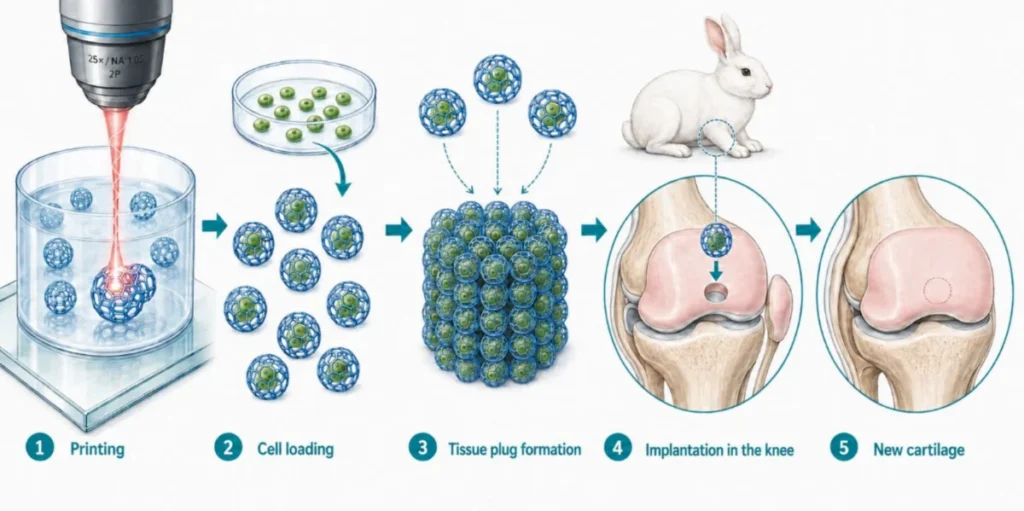
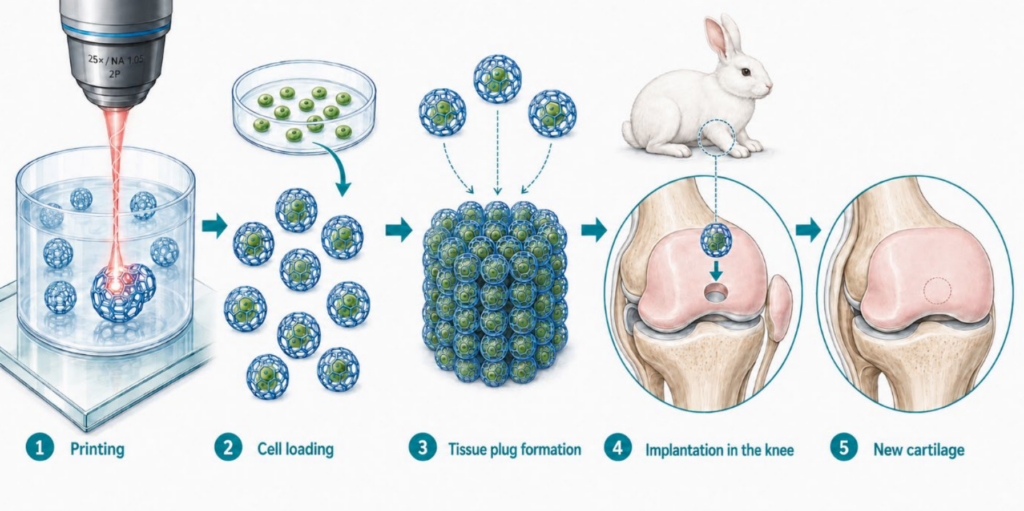
In the realm of regenerative medicine, researchers are leveraging advanced 3D printing techniques to develop novel therapeutic solutions. A preclinical study conducted by scientists at TU Wien, in collaboration with the Ludwig Boltzmann Institute for Traumatology and the Medical University of Vienna, has demonstrated the successful regeneration of functional cartilage in living rabbits using 3D-printed implantable microscaffolds.
The study utilized DEGRAD INX, a biodegradable resin developed by BIO INX, renowned for its suitability in high-resolution 3D printing applications. The researchers employed multiphoton lithography, a cutting-edge 3D printing technology capable of achieving remarkable precision at the microscale, to fabricate the implantable scaffolds. These microscaffolds, measuring a mere 0.3mm in diameter, were meticulously designed to serve as biocompatible carriers for cartilage cells.
The process involved loading the microscaffolds with cell spheres derived from stem cells, which were then cultured to form tissue constructs. These engineered constructs were subsequently implanted into critical-sized osteochondral defects in the knees of rabbits. The results, observed after a 12-week period, were highly encouraging. Rabbits treated with the 3D-printed implants exhibited significant improvements in cartilage regeneration compared to untreated control subjects.
Cartilage tissue is notoriously difficult to regenerate due to its limited intrinsic healing capabilities. Therefore, this in vivo study represents a significant advancement in the field of regenerative therapies. BIO INX has emphasized that this publication marks the first demonstration of their technology’s successful application in living animals, underscoring the potential of advanced biofabrication and high-resolution biodegradable materials for minimally invasive regenerative treatments for cartilage repair.
Aysu Arslan, CSO and Co-founder of BIO INX, expressed enthusiasm for the findings: "This publication represents another important validation of our DEGRAD INX platform. By combining the unmatched resolution of multiphoton lithography with a fully biodegradable material, researchers can fabricate sophisticated cell carriers that simply were not possible before. Seeing these materials contribute to the regeneration of cartilage in vivo is an exciting step towards future regenerative therapies for patients." This research paves the way for new therapeutic strategies for conditions involving cartilage damage, offering hope for enhanced patient recovery and improved long-term joint health.
Innovative Upcycling: Plastic Waste Transformed into Edible Cookies
In a surprising and innovative development, researchers from Southern Illinois University (SIU) Carbondale have demonstrated a novel method for upcycling plastic waste into edible cookies through a process involving microbial conversion and 3D printing. This groundbreaking project, initially conceived as part of a NASA-led initiative to develop food sources for deep space missions, has significant implications for addressing global food security and plastic pollution on Earth.
The research focuses on polyethylene terephthalate (PET), a ubiquitous plastic commonly used in beverage bottles, which contains carbon-rich molecules. Traditionally, transforming these molecules into edible proteins and nutrients would involve complex chemical processes. However, the SIU team has opted for a more eco-friendly and sustainable approach by utilizing yeast, a type of microbe, to achieve this conversion.
The core of their methodology lies in a proprietary process known as oxidative hydrothermal dissolution. Through this advanced technique, researchers have engineered several strains of yeast to efficiently convert molecules found in PET plastic and biomass into essential vitamins, proteins, and flavor compounds. This microbial transformation bypasses the need for harsh chemical solvents and high-energy reactions, presenting a greener alternative for resource recovery.
Once the yeast has synthesized the key nutritional and flavor components, the researchers incorporate additional ingredients such as fiber, starch, and sweetener. The resulting mixture is then extruded through a 3D printer to produce protein-rich cookies, aptly named μBites (pronounced "microbites"). To further enhance consumer appeal and nutritional value, graduate student Sandhya Jayasekara has developed yeast strains capable of producing more diverse food additives, including vanilla flavoring derived from plant biomass.
Associate Professor Lahiru Jayakody highlighted the urgency and potential of this research: "Global food demand is expected to rise 35–56% by the year 2050, and about 30% of the world population will be at risk of hunger in the future. The way to address that, I believe, is by using microbes." This innovative approach not only offers a sustainable solution for managing plastic waste but also presents a viable pathway for producing nutrient-dense food in resource-constrained environments, such as long-duration space missions or remote terrestrial locations facing food scarcity. The ability to transform waste materials into a palatable and nutritious food source represents a significant paradigm shift in our approach to sustainability and food production.