The relentless pursuit of automotive safety hinges on meticulous crash testing, a process where the integrity of data captured is paramount. For the sophisticated cameras, optics, and electrical devices embedded within test vehicles, survival under extreme G-forces is not just desirable, it’s essential for them to "tell the tale" of a collision. Photron, a renowned crash test agency based in Japan, has long grappled with the challenges of ensuring their critical instrumentation withstands these brutal impacts and continues to function. A significant hurdle they faced was the potential for data loss stemming from the physical positioning and vulnerability of their equipment inside the vehicle.
To address these persistent issues, Photron has forged a crucial partnership with Andy Schaefer, the visionary owner and sole engineer behind Germany-based Additive Printing Solutions (APS). Founded five years ago, APS has rapidly established itself as a leader in design, 3D printing, and additive manufacturing workshops, dedicated to instilling an "AM thinking" mindset within manufacturing sectors. Schaefer’s expertise, particularly in leveraging advanced 3D printing technologies, has proven instrumental in developing bespoke solutions for Photron’s demanding crash test environments.
The Genesis of a Partnership: Addressing Critical Data Gaps
Photron’s core mission involves capturing high-resolution visual and sensor data during controlled vehicle impacts. These tests are not arbitrary; they are meticulously planned events designed to simulate real-world accident scenarios. The data gathered is then analyzed by engineers and safety experts to assess vehicle structural integrity, the effectiveness of restraint systems like airbags and seatbelts, and the overall occupant protection. The accuracy and completeness of this data directly influence future vehicle design, regulatory standards, and ultimately, public safety.
Historically, the placement of sensitive recording equipment within a crash test vehicle presented a significant logistical and technical challenge. Cameras, often positioned in tight or vulnerable locations such as beneath seats or behind steering columns, are subjected to immense shockwaves and deformation. The violent deceleration can cause these devices to shift, lose focus, or even sustain damage that corrupts or erases vital data. This loss of information at the most critical moments of impact could necessitate costly and time-consuming repeat tests, or worse, leave critical safety questions unanswered.
Recognizing this vulnerability, Photron sought innovative solutions to enhance the reliability and resilience of their in-vehicle instrumentation. Their search led them to Andy Schaefer and APS, a company at the forefront of utilizing advanced additive manufacturing techniques for industrial applications.
Leveraging Advanced 3D Printing for Robust Crash Test Solutions
APS’s approach to solving Photron’s challenges has been centered on the precision and material capabilities offered by Markforged’s polymer-composite 3D printing technology and their proprietary Onyx material. Onyx is a high-strength, high-temperature nylon composite renowned for its durability, chemical resistance, and excellent surface finish, making it ideal for demanding environments. The combination of precise 3D printing and this robust material has enabled APS to engineer a suite of custom solutions that have significantly improved Photron’s data capture capabilities.
Fortifying the Gaze: Advanced Camera Casings
One of the primary areas of concern for Photron was the stability and focus of cameras positioned within the vehicle. These cameras are critical for observing the kinematics of the crash dummy, the deployment of airbags, and the overall structural response of the vehicle interior. However, the intense forces generated during an impact could easily disrupt the delicate focusing mechanisms of these small, strategically placed cameras.
APS addressed this by designing and 3D printing custom camera casings. These casings are not merely protective shells; they are engineered to securely hold the camera in its optimal position, often using simple yet effective zip ties, a common fastening method in crash test setups. This secure mounting prevents the camera from shifting or vibrating excessively during the impact, thereby preserving its focus and ensuring that crisp, clear imagery is captured precisely when it matters most. The ability to create these bespoke casings on demand, tailored to the specific dimensions and mounting points of various camera models, offers a level of customization and rapid iteration that traditional manufacturing methods could not easily provide.
Bridging the Gap: Innovative Cabling Adapters
Another significant challenge identified by Schaefer involved the complex network of cables connecting the in-vehicle cameras and sensors to the data collection console, typically located in the rear of the vehicle. While the camera housings themselves were often standardized, the lengths of the connecting cables varied depending on the camera’s placement. This variation necessitated different connector configurations, leading to potential compatibility issues and the need for a cumbersome array of specialized adapters.
"If they have a 3-meter cable or an 8-meter cable, they need different adapters," Schaefer explains, highlighting the practical difficulties Photron faced. "They don’t want to have to make another housing for the cameras, so I make them adapters so they can always use the same housing."
APS’s solution was to design and 3D print compact, puck-shaped adapters. These adapters act as crucial intermediaries, ensuring a robust and consistent cable connection regardless of the cable length. Schaefer manufactures these adapters in three distinct sizes, precisely matching the common cable diameters used by Photron. This seemingly simple innovation eliminates the need for multiple camera housings and streamlines the setup process for each crash test, saving valuable time and reducing the potential for connection errors. The precision of the 3D printing process ensures a snug fit and reliable electrical contact, crucial for uninterrupted data flow.

Securing the Flow: Advanced Cable Management Tooling
The most complex and impactful solutions developed by APS for Photron address the critical task of maintaining uninterrupted data flow to the central console. With numerous instruments feeding vital information into this console, any disconnections, however brief, during the violent moments of impact could result in significant data gaps. This is where Schaefer’s ingenuity, combined with Markforged’s advanced capabilities, truly shines.
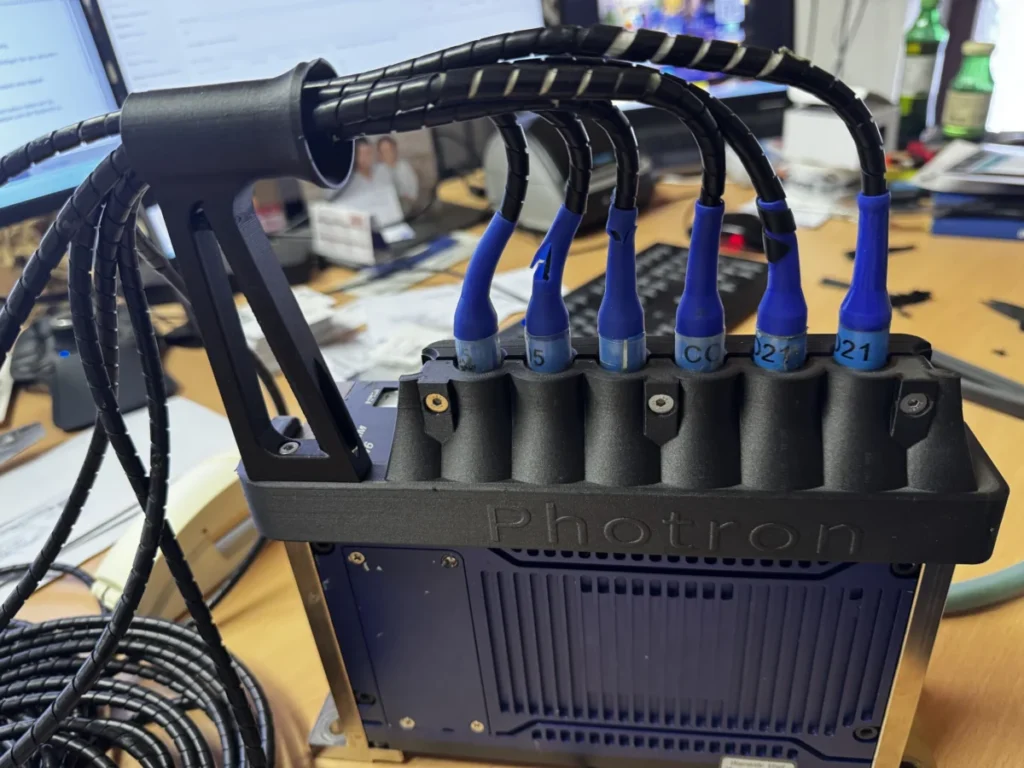
Initially, Schaefer developed a support for the plug connections that could be easily affixed to the console using zip ties. He notes the ubiquity of zip ties in crash test assemblies, often serving as the most practical and accessible fastening solution. However, recognizing the need for even greater security and cable strain relief, APS moved to a more sophisticated, multi-part design.
The current iteration of the cable management tooling is a testament to iterative design and advanced material science. It features a two-part construction designed to fully encompass each cable, providing a secure and stable connection point at the console. The outer support, which faces the camera, snaps directly onto the console. Crucially, it utilizes existing screw holes on the console, avoiding any need for permanent modification of the data acquisition unit. This outer piece is then secured with screws, further enhancing its stability.
The inner support, which attaches to the outer support via screws, incorporates embedded nuts that are integrated directly into the 3D printing process. This clever design element ensures a strong mechanical connection between the two parts.
Engineered for Resilience: Fiber Reinforcement and Structural Integrity
For the outer component of this advanced cable carrier, Schaefer leveraged Markforged’s Eiger software and its unique fiber-reinforcement capability. This technology allows for the strategic embedding of continuous strands of high-strength composite fibers, such as fiberglass, within the printed polymer structure. The outer support for Photron’s cable carrier includes four sections reinforced with fiberglass, each comprising 12 layers of material. This reinforcement significantly enhances the stiffness and overall structural integrity of the component, enabling it to withstand the extreme forces without deforming or failing.
Complementing this, a third piece of the assembly is designed to elevate the cables approximately 100 mm away from the console. This lift is not merely aesthetic; it serves a critical function in maintaining the integrity of the data signal by reducing stress on the wires at the connection point. By preventing sharp bends or kinks in the cables as they approach the console, the risk of signal degradation or intermittent connection is substantially minimized. Furthermore, this taller support structure incorporates three fiberglass-reinforced regions oriented in the direction of travel. This strategic reinforcement ensures that the support itself remains robust and stable throughout the impact, providing continuous protection for the critical cable connections.
The Paradox of Durability: A Success Story with a Catch
The success of these 3D printed solutions extends beyond mere functionality. They have proven to be exceptionally durable, capable of surviving multiple crash tests and being reused. This reusability represents a significant cost-saving for Photron and underscores the high-quality engineering and material selection employed by APS.
However, this durability presents a humorous paradox for Schaefer. "This is the problem," he quips, a smile in his voice. "On the one hand, I’m very happy about this fact that they don’t break down on the crash test. But on the other side, I don’t sell them much, because they are reused so often." This lighthearted observation speaks volumes about the reliability and longevity of the solutions APS provides, turning a potential business challenge into a testament to their engineering prowess.
Implications and the Future of Crash Test Instrumentation
The collaboration between Photron and APS, powered by Markforged’s additive manufacturing technology, represents a significant advancement in the field of automotive crash testing. By addressing critical vulnerabilities in data capture instrumentation, they are not only improving the efficiency and accuracy of testing but also contributing to the broader goal of enhancing vehicle safety.
The ability to rapidly design, prototype, and manufacture custom, high-performance components using 3D printing offers several key advantages:
- Cost-Effectiveness: Custom solutions can be produced on demand, reducing the need for expensive, mass-produced tooling and minimizing waste.
- Speed and Agility: The iterative design process allows for quick adjustments and improvements, accelerating problem-solving.
- Performance Enhancement: Advanced materials and design freedom enable the creation of components with superior strength, stiffness, and functionality.
- Reduced Lead Times: On-demand manufacturing significantly shortens the time from design conception to functional part deployment.
The success of APS in the demanding crash test environment suggests that similar additive manufacturing solutions could be applied to a wide range of critical industrial applications where robust, custom-designed components are essential. As automotive safety standards continue to evolve and become more stringent, the need for precise and reliable data capture will only increase. Innovations like those pioneered by APS, leveraging the power of 3D printing, will undoubtedly play a crucial role in shaping the future of automotive development and ensuring the safety of road users worldwide. The ongoing evolution of materials and printing technologies promises even greater possibilities for creating resilient and intelligent instrumentation capable of withstanding the most extreme conditions, thereby pushing the boundaries of what is possible in the pursuit of automotive safety.