The rigorous process of automotive crash testing is indispensable for ensuring vehicle safety and compliance with stringent global regulations. However, the integrity of this critical development stage hinges entirely on the quality and completeness of the data captured. For the sophisticated cameras, optics, and electrical devices tasked with recording these high-impact events within a test vehicle, survival and functionality under extreme G-forces are paramount. Data loss due to equipment failure or displacement can render expensive tests inconclusive, necessitating costly repetitions. This challenge has been significantly addressed through an innovative collaboration between Photron, a leading Japanese crash test agency, and Additive Printing Solutions (APS), a German firm specializing in advanced 3D printing applications.
Photron, deeply entrenched in the demanding world of automotive safety validation, recognized that the physical mounting and stability of their data acquisition equipment were often the Achilles’ heel of their crash test setups. Traditional methods of securing sensitive electronics within the violent environment of a simulated collision frequently proved inadequate. The intense forces generated can dislodge cameras, disrupt their delicate optics, and sever vital data connections, leading to gaps in the crucial moments of impact. This realization prompted Photron to seek out specialized expertise capable of developing bespoke, resilient solutions.
The search led them to Andy Schaefer, the visionary owner and sole engineer behind Additive Printing Solutions (APS). Founded five years ago, APS has rapidly carved a niche for itself by offering comprehensive services in design, 3D printing, and crucially, by coaching manufacturers on integrating additive manufacturing (AM) into their strategic thinking. Schaefer’s approach emphasizes not just the printing process, but a deep understanding of material science and engineering principles to create functional, durable components tailored to specific, often extreme, operational requirements.
Leveraging Advanced Materials and Manufacturing for Resilience
APS’s engagement with Photron has focused on utilizing polymer-composite 3D printing technology from Markforged, specifically employing their robust Onyx material. This combination of high-performance 3D printing and advanced composite materials has empowered APS to engineer a suite of solutions designed to overcome the unique challenges of crash test environments. The inherent strength, durability, and precise geometric capabilities of 3D printing, when combined with materials engineered to withstand significant stress, have proven to be a transformative force in enhancing the reliability of crash test data.
Securing Critical Imaging: Advanced Camera Casings
One of the primary areas where APS has made a significant impact is in the design of protective casings for the small, high-speed cameras used within crash test vehicles. These cameras, often strategically placed under seats, behind airbags, or near the dashboard, are vital for documenting the intricate movements of vehicle occupants and structural deformation. However, the jarring impacts of a crash can easily cause these cameras to shift, vibrate excessively, or even become dislodged, leading to blurred or completely lost footage at the most critical junctures.
APS, under Schaefer’s direction, has developed custom-designed camera casings that provide a secure, vibration-dampening environment for these sensitive instruments. These casings are engineered for easy installation, often utilizing readily available zip ties for a firm, yet adaptable, attachment to the vehicle’s interior structure. This approach ensures that the camera remains precisely positioned, maintaining its optical focus throughout the impact sequence. By preventing unwanted movement, these 3D printed solutions guarantee that Photron’s cameras can capture sharp, clear imagery, providing invaluable visual data that is essential for post-test analysis and safety validation. The ability to precisely control the internal dimensions of the casing also allows for optimal integration with camera mounting hardware, further enhancing stability.
Streamlining Data Connectivity: Innovative Cabling Adapters
Beyond camera stability, the integrity of the data transmission network within a crash test vehicle is equally critical. Cameras and sensors are connected to a central data logging unit, typically housed in the rear of the vehicle, via a complex web of cables. A common point of failure or inconvenience arises from the varying lengths of these cables. While the camera housings themselves are standardized, the electrical connectors can differ based on the required cable length – a factor dictated by camera placement and vehicle dimensions.
Historically, Photron might have faced the prospect of needing different camera housings or complex modifications to accommodate these varying cable connections. Andy Schaefer addressed this challenge by designing a series of clever, puck-shaped adapters. These adapters are specifically engineered to mate with the existing camera housings, providing a standardized interface for different cable types. This innovative solution allows Photron to maintain their established camera housing infrastructure while seamlessly accommodating cables of different lengths, ranging from short, meters-long runs to longer, eight-meter extensions.
Schaefer produces these adapters in three distinct sizes, precisely matching the cable diameters commonly used by Photron. This customizability ensures a snug and secure fit for each cable, preventing any slack or potential for disconnection during the extreme forces of a crash. The use of 3D printing allows for rapid iteration and precise manufacturing of these critical interface components, minimizing lead times and costs associated with traditional manufacturing methods for such specialized parts. The material chosen for these adapters also needs to withstand the vibrational environment and potential minor impacts within the vehicle.

Fortifying Data Acquisition: Advanced Cable Management Tooling
The final frontier of data integrity addressed by APS for Photron involves the data collection console itself. With numerous instruments and sensors feeding real-time data into this central unit, maintaining uninterrupted connections is paramount. Photron had observed instances where, during the violent deceleration of a crash, cables would momentarily disconnect from the console, leading to critical data gaps.
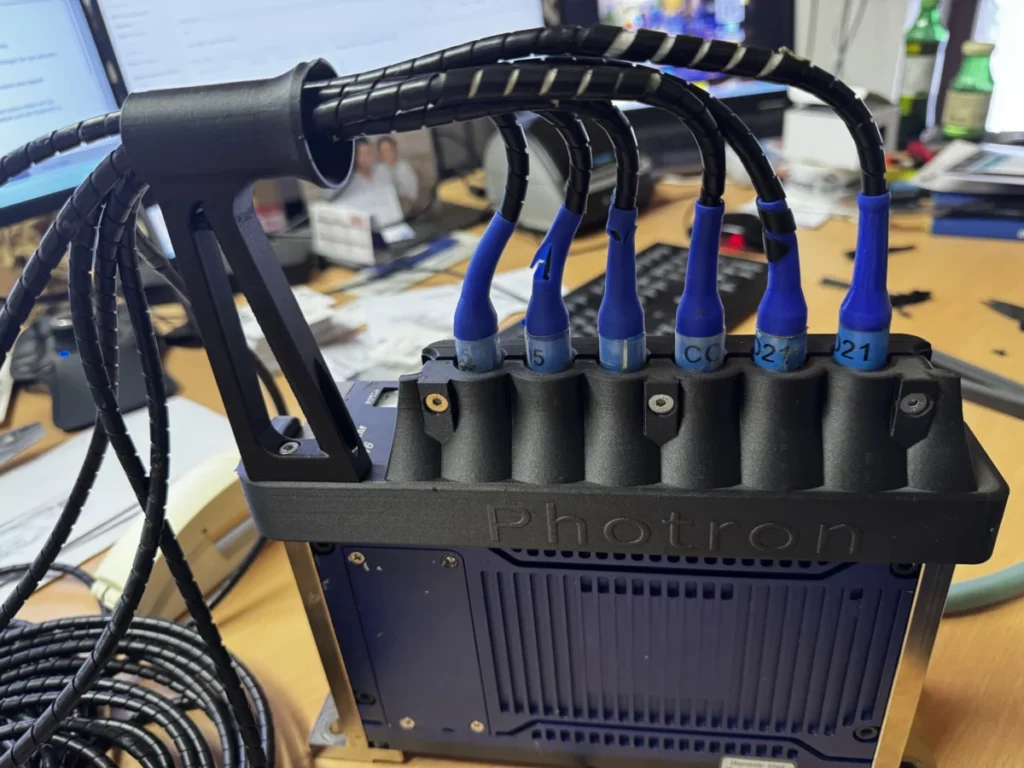
Schaefer’s solution involved developing 3D printed tooling that could be affixed to the data collection console without requiring permanent modifications to the existing, often expensive, equipment. The initial iteration of this solution involved a simple support for the plug connections, secured with zip ties. Schaefer notes the ubiquitous nature of zip ties in crash test assemblies, highlighting their practicality and ease of use in such dynamic environments. "Zip ties are everywhere in crash test assemblies," he remarks. "If you can zip it with a tie, it’s the easiest solution."
The evolution of this design led to a more sophisticated, two-part construction aimed at providing robust, comprehensive cable support. The current iteration features an outer support that snaps onto the console, utilizing existing screw holes for a secure, non-intrusive attachment. This outer component is designed to fully encompass the cable entry point. A secondary, inner support then attaches to the outer piece via screws. This inner support incorporates embedded nuts, a feature made possible by the additive manufacturing process, allowing for strong, secure fastening during the printing phase.
Crucially, the outer part of this cable carrier leverages Markforged’s Eiger software and its advanced fiber-reinforcement capabilities. This allows Schaefer to integrate continuous fiberglass reinforcement into specific layers of the print. The outer support includes four sections, each 12 layers thick, reinforced with fiberglass to impart exceptional stiffness and tensile strength. This engineered reinforcement is vital for resisting the shear and tensile forces exerted on the cables during impact.
Further enhancing the system, a third 3D printed component is integrated into the assembly. This piece elevates the cables approximately 100 mm away from the console, effectively creating a strain relief mechanism. By lifting the cables and providing a gentle curve, this element significantly reduces stress on the wires at the connection point, preventing the sharp bends and tugs that can lead to disconnections. This elevated support also incorporates three strategically placed fiberglass-reinforced regions, oriented in the direction of travel, to ensure its structural integrity during the frontal impact of a crash test.
The Paradox of Durability: Reusable Components and Cost-Effectiveness
The success of APS’s 3D printed solutions for Photron extends beyond mere functionality; the durability of these components has proven exceptional. The camera casings, adapters, and cable management tooling are not only surviving the intense forces of crash testing but are also proving to be reusable. This longevity represents a significant economic advantage for Photron, reducing the need for frequent replacements and lowering the overall cost of their testing operations.
However, Andy Schaefer humorously points out the paradoxical nature of this success. "This is the problem," he quips. "On the one hand, I’m very happy about this fact that they don’t break down on the crash test. But on the other side I don’t sell them much, because they are reused so often." This statement underscores the inherent value proposition of high-quality, durable additive manufacturing: it solves problems effectively and sustainably, leading to long-term cost savings for the end-user.
Broader Implications for Automotive Safety Development
The collaboration between Photron and APS exemplifies a broader trend in the automotive industry: the increasing reliance on advanced manufacturing technologies like 3D printing to solve complex engineering challenges. Crash testing, a field where precision, reliability, and data integrity are paramount, is a prime candidate for such innovation.
The ability to rapidly design, prototype, and produce highly customized, robust components using materials like Markforged’s Onyx, reinforced with continuous fibers, opens up new possibilities. It allows safety engineers to focus on the critical aspects of vehicle design and testing, rather than being hampered by limitations in data acquisition hardware. The implications are far-reaching:
- Enhanced Data Accuracy: Improved equipment stability and connection reliability lead to more complete and accurate data sets, enabling deeper insights into vehicle behavior during a crash.
- Reduced Testing Costs: Reusable components and fewer failed tests translate into significant cost savings, allowing for more frequent testing or allocation of resources to other R&D areas.
- Accelerated Development Cycles: The agility of 3D printing allows for quicker iteration and deployment of solutions, potentially shortening the overall vehicle development timeline.
- Improved Safety Standards: Ultimately, more reliable and comprehensive crash test data contributes to the development of safer vehicles, benefiting consumers worldwide.
The story of Photron and APS highlights how a focused application of additive manufacturing, combined with a deep understanding of specific industry challenges, can yield transformative results. As automotive safety standards continue to evolve and become more demanding, technologies that can ensure the fidelity of critical data capture will play an increasingly vital role in shaping the future of vehicle safety. The future of crash testing is not just about simulating impacts, but about reliably capturing every critical detail of those impacts, and 3D printing is proving to be an indispensable tool in achieving that goal.