The global push towards electrification, particularly in the automotive sector, has brought the efficiency of electric motors into sharp focus. With millions of electric vehicles (EVs) now on roads worldwide and projections indicating exponential growth in the coming decades, even marginal improvements in motor efficiency can translate into colossal energy savings, reduced carbon footprints, and extended battery ranges. One of the most significant hurdles in achieving peak efficiency is the phenomenon known as iron loss, or magnetic hysteresis loss. This intrinsic energy dissipation occurs within the motor’s core, typically constructed from soft magnetic materials, as the internal magnetic fields repeatedly reverse direction during operation. This ceaseless flipping generates unwanted heat, effectively wasting energy and contributing to thermal stress within the motor. Compounding this challenge, electric motors frequently operate at elevated temperatures, which can partially demagnetize these crucial soft magnetic materials, further exacerbating the energy loss problem and complicating the engineering landscape.
The Invisible Battle: Understanding Magnetic Domains
At the heart of these complex thermal and magnetic interactions lies the intricate behavior of magnetic domains. These are microscopic regions within magnetic materials where the atomic magnetic moments are aligned in a uniform direction. The collective arrangement, size, and structure of these domains dictate how a magnetic material responds to external magnetic fields and, crucially, how much energy it dissipates as heat during dynamic operation. In essence, the dance of these tiny magnetic entities governs the macroscopic efficiency of an electric motor.
The problem of iron loss is not new, but its urgency has escalated with the advent of high-performance EVs and renewable energy systems, which demand motors capable of operating at higher speeds and temperatures with unparalleled efficiency. Conventional electric motors can lose anywhere from 5% to 15% of their input energy due to various factors, with iron loss being a significant contributor, especially at higher frequencies. For an EV, this translates directly to reduced range, increased charging frequency, and a heavier burden on the battery system, ultimately impacting consumer adoption and the overall economic viability of electric transportation.
The Enigma of Maze Domains
Among the myriad of magnetic domain structures, certain soft magnetic materials exhibit particularly complex and fascinating configurations known as maze domains. These structures are aptly named for their highly intricate, zig-zagging, and labyrinth-like appearance. Unlike simpler domain patterns, maze domains are notoriously dynamic, undergoing abrupt and significant changes in response to fluctuations in temperature. This inherent instability makes them a critical, yet poorly understood, factor in energy loss mechanisms.
Scientists and engineers have long grappled with fully characterizing and predicting the behavior of these maze domains. The challenge stems from the multitude of interacting factors at play: the material’s precise microscopic structure, the pervasive influence of thermal effects, and the delicate balance of energy stability within the material. Traditional experimental techniques often provide snapshots of these domains but struggle to reveal the underlying causal mechanisms, while conventional simulations frequently oversimplify the complex realities of real-world materials, failing to capture the full spectrum of their dynamic behavior.
A Breakthrough in Understanding: The eX-GL Model
Addressing this fundamental scientific gap, a pioneering research team spearheaded by Professor Masato Kotsugi and Dr. Ken Masuzawa from the Department of Material Science and Technology at Tokyo University of Science (TUS), Japan, has developed a groundbreaking new approach. Collaborating with experts from the University of Tsukuba, Okayama University, and Kyoto University, the team engineered a novel model dubbed the entropy-feature-eXtended Ginzburg-Landau (eX-GL) model. This innovative framework was specifically designed to delve into the complex energy landscape of maze domains, with their initial focus on a rare-earth iron garnet (RIG), a material known for its intricate magnetic properties.
"Conventional simulations often oversimplify the complex realities of real materials, while traditional experiments, though revealing complexity, lack a clear, quantifiable pathway to establish cause and effect," explained Professor Kotsugi, highlighting the limitations of existing methodologies. "Our physics-based, explainable artificial intelligence (AI) framework directly addresses these shortcomings. It is meticulously designed to mechanistically explain the temperature-dependent magnetization reversal process, offering unprecedented insights into these previously hidden dynamics."
The team’s significant findings, which promise to revolutionize our understanding of magnetic materials, were formally published in the esteemed scientific journal Scientific Reports, marking a pivotal moment in the quest for more efficient electric motors.
AI and Physics Converge to Reveal Hidden Magnetic Behavior
To meticulously investigate how varying temperatures influence the magnetization reversal process within maze domains, the researchers embarked on a multi-stage experimental and computational journey. They began by capturing high-resolution microscopic images of the magnetic domains within the RIG sample across a spectrum of different temperatures. These detailed images, representing the material’s magnetic microstructure at various thermal states, then became the primary input for their sophisticated eX-GL model.
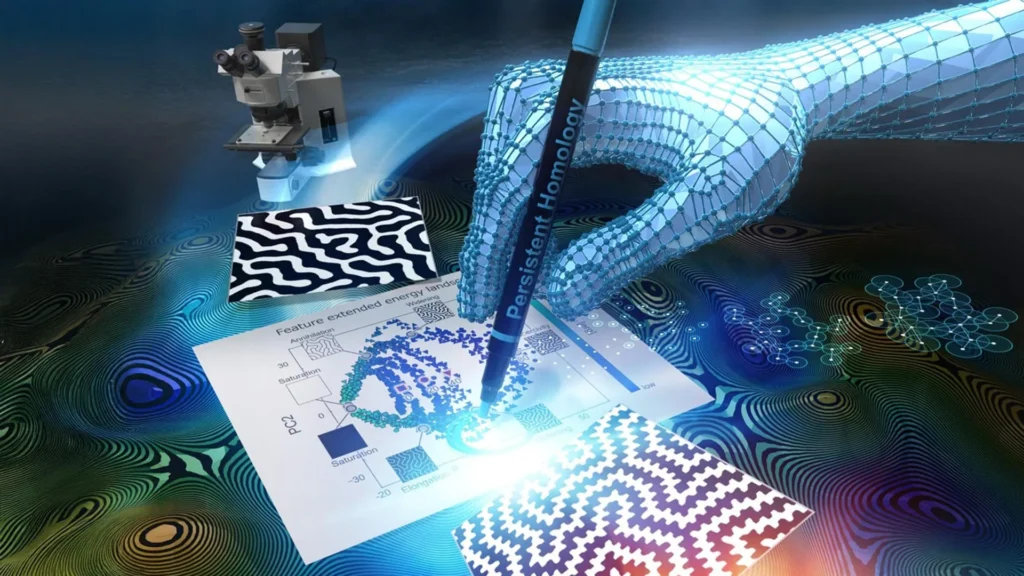
The analytical process unfolded in several ingenious stages. The first stage leveraged persistent homology (PH), a cutting-edge mathematical method rooted in topological data analysis. PH is uniquely capable of identifying and quantifying structural features within data, regardless of their scale. In this context, it allowed the team to precisely detect and characterize the uneven, complex structural characteristics inherent in the magnetic domain images – features that might otherwise be missed by conventional image analysis.
Following the application of PH, the derived data was fed into a machine learning-based pattern recognition system. This AI component was tasked with identifying the most salient and influential features from the vast amount of PH data. The output of this stage was a digital free-energy landscape, a sophisticated map that meticulously tracks how the magnetic microstructures evolve and transform as the material’s energy state changes. This landscape provided an unprecedented dynamic view of the magnetic domain behavior.
Finally, a rigorous mathematical analysis was employed to establish a direct link between these observed microscopic domain structures and the broader, macroscopic process of magnetization reversal. This crucial step allowed the researchers to bridge the gap between the atomic-level magnetic phenomena and the material’s overall magnetic response, which is directly relevant to motor efficiency.
Through this comprehensive methodology, the research team successfully identified a dominant feature, termed PC1 (Principal Component 1), which proved to be remarkably effective in capturing and describing the entire magnetization reversal process. By establishing a robust connection between PC1 and the underlying physical properties of the material, the team was able to visually map out four major energy barriers. These barriers, previously invisible to conventional analysis, were found to exert a profound influence on the dynamics of magnetization reversal, acting as critical junctures that dictate how efficiently a motor’s magnetic core can respond to changing fields.
Unveiling Hidden Energy Barriers Inside Magnetic Materials
A deeper, more granular analysis of these newly identified energy barriers and their associated microstructures provided critical insights into how different forms of energy intricately affect the magnetization reversal process. The researchers meticulously quantified energy transfer mechanisms involving fundamental physical interactions: exchange interactions (the quantum mechanical forces that align adjacent atomic magnetic moments), demagnetizing effects (forces that tend to reduce the overall magnetization of a material), and crucially, entropy (a measure of disorder or randomness within the system).
One of the most striking discoveries was the revelation that maze domains exhibit increasing complexity as the length of their domain walls expands. This escalating complexity, a key factor in energy dissipation, was found to be predominantly driven by the dynamic interplay between entropy and exchange forces. This finding is particularly significant because it clarifies the precise physical mechanisms underlying the elusive reversal behavior of maze domains, providing a foundation for future material design.
Expert Commentary and Broader Implications
Professor Kotsugi emphasized the transformative potential of their new framework: "Our eX-GL approach offers an effective, automated means to interpret the highly complex magnetization reversal process. It uniquely enables the identification of hidden mechanisms that are incredibly difficult, if not impossible, to discern using conventional analytical methods." He further elaborated on the versatility of their model, stating, "Furthermore, given that free energy is a universal thermodynamic metric, our model possesses remarkable extensibility and can be adapted to analyze other physical systems exhibiting similar complex characteristics, potentially opening doors in fields far beyond magnetic materials."
The implications of this research extend far beyond the laboratory. For the electric vehicle industry, a deeper understanding of iron loss mechanisms and the behavior of soft magnetic materials could pave the way for the development of next-generation electric motors that are significantly more energy-efficient. Even a percentage point improvement in motor efficiency could translate into several miles of additional range for an EV, a substantial saving in charging costs over the vehicle’s lifetime, and a reduced demand on grid infrastructure. This could accelerate EV adoption rates and contribute significantly to global decarbonization efforts.
Beyond EVs, these advancements have profound implications for a vast array of industrial applications. High-efficiency motors are critical in manufacturing, robotics, home appliances, and renewable energy generators like wind turbines. Reducing energy waste in these sectors translates directly into lower operational costs, increased sustainability, and enhanced performance. The ability to design materials with tailored magnetic properties, minimizing hysteresis loss and thermal demagnetization, could lead to a new era of energy-efficient technologies.
The Role of AI in Materials Science
This study also stands as a testament to the burgeoning power of artificial intelligence and advanced computational methods in accelerating scientific discovery. By integrating persistent homology with machine learning and classical physics, the researchers have created an "explainable AI" framework. This is crucial because it doesn’t just predict outcomes but helps scientists understand why certain phenomena occur, fostering deeper scientific insight rather than just black-box solutions. This approach represents a paradigm shift in materials science research, enabling scientists to unravel complex material behaviors with unprecedented precision and speed.
Funding and Future Outlook
This groundbreaking research was made possible through substantial support from various esteemed institutions. Key funding was provided by a Japan Society for the Promotion of Science (KAKENHI) Grant-in-Aid for Scientific Research (A) (21H04656). Additional crucial support came from the Japan Science and Technology Agency (JST-CREST) under Grant No. JPMJCR21O1. Furthermore, Dr. C. Mitsumata received dedicated support from the Tsukuba Research Center for Energy Materials Science (TREMS) at the University of Tsukuba, underscoring the collaborative and interdisciplinary nature of this significant scientific endeavor.
In conclusion, this comprehensive study not only casts a revealing light on the intricate mechanics of maze domains and their critical role in energy dissipation within magnetic materials, but it also introduces a powerful, broader strategy for systematically investigating complex energy landscapes across a wide spectrum of magnetic systems and other related physical materials. The eX-GL model, with its unique blend of topological data analysis, machine learning, and fundamental physics, represents a significant leap forward in our ability to understand, predict, and ultimately engineer materials for a more energy-efficient future. As the world continues its journey towards electrification and sustainable energy, such scientific breakthroughs will be indispensable in powering the next generation of technological innovation.