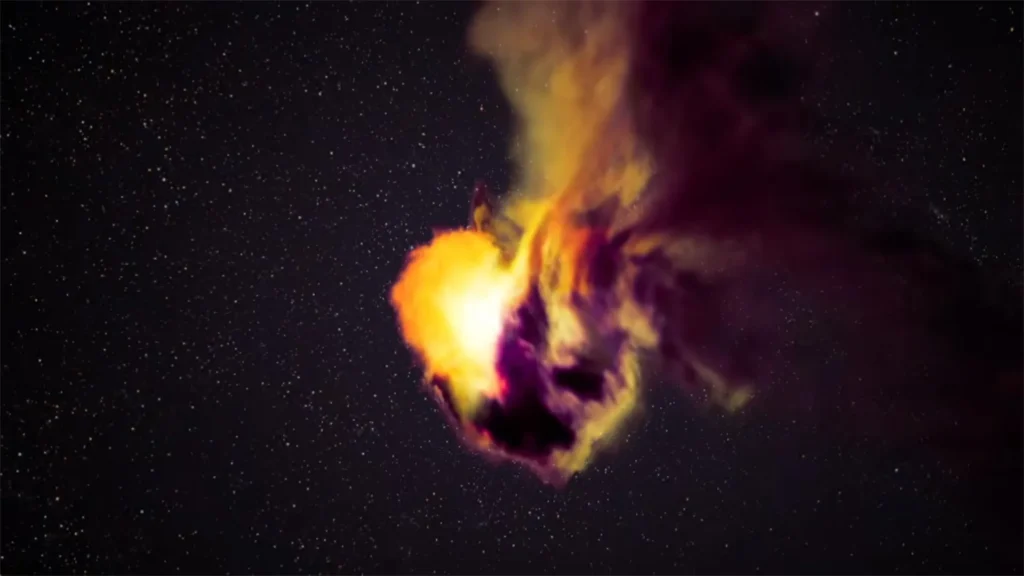
The observation of a rare cosmic phenomenon known as an "extremely stripped supernova" has provided astronomers with an unprecedented look at the internal chemical structure of a massive star in its final moments. In a comprehensive study published in the journal Nature, an international team of researchers led by Steve Schulze of Northwestern University detailed the discovery and analysis of supernova SN 2021yfj. The explosion, which occurred in a distant galaxy, was surrounded by a dense shell of gas that revealed the presence of elements typically buried deep within a star’s core. This discovery serves as a vital confirmation of the theoretical models regarding stellar evolution and the nucleosynthesis of the elements that comprise the known universe.
The lifecycle of a massive star is defined by a continuous struggle between the inward pull of gravity and the outward pressure generated by nuclear fusion. For millions of years, these celestial engines convert lighter elements into heavier ones, creating a layered, "onion-like" internal structure. However, the observation of these layers has historically been difficult because the outermost envelopes of hydrogen and helium usually obscure the heavier elements produced in the core. SN 2021yfj represents a significant departure from this norm, as the star appears to have shed nearly all of its outer layers prior to its death, exposing the silicon-rich material that represents the final stage of fusion before a catastrophic core collapse.
The Mechanics of Stellar Nucleosynthesis
To understand the significance of SN 2021yfj, one must first look at the process of stellar nucleosynthesis. Stars are the primary factories of the universe, responsible for forging the chemical elements found on the periodic table. This process begins with the fusion of hydrogen into helium in the star’s core. Once the hydrogen fuel is exhausted, the core contracts and heats up, allowing for the fusion of helium into carbon and oxygen.
In stars significantly more massive than our Sun, this process continues through several increasingly rapid stages. Following carbon fusion, the star begins to fuse neon, then oxygen, and finally silicon. Each successive cycle requires higher temperatures and pressures, and each lasts for a shorter duration than the one before it. While the initial hydrogen-burning phase can persist for millions or even billions of years, the final silicon-burning phase—which produces elements like sulfur, argon, calcium, and iron—is completed in a matter of days.
As these cycles progress, the star develops a stratified composition. The outermost layer remains primarily hydrogen, followed by layers of helium, carbon, neon, oxygen, and silicon, with a growing core of iron at the very center. Under normal circumstances, when such a star explodes as a supernova, the light we see is dominated by the outermost layers of hydrogen or helium. SN 2021yfj is extraordinary because the material detected in its immediate vicinity was composed of silicon, indicating that the star had been "stripped" of its outer layers right down to the deepest level of fusion.
The Discovery and Analysis of SN 2021yfj
Supernova 2021yfj was first detected by automated sky surveys designed to catch transient events—objects that suddenly appear or change brightness in the night sky. Following its detection, Steve Schulze and his colleagues utilized spectroscopic analysis to determine the chemical makeup of the ejecta. Spectroscopy involves breaking down the light from the explosion into its constituent colors, creating a "fingerprint" of the elements present.
The data revealed a thick shell of gas surrounding the supernova that was rich in silicon. This was a startling find. In standard "Type II" supernovae, hydrogen is the dominant signature. Even in "Type Ib" or "Type Ic" supernovae, where hydrogen and helium have been lost, astronomers typically only see the carbon or oxygen layers. To see a silicon-rich shell suggests that the star underwent an extreme mass-loss event shortly before its demise.
The researchers noted that the silicon layer is produced only in the final months and days of a star’s life. For this material to be found in a shell outside the star at the time of the explosion, it must have been expelled from the star’s interior with incredible speed and efficiency. The timing of this expulsion is critical; because the silicon-burning phase is so brief, the mechanisms that stripped the star must have been active right up until the moment of the core collapse.
The Mystery of the Stripped Layers
The central mystery surrounding SN 2021yfj is how a star could lose so much of its mass so quickly. While massive stars possess powerful stellar winds—streams of charged particles ejected from the upper atmosphere—these winds are generally not strong enough to strip a star down to its silicon layer.
The research team proposed that the most likely explanation involves a binary star system. In this scenario, the progenitor of SN 2021yfj was not a solitary star but was instead orbiting a close companion. As the primary star expanded during its late evolutionary stages, its outer layers could have been gravitationally siphoned off by the companion star—a process known as Roche lobe overflow.
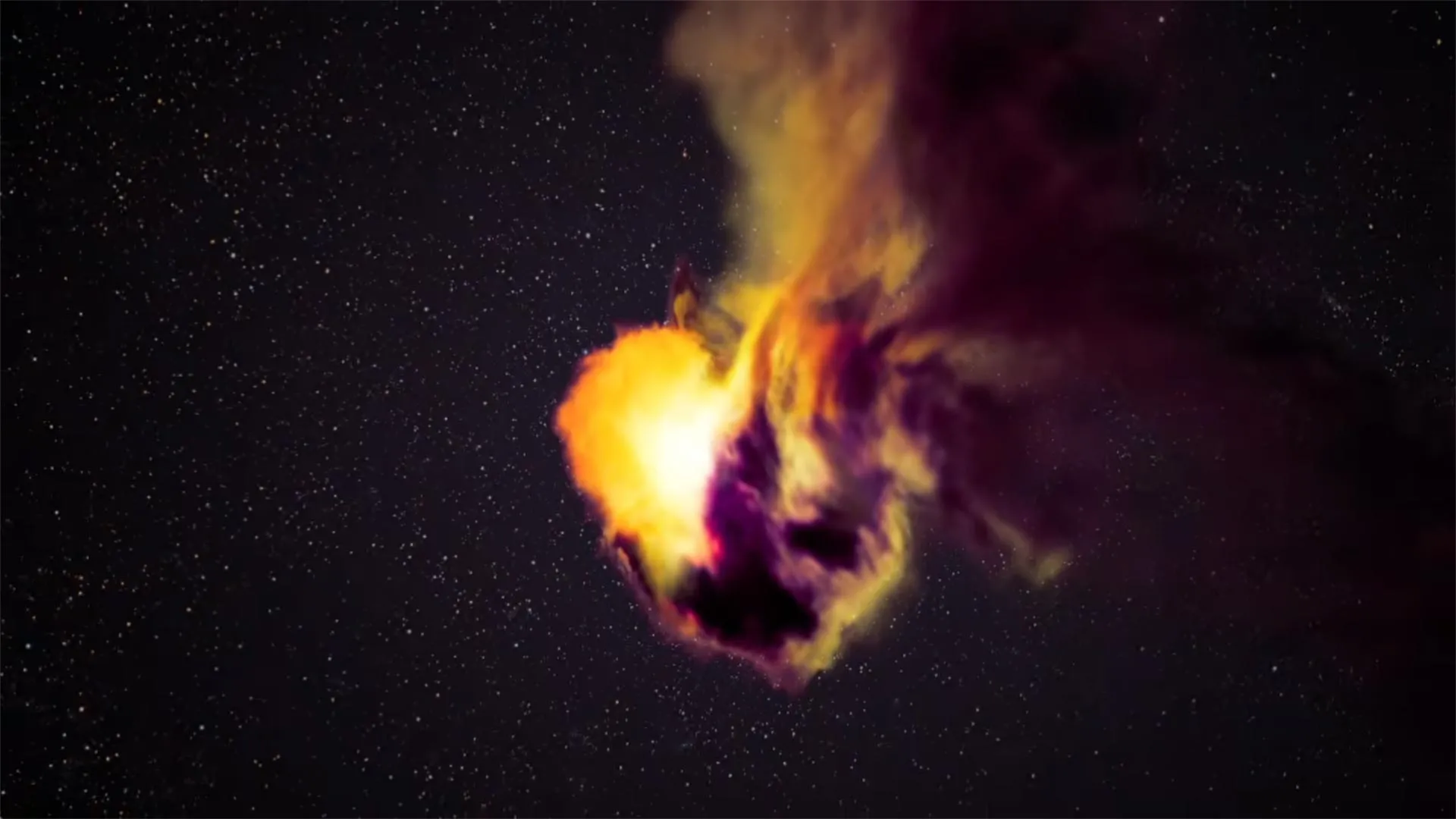
In an even more extreme "common envelope" phase, the two stars might have briefly shared a single outer atmosphere. The friction generated as the stars spiraled toward each other would provide the energy necessary to eject the envelope into space. This would leave the primary star "naked," consisting almost entirely of its heavy-element core, just as it reached the iron-production stage. This binary interaction provides a logical framework for how the silicon layer, which usually remains hidden, could be expelled into the surrounding environment just before the supernova occurred.
Core Collapse and the Birth of a Supernova
The death of a massive star is triggered when its core becomes dominated by iron. Unlike the fusion of lighter elements, the fusion of iron atoms consumes more energy than it releases. This creates a sudden and terminal deficit in the outward pressure that supports the star against gravity.
In a fraction of a second, the iron core—roughly the size of Earth but with a mass greater than the Sun—collapses inward. The density reaches a point where the core becomes a solid ball of neutrons or, if the mass is high enough, a black hole. The outer layers of the star, falling inward at a significant fraction of the speed of light, strike this ultra-dense core and "bounce" back. This creates a shockwave that tears the star apart in a core-collapse supernova.
In the case of SN 2021yfj, this shockwave slammed into the previously ejected silicon shell. The resulting "flash spectroscopy" allowed astronomers to identify the chemical composition of the shell with high precision. It confirmed that the theoretical "onion" model of stellar interiors is not just a mathematical convenience but a physical reality.
Broader Implications for Galactic Evolution
The findings from the study of SN 2021yfj have significant implications for our understanding of the chemical evolution of the universe. Every atom of oxygen we breathe, every bit of calcium in our bones, and every silicon chip in our computers was forged inside a massive star and distributed through the cosmos by supernova explosions.
However, the specific ratios of these elements depend on the types of supernovae that occur. If "extremely stripped" supernovae like SN 2021yfj are more common than previously thought, it may change our calculations of how efficiently heavy elements are dispersed.
Furthermore, the discovery sheds light on the early universe. In the first few billion years after the Big Bang, stars were composed almost entirely of hydrogen and helium. These early stars burned hotter and faster, and their deaths provided the first "seeds" of heavy elements. By studying modern examples of stripped supernovae, astronomers can better model how those early stars enriched the interstellar medium, eventually leading to the formation of planets and life.
Chronology of a Cosmic Event
To contextualize the discovery, the researchers outlined a likely timeline for the progenitor of SN 2021yfj:
- The Hydrogen/Helium Phase (Millions of years): The star burns steadily, likely in a binary system, slowly losing its outermost hydrogen envelope to its companion.
- The Advanced Burning Stages (Centuries to Decades): The star moves through carbon, neon, and oxygen fusion. During this time, the binary interaction intensifies, stripping the star of its helium and carbon layers.
- The Final Months: The star begins silicon fusion. A violent mass-loss event—potentially triggered by an instability in the core or a final gravitational tug from the companion—expels the silicon-rich material into a circumstellar shell.
- The Collapse (Seconds): The iron core reaches the Chandrasekhar limit and collapses. The supernova shockwave is generated.
- The Observation (Days/Weeks post-explosion): The shockwave reaches the silicon shell, ionizing the gas and producing the specific spectral lines detected by Steve Schulze’s team.
Conclusion and Future Research
The study of SN 2021yfj is a landmark in transient astronomy. It provides a rare "X-ray" view into the heart of a dying star, verifying decades of theoretical work regarding the end-stages of stellar life. The existence of such extremely stripped progenitors suggests that the interaction between binary stars plays a much larger role in the lifecycle of the universe’s most massive objects than was once assumed.
Moving forward, astronomers hope to find more examples of these events using next-generation facilities like the Vera C. Rubin Observatory in Chile. By building a larger catalog of stripped supernovae, researchers can determine the frequency of these events and further refine our understanding of how the universe manufactures the building blocks of reality. For now, SN 2021yfj stands as a singular piece of evidence, a cosmic laboratory that has allowed humanity to witness the final, frantic breaths of a dying giant.