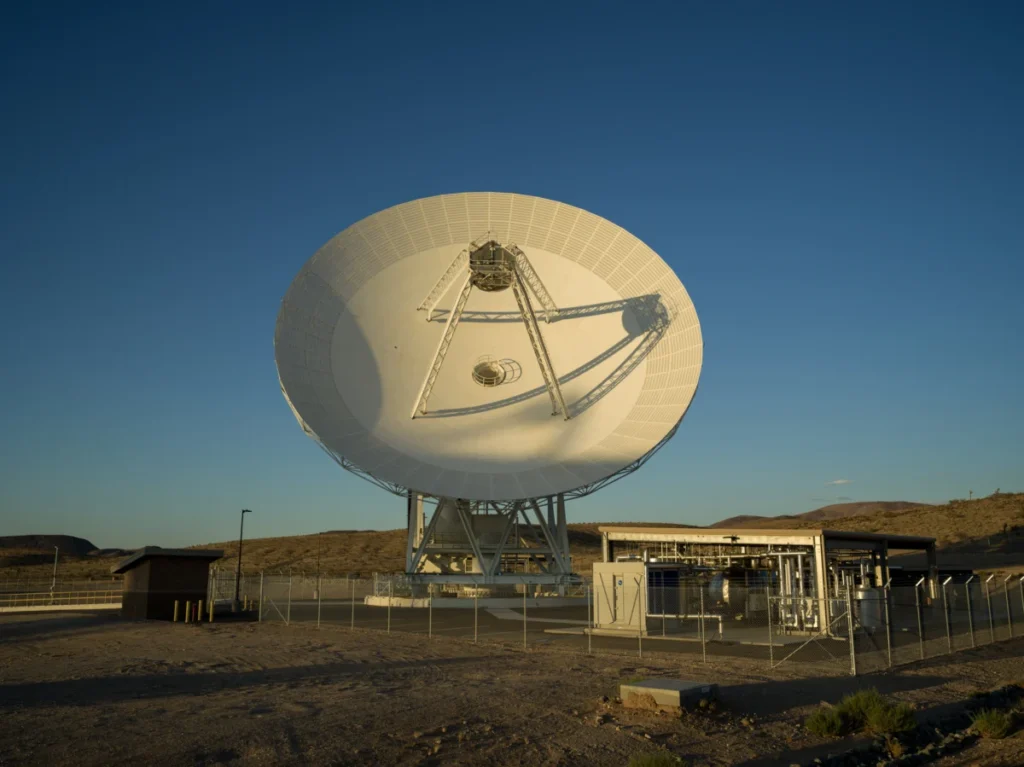
The Goldstone Deep Space Communications Complex, a pivotal node in NASA’s global network responsible for communicating with spacecraft exploring the vastness of our solar system and beyond, has officially welcomed a significant new addition to its infrastructure. The newly completed Deep Space Station 23 (DSS-23), a cutting-edge 34-meter (114-foot) diameter radio frequency antenna, marks a substantial enhancement to the agency’s capabilities for deep space communication and navigation. Managed by NASA’s Jet Propulsion Laboratory (JPL) in Southern California, this advanced antenna is poised to play a crucial role in supporting the ever-increasing demands of scientific exploration.
The inauguration ceremony, attended by NASA leadership, personnel, and distinguished guests, featured a symbolic ribbon-cutting event at the base of the impressive DSS-23 antenna. This momentous occasion underscores the successful culmination of the Deep Space Network’s Aperture Enhancement Project, an ambitious initiative launched in 2009. The project’s overarching goal has been to modernize and expand the network’s capacity by integrating six new 34-meter multifrequency beam-waveguide antennas. These state-of-the-art dishes are engineered for exceptional versatility, enabling them to effectively communicate with a diverse array of missions operating across a broad spectrum of radio frequencies.
A New Era of Deep Space Connectivity
James Kenyon, associate administrator of NASA’s Research and Technology Mission Directorate at NASA Headquarters in Washington, articulated the profound significance of this expansion. "By expanding the Deep Space Network, we are strengthening the communications foundation NASA needs for the bold missions ahead – from exploring more of the Moon than ever before to peering deeper into the solar system," Kenyon stated. He further emphasized, "This new antenna will help us deliver on our national goals for space exploration and push beyond the limits of what once seemed impossible." This sentiment highlights the strategic importance of enhanced communication infrastructure in enabling humanity’s most ambitious space endeavors.
Following a rigorous testing campaign conducted from May through July, which meticulously demonstrated its full operational capabilities, DSS-23 commenced its official duties on August 3rd. Its inaugural task involved tracking NASA’s Chandra X-ray Observatory, a testament to its advanced sensitivity and precision. Since then, DSS-23 has been actively engaged in communicating with a multitude of vital missions. These include established explorers such as NASA’s Mars Reconnaissance Orbiter, the groundbreaking asteroid-bound mission Psyche, the Jupiter-exploring Juno spacecraft, and the venerable Voyager 1 probe, which continues its journey into interstellar space. The antenna’s integration signifies an immediate boost to the network’s capacity to manage the increasing volume of data and commands being exchanged with these distant emissaries.
Dave Gallagher, director of JPL, underscored the transformative impact of this next-generation technology. "The addition of this next-generation antenna brings us closer to a completely modernized network that embraces advanced technology to ensure NASA’s leadership in deep space communications," Gallagher remarked. He continued, "After over 60 years of continuous operations supporting consequential missions, these upgrades prime the network for a new era of exploration. The teams that designed, planned, and built DSS-23 should be proud." His words reflect the culmination of years of dedicated effort and technological innovation.
A Monumental Construction Endeavor
The journey to bring DSS-23 online was a complex and multi-year undertaking. Construction officially commenced in February 2020, initiating a meticulous process of engineering and assembly. A pivotal moment in its construction occurred in December 2024 when the 133-ton metal reflector framework was hoisted and securely bolted atop the antenna’s robust pedestal. This was followed by the precise installation of thousands of individual panels that form the reflector surface, designed to accurately capture and direct radio frequency signals to and from spacecraft. The subsequent phase involved an intricate calibration process, ensuring DSS-23 could seamlessly integrate and synchronize its operations with the existing Deep Space Network infrastructure.
DSS-23 now stands as the fifth large-diameter antenna at the Goldstone complex, joining three existing 34-meter antennas and the facility’s original 70-meter (230-foot) antenna. It also represents the fifth such enhancement-project antenna to be integrated into the global network. The Deep Space Network comprises three strategically positioned complexes: Goldstone in California, the Madrid Deep Space Communications Complex in Spain, and the Canberra Deep Space Communication Complex in Australia. This global distribution ensures continuous communication coverage as the Earth rotates.
A key innovation distinguishing the new 34-meter antennas, including DSS-23, is their beam-waveguide design. This advanced architecture directs radio signals down to a stable, climate-controlled underground room, rather than housing sensitive and heavy electronic equipment directly on the moving antenna dish. This design not only enhances the antenna’s versatility by allowing it to operate across multiple radio frequencies but also significantly improves accessibility for maintenance and future upgrades, a critical factor for long-term operational efficiency.
Germaine Aziz, manager of the Deep Space Network Aperture Enhancement Project at JPL, highlighted the intricate nature of the project. "The biggest challenge wasn’t actually constructing the antenna. It was transforming a complex collection of mechanical, electrical, software, radio frequency, and infrastructure systems into a single, mission-ready asset," Aziz explained. She elaborated on the demanding integration process: "Every subsystem must be integrated, calibrated, and verified to operate with extraordinary precision and reliability before it can support NASA’s deep space missions." This statement underscores the immense engineering and logistical challenges involved in bringing such a sophisticated piece of technology to full operational status.
Future Expansion and Network Resilience
The Aperture Enhancement Project is slated for completion with the anticipated online status of a sixth enhancement-project antenna, Deep Space Station 33 (DSS-33), at the Canberra facility in 2029. Upon its activation, the total number of 34-meter antennas across the entire Deep Space Network will reach thirteen.
A significant advantage of these 34-meter antennas lies in their ability to be "arrayed" – meaning they can be combined and operated together. This arraying capability effectively provides a communications backup for each facility’s single, much larger 70-meter antenna. The 70-meter antennas, some of which have been in near-continuous operation for over 50 years, are becoming increasingly costly to maintain and repair, making the arrayed 34-meter antennas a vital component for ensuring network redundancy and resilience. This strategic approach to network architecture enhances NASA’s ability to maintain uninterrupted contact with its missions, even in the face of unforeseen technical challenges.
The Deep Space Network: A Lifeline for Exploration
Managed by the California Institute of Technology (Caltech) for NASA, the Jet Propulsion Laboratory (JPL) oversees the day-to-day operations of the Deep Space Network. This oversight is conducted under the guidance of NASA’s Space Communications and Navigation (SCaN) Program, which resides within the agency’s Research and Technology Mission Directorate. The Deep Space Network, along with the Near Space Network, collectively serves as a critical communication backbone for over 100 NASA and non-NASA missions.
The scope of missions reliant on this vital network is vast and diverse. It encompasses crucial support for astronauts aboard the International Space Station, vital communication links for upcoming Artemis missions to the Moon, comprehensive Earth monitoring initiatives, extensive lunar exploration endeavors, and the ongoing scientific quests to understand our solar system and the cosmos beyond. The addition of DSS-23 represents a tangible step forward in ensuring that these ambitious scientific and exploratory endeavors have the robust communication infrastructure they require to succeed.
The continued investment in and modernization of the Deep Space Network underscores NASA’s commitment to pushing the boundaries of human knowledge and exploration. As humanity sets its sights on increasingly distant and complex objectives, the ability to communicate reliably and efficiently across the vast gulfs of space becomes paramount. The new DSS-23 antenna at Goldstone is a powerful symbol of this commitment, a beacon of connectivity enabling the pursuit of scientific discovery and the advancement of space exploration for generations to come.
For further details on the Deep Space Network and its critical role in space exploration, interested parties can visit the official NASA website at: https://www.nasa.gov/communicating-with-missions/dsn.