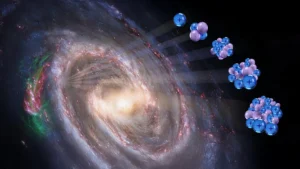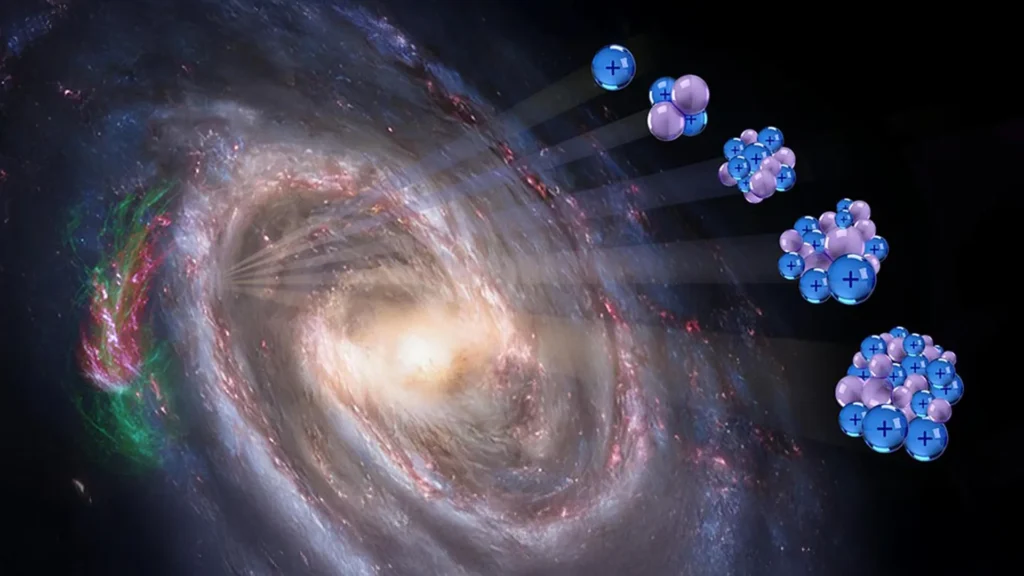
Cosmic rays represent the most energetic particles ever observed in nature, dwarfing the energies achievable by even the most advanced terrestrial particle accelerators like the Large Hadron Collider (LHC). While the LHC can accelerate protons to energies approaching 6.5 teraelectron-volts (TeV) per beam, individual cosmic ray particles can possess energies orders of magnitude higher, reaching petaelectron-volts (PeV) and even exaelectron-volts (EeV). These staggering energies suggest their genesis in some of the universe’s most cataclysmic events: the explosive finales of massive stars in supernovae, the colossal jets emanating from supermassive black holes at the hearts of galaxies, and the rapidly spinning, highly magnetized remnants of collapsed stars known as pulsars. Pinpointing the exact cosmic accelerators responsible for these extreme energies has been one of astrophysics’ most enduring puzzles.
A Century-Long Cosmic Quest: The Enigma of Cosmic Rays
The journey to understand cosmic rays began in 1912 when Austrian physicist Victor Hess made a groundbreaking discovery during a series of daring balloon flights. Equipped with electrometers designed to measure atmospheric ionization, Hess ascended to altitudes of over 5 kilometers, observing that ionization levels consistently increased with altitude. This counterintuitive finding contradicted the prevailing belief that radiation originated solely from Earth’s crust. Hess deduced that a powerful, penetrating radiation must be entering Earth’s atmosphere from outer space, a phenomenon he dubbed "Höhenstrahlung" (high-altitude radiation), later coined "cosmic rays" by Robert Millikan. This pioneering work earned Hess the Nobel Prize in Physics in 1936 and ignited a century of relentless inquiry into the nature and origins of these ethereal visitors.
For decades, scientists employed ground-based detectors, high-altitude balloons, and eventually satellites to study cosmic rays. They discovered that these particles are primarily atomic nuclei, stripped of their electrons, traveling at nearly the speed of light. The composition is overwhelmingly dominated by protons (approximately 90%), followed by helium nuclei (around 9%), and a smaller fraction of heavier elements like carbon, oxygen, and iron, along with a trace amount of electrons and positrons. Understanding their energy spectrum – the distribution of particles across different energy levels – is crucial, as it holds clues to the mechanisms that accelerate them to such incredible speeds and how they propagate through the vast interstellar medium. However, the exact "where" and "how" of their acceleration remained largely elusive, shrouded by the immense distances involved and the complex magnetic fields that bend their paths, obscuring their point of origin.
DAMPE: A New Eye on the High-Energy Universe
The Dark Matter Particle Explorer (DAMPE), also known as "Wukong" after the mythical Monkey King, was launched on December 17, 2015, by the Chinese Academy of Sciences (CAS) from the Jiuquan Satellite Launch Center. This state-of-the-art space telescope was specifically designed to address fundamental questions in high-energy astrophysics and particle physics, with a dual primary objective: to precisely measure the energy spectrum and composition of cosmic rays and gamma rays, and to search for indirect signatures of dark matter annihilation or decay. Orbiting at an altitude of approximately 500 kilometers, DAMPE has been meticulously collecting data, providing an unprecedented level of precision in cosmic ray measurements.
The DAMPE mission is a testament to international scientific collaboration, though spearheaded by China. It involves significant contributions from institutions across Europe, including major input from the astrophysics group at the Department of Nuclear and Particle Physics (DPNC) at the University of Geneva (UNIGE). The UNIGE team played a pivotal role in both the hardware development and the sophisticated data analysis that underpins the recent findings.
The satellite’s detector payload is comprised of four main subsystems, each optimized for specific measurements:
- Plastic Scintillator Array (PSA): This top layer detects incoming particles and provides a fast trigger for the subsequent detectors, also identifying charged particles.
- Silicon-Tungsten Tracker (STK): Developed with crucial leadership from the Geneva group, the STK is an essential instrument for accurately tracing the paths of incoming cosmic rays. It consists of multiple layers of silicon microstrip detectors interleaved with tungsten plates, allowing for precise determination of a particle’s trajectory and its electrical charge. This precision is vital for distinguishing between different types of cosmic ray nuclei.
- Bismuth Germanate (BGO) Calorimeter: This is the core detector, measuring the energy of the particles by absorbing them and converting their energy into light. Its high energy resolution is critical for detailed spectral measurements.
- Neutron Detector (ND): Located at the bottom, this detector helps in distinguishing between electrons and hadrons (like protons and nuclei) by detecting secondary neutrons produced in hadronic showers.
These detectors work in concert to provide a comprehensive profile of each cosmic ray event, from its charge and trajectory to its energy.
The Discovery of a Universal Spectral Softening
By meticulously analyzing the highly precise data collected by DAMPE, researchers uncovered a profound and universal pattern in the energy spectra of primary cosmic ray nuclei. This pattern, dubbed "spectral softening," describes a phenomenon where the number of particles detected begins to drop much more rapidly after reaching a specific energy threshold.
"Cosmic rays are primarily composed of protons, but also of helium, carbon, oxygen, and iron nuclei,” explains Andrii Tykhonov, associate professor at the DPNC in the Faculty of Science at UNIGE, and co-author of the study. "These particles are also categorised according to their energy: low, up to a few billion electron-volts; intermediate, from a few billion to several hundred billion electron-volts; and high, from 1,000 billion electron-volts and beyond."
The standard expectation is that higher-energy cosmic rays are progressively less common as energy increases, following a power-law distribution. However, the DAMPE observations revealed that this decline becomes dramatically steeper beyond a critical "rigidity" value of approximately 15 TV (teraelectron-volts). Rigidity, a fundamental property in cosmic ray physics, describes how strongly a charged particle’s path resists being bent by magnetic fields. It is defined as momentum divided by charge (R = pc/Ze), where p is momentum, c is the speed of light, Z is the atomic number, and e is the elementary charge. Essentially, particles with higher rigidity are less affected by the magnetic fields they encounter in space.
The fact that this identical spectral softening feature appears consistently across a wide range of different particle types – from lightweight protons to helium, carbon, oxygen, and much heavier iron nuclei – provides compelling evidence. This universality strongly supports theories suggesting that both the acceleration of cosmic rays in their astrophysical sources and their subsequent propagation through the complex galactic magnetic fields are fundamentally controlled by rigidity.
This finding carries immense weight because it largely rules out competing explanations based on "energy per nucleon" (the total energy of the particle divided by the number of protons and neutrons in its nucleus). If energy per nucleon were the dominant factor, the softening threshold would vary significantly for different nuclei due to their differing mass-to-charge ratios. The DAMPE data, however, points to a rigidity-dependent cutoff, with the confidence level against those alternative models reaching an astonishing 99.999%. This extremely high statistical significance effectively closes the door on many prior theoretical frameworks.
The Role of AI and Advanced Detectors
The breakthrough would not have been possible without cutting-edge technology and sophisticated analytical methods, in which researchers from Geneva played a major, indeed instrumental, role. The UNIGE team developed advanced artificial intelligence (AI) and machine learning techniques crucial for reconstructing particle events detected by the telescope. Cosmic ray interactions within the detector generate complex signals, and AI algorithms are essential for accurately disentangling these signals, identifying the particle type, its energy, and its trajectory from a cascade of secondary particles. This allows for a much higher precision in data processing than traditional methods.
Beyond AI, the Geneva group’s direct involvement in hardware development was equally critical. They led the development of one of DAMPE’s key instruments, the Silicon-Tungsten Tracker (STK). This detector is not merely a component; it is fundamental for accurately tracing particle paths and precisely determining the electrical charge of incoming cosmic rays. The STK’s ability to measure charge with high fidelity is what allowed scientists to differentiate between protons, helium, carbon, oxygen, and iron nuclei, and thus observe the universal softening across these distinct particle species. Furthermore, the Geneva team contributed significantly to important measurements involving proton and helium fluxes, and they played a key role in analyzing carbon nuclei data, ensuring the robustness and reliability of the overall findings.
Implications for Cosmic Ray Acceleration and Propagation
The discovery of a rigidity-dependent spectral softening marks a pivotal advance in our understanding of how cosmic rays are created and how they traverse the galaxy. It provides crucial constraints on theoretical models that aim to explain these phenomena.
Firstly, regarding acceleration mechanisms, the observed rigidity dependence suggests that the astrophysical sources responsible for accelerating cosmic rays up to TeV energies likely operate under principles where the magnetic environment plays a dominant role in determining the maximum energy a particle can attain. The most widely accepted mechanism for cosmic ray acceleration is the Fermi acceleration process, particularly Diffusive Shock Acceleration (DSA) occurring at supernova remnants (SNRs). In DSA, charged particles repeatedly cross a shock front, gaining energy with each traversal. The maximum energy a particle can achieve in such a scenario is often limited by the size and strength of the magnetic fields within the acceleration region, which directly relates to a particle’s rigidity. The 15 TV cutoff could signify a universal limit to the acceleration efficiency in a significant population of galactic cosmic ray sources, or it could indicate a change in the dominant acceleration mechanism or source type at higher rigidities.
Secondly, the findings refine our understanding of how high-energy particles move through interstellar space. The galaxy is permeated by a turbulent magnetic field that scatters cosmic rays, making their paths tortuous and effectively randomizing their arrival directions. This propagation process is also thought to be rigidity-dependent, with higher rigidity particles escaping the galaxy more easily or being scattered less frequently. The DAMPE results suggest that the "leakage" of cosmic rays from the Milky Way’s magnetic confinement becomes significantly more pronounced for particles above the 15 TV rigidity threshold. This could explain the observed steepening of the spectrum: as particles reach this rigidity, they simply escape the galaxy more efficiently, leading to a faster drop in their observed flux.
The consistency of the softening across different nuclei implies that the processes governing both acceleration and propagation are intimately linked to a particle’s charge and momentum rather than its mass. This new data places tighter limits on existing models, forcing theorists to re-evaluate their assumptions about the properties of galactic accelerators and the structure of the interstellar magnetic field.
Future Outlook and the Search for Dark Matter
While the DAMPE’s recent findings primarily illuminate the nature of ordinary cosmic rays, they also indirectly contribute to its secondary objective: the search for dark matter. A precise understanding of the background cosmic ray flux and its characteristics is absolutely essential for identifying any anomalous signals that might point to the annihilation or decay of dark matter particles. Any subtle excesses or features in the cosmic ray spectra, particularly in electrons or positrons, could be a tell-tale sign of dark matter interactions. By accurately mapping the "standard" cosmic ray landscape, DAMPE improves the sensitivity of future dark matter searches.
The publication in Nature marks a significant milestone in cosmic ray research, offering a profound clue to one of the universe’s most enduring mysteries. Scientists are now poised to use this new knowledge to develop more sophisticated models, exploring what astrophysical sources might impose such a universal rigidity-dependent limit and how galactic magnetic fields precisely govern particle propagation. The DAMPE mission continues to collect data, promising further insights into the extreme physics of the cosmos and perhaps, one day, revealing the ultimate origins of these enigmatic messengers from across the universe.