A groundbreaking radar system, compact enough to be housed within a standard shipping container, is set to undertake an expanded mission for the US Space Force. LeoLabs, a leader in commercial space domain awareness (SDA), will deliver a modified iteration of its Scout radar technology, marking a pivotal opportunity to demonstrate the system’s versatility for defense applications extending beyond its original mandate of tracking objects in Earth’s orbit. This development underscores a growing trend within defense procurement towards agile, transportable, and commercially proven solutions to address evolving security challenges across multiple domains.
The Evolution of Space Domain Awareness and the Need for Agile Sensing
For the past decade, LeoLabs has been at the forefront of developing and operating high-performance radar systems, meticulously designed to monitor the rapidly growing and increasingly complex environment of low Earth orbit (LEO) and very low Earth orbit (VLEO). The company’s CEO, Tony Frazier, has consistently highlighted the strategic importance of investing in transportable, proliferated sensing capabilities to meet dynamic mission requirements. This latest demonstration follows the successful deployment of LeoLabs’ inaugural operational Scout system earlier this year, a unit specifically optimized for its foundational role in space domain awareness. The operational success of systems like Scout Hawaii, which began observing orbital objects within hours of its activation, exemplifies the rapid deployment and operational readiness that distinguishes these advanced systems from traditional, fixed installations.
The landscape of space has undergone a profound transformation. What was once a relatively sparse environment has become increasingly congested, driven by the proliferation of mega-constellations like SpaceX’s Starlink and OneWeb, alongside a surge in small satellite launches by both commercial entities and nation-states. This exponential growth in orbital traffic, coupled with the persistent threat of space debris – remnants of defunct satellites, rocket stages, and collision fragments – poses significant operational challenges. The potential for Kessler Syndrome, a theoretical scenario where the density of objects in LEO is so high that collisions generate enough debris to cause further collisions in a cascade, remains a serious concern for all spacefaring nations. As of early 2024, estimates from organizations like the European Space Agency (ESA) indicate tens of thousands of tracked objects larger than 10 cm, with millions more untracked fragments posing silent threats.
In this dynamic environment, the US Space Force faces the monumental task of maintaining comprehensive Space Domain Awareness (SDA). This involves not only tracking operational satellites and identifying potential collision risks but also monitoring the activities of potential adversaries, detecting anomalous behaviors, and safeguarding critical national security assets in orbit. Traditional SDA architectures, often reliant on a limited number of large, fixed ground-based radars and space-based sensors, struggle to provide the continuous, high-fidelity tracking necessary to navigate this complexity. These systems, while powerful, can suffer from limited geographic coverage, susceptibility to localized threats, and lengthy deployment timelines, creating gaps in persistent custody of orbital objects.
Scout: Engineered for Portability and Rapid Deployment
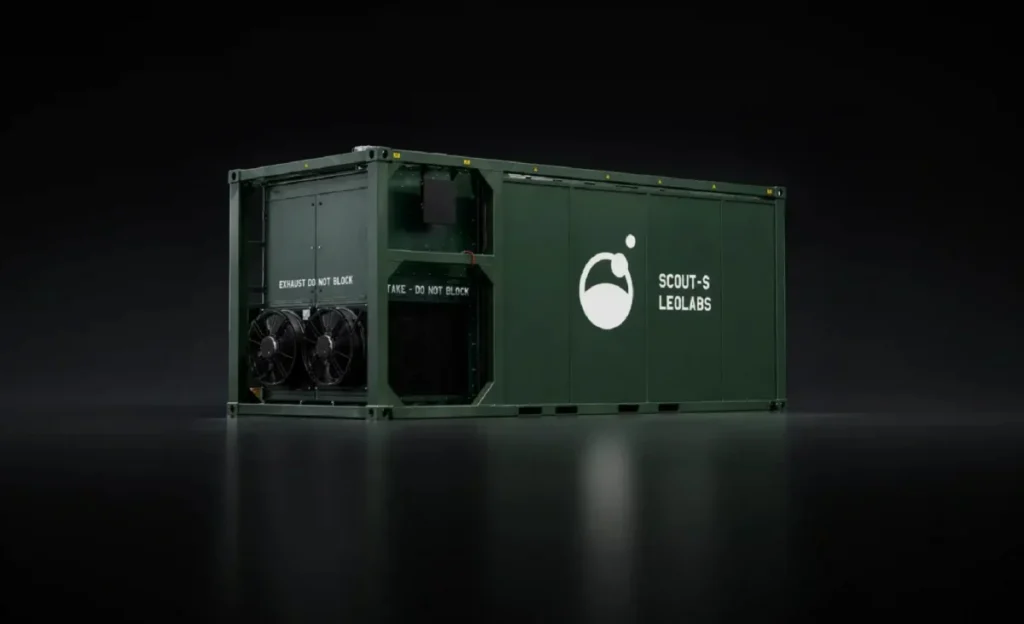
Central to LeoLabs’ strategy is its Scout family of radars, a series of containerized, transportable 3D search radars engineered for seamless integration into existing defense architectures. Each Scout unit is ingeniously designed to fit within a standard 20-foot ISO shipping container, a globally recognized standard for intermodal freight transport. This critical design feature bestows an unparalleled level of mobility upon the system, allowing it to be transported by truck, plane, or ship to virtually any location on Earth. Such logistical flexibility is a game-changer, enabling deployment to austere or forward operating environments that are simply inaccessible to conventional, fixed radar installations.
The technical prowess of the Scout system lies in its sophisticated combination of 3D scanning capabilities, direct radiating array technology, and a modular S-band electronic design. This synergistic integration allows Scout to perform uncued searches, meaning it can independently discover new objects without requiring prior "tip-off" or external cues about their approximate location. This is a significant advantage in rapidly evolving scenarios where unexpected objects or events may emerge. Furthermore, the system is adept at maintaining sustained tracks on high-interest targets, providing continuous data streams rather than intermittent snapshots. All these capabilities are packed into a system compact enough to be relocated on short notice, offering tactical adaptability that fixed systems cannot match.
Operational Modes: Search, Track, and Respond
The operational efficacy of Scout is further enhanced by its advanced search-to-track and track-while-scan modes. These functionalities empower operators to dynamically monitor activity across vast swathes of space, crucially including the ability to detect non-cooperative launches – such as missile tests or clandestine satellite deployments – as they occur. The speed with which Scout can become operational is a testament to its design philosophy. As demonstrated by the Scout-S unit, known as Scout Hawaii, which commenced observing objects within hours of being powered on after its deployment earlier this year, this rapid readiness is invaluable in time-sensitive defense scenarios.
This operational velocity translates directly into enhanced decision-making capabilities. Traditional tracking systems, due to their fixed nature or orbital mechanics, typically observe a satellite for only a brief window before having to wait for its next pass overhead. Scout’s innovative design fundamentally aims to extend these observation windows significantly. By deploying multiple transportable units, operators can achieve a more continuous, high-fidelity picture of objects traversing low Earth orbit and very low Earth orbit. This provides a dynamic narrative of movement and behavior, replacing a series of disconnected snapshots with a comprehensive, evolving understanding of the space environment. The ability to maintain persistent custody of critical assets and potential threats is paramount for national security and strategic advantage.
A Distributed Answer to Evolving Threats
LeoLabs positions its Scout system as a cornerstone of a broader, paradigm-shifting approach to defense sensing. The company argues compellingly that as potential threats become faster, more numerous, and more maneuverable – whether in space, air, or terrestrial domains – maintaining persistent custody and reliable tracking increasingly necessitates a distributed sensing architecture. This approach represents a deliberate strategic pivot away from an over-reliance on large, centralized, and inherently vulnerable fixed installations.
The distributed sensing model advocates for pairing existing large, "exquisite" systems – high-cost, high-performance assets that provide foundational capabilities – with rapidly deployable, more numerous, and cost-effective capacity. This synergistic combination serves multiple critical functions: it extends coverage into previously underserved areas, significantly enhances resilience against attacks or failures by diversifying assets, and allows for rapid adaptation as operational needs shift. Under the terms of this latest award, LeoLabs will demonstrate a modified Scout variant specifically tailored for a mission set distinct from its primary space-tracking role. This demonstration will serve as a crucial test of whether the same core radar architecture can be effectively extended into new, diverse defense applications, potentially encompassing areas like tactical air surveillance, missile detection and tracking, or even border security.
Strategic Implications and the Future of Defense Acquisition
The partnership between LeoLabs and the US Space Force carries significant implications for both parties and the broader defense industry. For the US Space Force, it signals a strategic commitment to leveraging commercial innovation for enhanced agility and resilience. By adopting a system designed for rapid deployment and versatility, the Space Force can augment its existing SDA capabilities and potentially expand its operational reach into other defense domains with unprecedented speed. The ability to quickly establish radar coverage in contested or remote areas could be a decisive factor in future conflicts or humanitarian missions.
For LeoLabs, this contract represents a profound validation of its decade-long investment in cutting-edge radar technology and its "proliferated sensing" vision. It proves that their commercially developed, battle-tested systems can meet the rigorous demands of national defense missions, potentially unlocking a much broader market beyond commercial space tracking. The success of this demonstration could pave the way for subsequent contracts and further integration of LeoLabs’ technology into various branches of the US military.
Frazier’s statement that this effort is proof that "proven commercial radar technology can accelerate how quickly new capabilities reach US defense missions" encapsulates a transformative shift in defense acquisition. Historically, the development of purpose-built defense systems has been characterized by lengthy timelines, often stretching for years, and escalating costs. By embracing commercial off-the-shelf (COTS) solutions like Scout, the US Department of Defense can potentially bypass these traditional acquisition hurdles, rapidly integrating advanced capabilities into its operational forces. This approach fosters innovation, reduces development risk, and allows for quicker responses to emergent threats.
Moreover, this development aligns with a broader strategic imperative to diversify and harden critical infrastructure. Relying on a distributed network of smaller, more mobile sensors inherently makes the overall sensing architecture more resilient to attack or disruption. If one unit is compromised, others can continue to operate, and replacement units can be rapidly deployed. This contrasts sharply with the vulnerability inherent in a system dependent on a few large, high-value, fixed installations.
Beyond Space Tracking: Potential New Mission Sets
While the specifics of the "new mission set" remain under wraps, logical inferences based on the Scout’s capabilities suggest several potential avenues. Given its 3D search capabilities, S-band frequency (often used for air traffic control, weather, and naval surface search radars), and ability to detect non-cooperative launches, the modified Scout variant could potentially be tested for:
- Tactical Air Surveillance: Providing localized air domain awareness, detecting low-flying drones, cruise missiles, or even manned aircraft in contested zones.
- Ballistic Missile Defense: Enhancing early warning and tracking capabilities for short to medium-range ballistic missiles, particularly in regions where fixed radar coverage is sparse.
- Border Security: Monitoring land or maritime borders for illicit crossings, smuggling activities, or unauthorized incursions.
- Expeditionary Operations: Supporting forward-deployed military units with immediate, localized sensor coverage without the need for extensive infrastructure development.
The ability of Scout to perform uncued searches and maintain sustained tracks makes it highly adaptable to these varied scenarios, where unknown targets may appear suddenly and require continuous monitoring.
Conclusion
The forthcoming demonstration of LeoLabs’ modified Scout radar system for the US Space Force marks a significant milestone in the evolution of defense sensing. It not only highlights the increasing importance of agile, transportable, and resilient technologies in an era of complex and rapidly evolving threats but also underscores the strategic value of leveraging commercial innovation for national security. By proving that a commercially developed, containerized radar system can extend its utility far beyond its original space-tracking purpose, LeoLabs is poised to redefine how defense capabilities are conceived, acquired, and deployed. This collaborative effort signals a future where distributed, adaptable sensing architectures are fundamental to maintaining global security and strategic advantage across all domains.