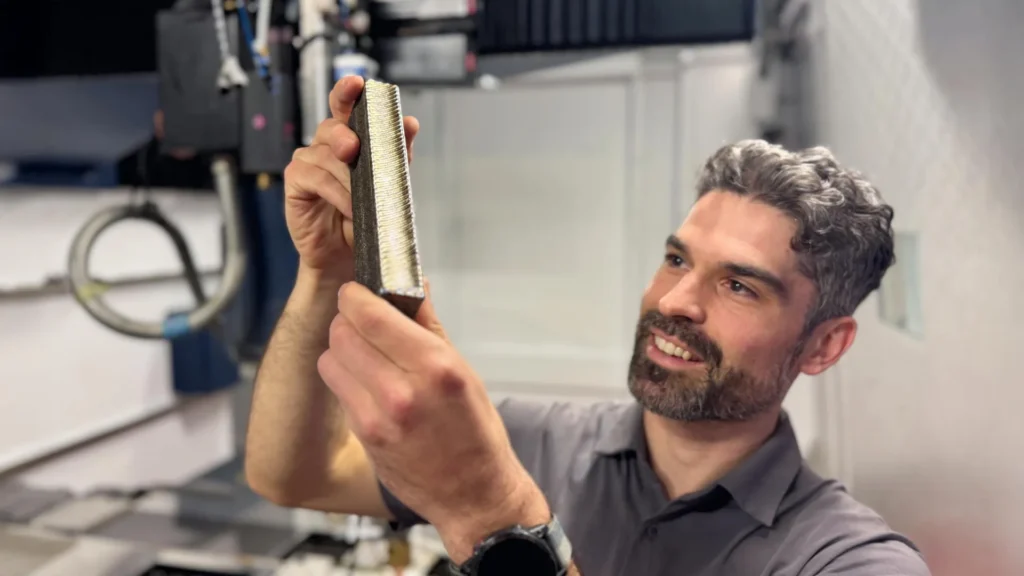
Engineers at RMIT University in Australia have achieved a significant breakthrough in additive manufacturing, developing a novel 3D-printed titanium alloy that promises to be approximately one-third cheaper than commonly used titanium alloys. This innovation, detailed in a provisional patent filing and a recent publication in Nature Communications, stems from the strategic replacement of increasingly expensive vanadium with more accessible and cost-effective alternative materials. The development holds immense potential to revolutionize industries ranging from aerospace and defense to medical devices, where the demand for high-performance, lightweight, and cost-efficient materials is paramount.
A New Era for Titanium in Additive Manufacturing
The current landscape of 3D-printed titanium is largely dominated by legacy alloys, most notably Ti-6Al-4V (titanium-6aluminum-4vanadium). While these alloys have served as the industry standard, their limitations, particularly in the context of advanced manufacturing techniques like 3D printing, are becoming increasingly apparent. Ryan Brooke, a PhD candidate at RMIT’s Centre for Additive Manufacturing (RCAM) and lead author of the study, articulated this challenge, stating, "3D printing allows faster, less wasteful and more tailorable production yet we’re still relying on legacy alloys like Ti-6Al-4V that doesn’t allow full capitalization of this potential. It’s like we’ve created an aeroplane and are still just driving it around the streets." This analogy highlights the disconnect between the transformative capabilities of additive manufacturing and the constraints imposed by traditional material science.
The RMIT team’s innovation directly addresses this gap by creating a new alloy that not only reduces production costs but also enhances material properties. The research team’s approach focused on developing a more efficient and predictive framework for alloy design. This framework allows for the selection of elements that can leverage the inherent advantages of 3D printing, such as rapid prototyping, complex geometries, and reduced material waste, without compromising on performance.
The Innovation: Cost Reduction Through Material Science
The core of RMIT’s breakthrough lies in its ingenious approach to alloy composition. Vanadium, a critical component in many high-performance titanium alloys, has seen its price fluctuate significantly and increase over time due to various global supply chain factors and demand pressures. By identifying and successfully integrating alternative, more readily available elements, the RMIT team has managed to substantially reduce the material cost of their new titanium alloy. While specific details of the proprietary alloy composition are not disclosed due to commercial considerations, the impact is undeniable: a 29% reduction in production cost compared to standard 3D-printed titanium alloys.
Beyond cost savings, the new alloy exhibits improved strength and performance characteristics. Crucially, the team’s design framework has led to a more uniform grain structure during the printing process. Traditional 3D printing of metals can sometimes result in undesirable columnar microstructures, which are characterized by elongated, column-shaped grains. These microstructures can lead to uneven mechanical properties, creating weak points within the printed component and limiting its overall reliability and performance. The RMIT alloy, however, prints more evenly, avoiding this detrimental effect and promoting consistent mechanical integrity throughout the printed object.
"By developing a more cost-effective formula that avoids this columnar microstructure, we have solved two key challenges preventing widespread adoption of 3D printing," explained Brooke. This dual benefit of reduced cost and improved structural integrity positions the new alloy as a highly attractive proposition for industrial adoption.
A Glimpse into the Development Timeline and Research Process
The journey to this groundbreaking discovery has been a culmination of dedicated research and development at RMIT’s renowned Centre for Additive Manufacturing. While a precise timeline for the initial conception of the idea is not publicly detailed, the research leading to the Nature Communications publication represents a significant milestone. The study itself outlines a time- and cost-saving method for selecting alloying elements, a process that is vital for accelerating the development of new materials tailored for additive manufacturing.
The team’s commitment to understanding and predicting the behavior of metallic alloys during 3D printing is evident. Their work provides a clearer framework for predicting the printed grain structure of metallic alloys in additive manufacturing, a critical step towards achieving predictable and repeatable results. This fundamental research underpins the practical application of their new alloy.
Ryan Brooke’s dedication to commercializing this technology is further underscored by his recent acceptance of a Research Translation Fellowship at RMIT. This fellowship signifies a focused effort to explore the next steps in bringing the low-cost titanium alloy to market. His involvement in CSIRO’s ON Prime program, a national initiative designed to accelerate the commercialization of scientific discoveries, provided him with invaluable insights into the needs and expectations of industry end-users. He reported, "What I heard loud and clear from end users was that to bring new alloys to market, the benefits have to not just be minor incremental steps but a full leap forward, and that’s what we have achieved here."
Industry Implications and Future Prospects
The implications of this cost-effective and high-performance 3D-printed titanium alloy are far-reaching.
Aerospace and Defense
In the aerospace and defense sectors, weight reduction and material efficiency are paramount for fuel economy, payload capacity, and overall performance. Titanium alloys are already widely used due to their high strength-to-weight ratio and excellent corrosion resistance. However, the high cost of traditional titanium alloys and the manufacturing complexities associated with them have limited their widespread adoption in certain applications.
The RMIT alloy’s reduced cost could enable the use of 3D-printed titanium in a broader range of aerospace components, from structural elements in aircraft to complex parts in satellite systems and defense equipment. The ability to print lighter, stronger, and more complex geometries with less material waste could lead to significant cost savings and performance enhancements for aircraft manufacturers and defense contractors. For instance, intricate internal structures that were previously impossible or prohibitively expensive to manufacture could now be realized, optimizing aerodynamic efficiency and reducing overall weight.
Medical Devices
The medical device industry is another sector poised to benefit significantly. Titanium is biocompatible and commonly used in implants, prosthetics, and surgical instruments. The cost reduction offered by the new alloy could make advanced titanium implants more accessible to a wider patient population. Furthermore, the ability to 3D print patient-specific implants with complex designs tailored to individual anatomy would become more economically viable. This could lead to improved surgical outcomes, faster patient recovery times, and enhanced quality of life.
The enhanced ductility of the new alloy, alongside its uniform grain structure and strength, is particularly relevant for medical applications where flexibility and resistance to fatigue under physiological loads are critical. This combination of properties can lead to more durable and reliable medical implants.
Automotive Industry
While not explicitly highlighted as a primary target in the initial announcement, the automotive industry also stands to gain. The pursuit of lighter vehicles to improve fuel efficiency and reduce emissions is a constant driver of innovation. 3D-printed titanium, with its strength and low weight, could be employed in high-performance vehicle components, such as engine parts, suspension systems, and structural elements, where extreme durability and reduced mass are essential.
Collaboration and the Path Forward
RMIT University is actively seeking partnerships to further develop and commercialize this promising technology. Professor Mark Easton, the corresponding author of the study and a key figure at RCAM, expressed enthusiasm for the alloy’s potential but emphasized the need for collaborative efforts across the supply chain. "We are very excited about the prospects of this new alloy, but it requires a team from across the supply chain to make it successful. So, we are looking for partners to provide guidance for the next stages of development," he stated.
The development and testing of the new alloy samples were conducted at RMIT’s state-of-the-art Advanced Manufacturing Precinct, a facility equipped with cutting-edge additive manufacturing technologies. This infrastructure has been instrumental in the successful realization and validation of the new material.
The framework for designing new alloys, as outlined in the study, is a significant contribution in itself. It provides a systematic approach that researchers and engineers can use to develop other novel metallic alloys for additive manufacturing. This framework has the potential to accelerate the discovery and development of a new generation of advanced materials, pushing the boundaries of what is achievable with 3D printing across various industrial applications.
The RMIT team’s achievement represents more than just a new material; it signifies a fundamental shift in how we can approach the design and production of critical components. By marrying advanced material science with cutting-edge manufacturing techniques, they have unlocked new possibilities for innovation, cost-effectiveness, and performance enhancement, paving the way for a future where additive manufacturing plays an even more integral role in shaping our technological landscape. The success of this venture will hinge on strong industry collaborations, translating this scientific breakthrough into tangible products that benefit society and drive economic growth.