The Cognitive Architecture of Programming Education
For a seasoned software engineer, solving a problem—such as sorting a list or drawing a geometric shape—is often a semi-automatic process. This fluency is the result of years of "chunking," a cognitive process where individual actions are grouped into larger, meaningful patterns. However, for the novice learner, every line of syntax and every logical operator requires high-intensity concentration. This discrepancy is often referred to in educational psychology as "cognitive load." When the extraneous cognitive load—the effort required to process the way information is presented—exceeds the learner’s capacity, learning stalls, and frustration sets in.
Subgoal labels serve as a structural intervention to reduce this load. By providing high-level descriptors for clusters of code, educators help students focus on the "why" and the "how" of a solution rather than just the "what." This method shifts the focus from rote memorization of syntax to the understanding of programmatic logic and problem-solving architecture.
Defining Subgoal Labels: Mechanics and Methodology
Subgoal labels are concise, descriptive instructions or headings integrated into educational materials, particularly within "worked examples." Unlike traditional step-by-step instructions that might tell a student exactly what to type, subgoal labels describe the purpose of a specific block of code. They act as signposts, guiding the learner through the hierarchy of a problem.
For instance, consider a standard introductory task: using a "turtle" sprite to draw a blue square in a specific quadrant of the screen. A traditional tutorial might provide a list of ten commands. In contrast, a subgoal-labeled approach would group these commands under specific headings:
- Initialize the Environment: Setting the turtle’s starting position and pen color.
- Define Geometry: Creating the loop or sequence that draws the four equal sides and 90-degree angles.
- Execution and Positioning: Moving the turtle to the top-right corner before or after the drawing process.
By categorizing the code into these subgoals, students begin to recognize that a "drawing a square" problem is actually composed of "initialization," "logic," and "positioning" components. These categories are transferable; the "initialization" subgoal will appear again when they learn to build games, process data, or develop web applications.
Historical Context and Educational Research
The concept of subgoal labels is not entirely new, but its application in computer science has gained significant momentum over the last decade. The technique draws heavily from the work of Richard Catrambone in the late 1990s, who demonstrated that students who learned with subgoal labels were better at solving "transfer problems"—tasks that were slightly different from the examples they had studied.
In the mid-2010s, researchers such as Lauren Margulieux and Briana Morrison applied these theories specifically to computing. Their studies found that students who used subgoal labels while learning languages like Scratch, App Inventor, or Python performed significantly better on assessments than those who used traditional materials. Crucially, the research indicated that these labels helped students form a mental model of the programming process, allowing them to explain why a certain piece of code was necessary.
The Raspberry Pi Foundation’s recent focus on this pedagogy represents a broader shift in the UK and international curricula toward evidence-based teaching. It acknowledges that the "sink or swim" method of teaching computer science, which was prevalent in the 20th century, is ineffective for a diverse classroom and contributes to high attrition rates in STEM subjects.
Practical Implementation in the Modern Classroom
Integrating subgoal labels does not require a complete overhaul of existing lesson plans. The Raspberry Pi Foundation suggests three primary methods for immediate implementation:
1. Enhancing Worked Examples
When presenting a finished script or a live-coding demonstration, teachers should explicitly label segments of the code. This can be done through comments in the code itself (e.g., # Subgoal: Calculate the average) or through visual headers in a handout. This helps students see the underlying structure of the solution.
2. Scaffolding Open-Ended Projects
In "unplugged" or planning phases, teachers can provide students with a list of subgoal labels and ask them to arrange the labels in the correct order before they begin coding. This encourages computational thinking—specifically decomposition—without the distraction of syntax errors.
3. Faded Scaffolding
As students gain proficiency, the "fading" technique can be applied. Initially, the teacher provides the subgoals and the code. In the next stage, the teacher provides the subgoals, and the student writes the code. Eventually, the student is asked to generate their own subgoal labels for a new problem, demonstrating that they have internalized the problem-solving framework.
Supporting Data and Educational Outcomes
Data from the Raspberry Pi Foundation and affiliated research bodies suggest that scaffolded learning techniques like subgoal labeling have a profound impact on learner retention. In various pilot programs, students reported a higher "self-efficacy" score—meaning they felt more confident in their ability to tackle new problems independently—when subgoal labels were utilized.
Furthermore, the use of these labels has been shown to reduce the time spent on debugging. When a student knows that a specific block of code is intended to "validate user input," and the program fails during input, they can isolate their troubleshooting to that specific "subgoal" area rather than searching through the entire script. This targeted problem-solving is a hallmark of professional programming.
Official Responses and Strategic Importance
Educational leaders and curriculum developers have welcomed the formalization of these techniques. Representatives from the National Centre for Computing Education (NCCE) have noted that subgoal labels are particularly effective for supporting "non-specialist" teachers—those who may be teaching computer science without a degree in the subject. By providing these teachers with a structured way to explain code, the quality of instruction becomes more consistent across different schools.
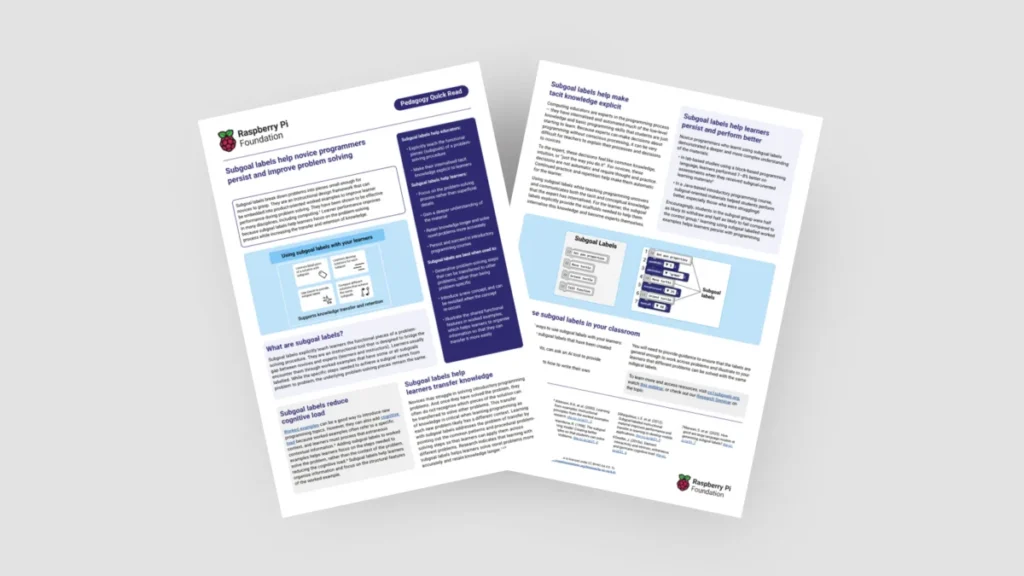
The Raspberry Pi Foundation’s release of the "Subgoal Labels Pedagogy Quick Read" is part of a larger series of resources aimed at making computing education accessible to all. By offering these materials for free, the Foundation is addressing the resource gap that often exists between high-funding private institutions and state-funded schools.
Analysis of Broader Implications and Future Outlook
The implications of adopting subgoal labels extend beyond the classroom. As the global economy becomes increasingly digitized, the demand for "computational literacy" is rising. However, the goal of K-12 computing education is not necessarily to turn every student into a professional software engineer, but to equip them with the ability to think logically and decompose complex issues. Subgoal labeling is a direct tool for teaching this type of high-level systems thinking.
Furthermore, in the era of Generative Artificial Intelligence (AI), the role of the programmer is shifting. With tools like GitHub Copilot and ChatGPT capable of generating syntax, the human element of programming is moving toward "prompt engineering" and "architectural oversight." Understanding subgoals is essential for this new paradigm. A programmer must be able to tell an AI precisely what the subgoals of a project are to receive accurate, functional code. Therefore, teaching students to think in subgoals is perhaps more relevant now than it was in the era of manual coding.
As the Raspberry Pi Foundation continues to update its pedagogical frameworks, the focus on subgoal labels is likely to expand into more complex areas, such as data science and machine learning. By mastering the art of breaking down a problem today, the next generation of learners will be better prepared to navigate the technological complexities of tomorrow. The move toward explicit, scaffolded instruction marks a maturing of computer science as an academic discipline, moving away from "magic" and toward a rigorous, accessible science.