Achieving true precision in modern motion control applications hinges critically on a deep understanding and meticulous selection of drives and controls, extending far beyond the mechanical specifications of actuators and motors alone. While system performance is often initially assessed by readily available data such as repeatability, accuracy, and load capability of mechanical components, this approach can prove insufficient for demanding, high-precision tasks. The intricate interplay between mechanics, motors, and their electronic orchestrators – the drives and controls – dictates the ultimate success of a motion system, particularly as industries push the boundaries towards micron and even nanometer-level accuracy. This third installment in a comprehensive series delves into the pivotal role of drives and controls, examining how their design, features, and capabilities form the intellectual core of any high-performance motion system.
The Foundational Role of Drives and Controls
Historically, the evaluation of motion control systems often began and ended with the mechanical components. Actuators were categorized by their inherent specifications, assuming that superior mechanics would inherently translate to superior system performance. However, as applications demand ever-increasing levels of precision, this simplistic view has proven inadequate. The first article in this series illuminated the often-overlooked mechanical nuances like bearing deflection, body stiffness, and structural smoothness. The second article subsequently explored the critical aspects of motor design, construction, and quality. Now, the focus shifts to the electronic "brains" – the drives and controls – which interpret commands, deliver power, and ultimately dictate the precise movement, speed, and positioning of the entire system. Without advanced, finely-tuned drives and controllers, even the most exquisitely engineered mechanics and motors cannot achieve their full potential, leading to performance gaps that are not evident on basic datasheets.
Evolution of Motion Control Electronics: From Basic to Bespoke
The journey of motion control electronics mirrors the broader technological revolution, evolving from rudimentary power delivery to sophisticated, intelligent command centers. In its most basic form, an electric motor operates by simply applying power, resulting in rotation. Early industrial applications often involved direct power application or simple switches. The advent of drives marked a significant leap, introducing electronic circuits designed to supply power to motors more smoothly and efficiently. These early drives enabled basic speed regulation and torque control, improving machine longevity and operational consistency.
Controllers then added another layer of intelligence, transforming simple motor operation into controlled motion. These devices provided the ability to manage acceleration, deceleration, velocity, and basic positioning, allowing for programmed sequences of actions. For many general-purpose industrial applications – such such as conveyor systems, simple pumping, or basic fan operations – this foundational level of electronics, often with default tuning settings, remains sufficient. The primary requirement is compatibility and reliable motor operation.
However, as industrial demands intensified, so did the complexity required from drives and controls. The mid-to-late 20th century saw the introduction of analog servo drives and then, critically, digital signal processing (DSP) based controllers. This digital transformation enabled faster processing, greater programmability, and more precise control algorithms, paving the way for the high-performance systems prevalent today. Modern controllers, often integrated with drives, represent the pinnacle of this evolution, capable of executing complex motion profiles, synchronizing multiple axes, and adapting to dynamic environmental conditions.
Tiered Performance: Matching Electronics to Application Needs
The concept of performance tiers, introduced earlier in this series, applies equally to drives and controls:
-
Basic Performance Tier: In this tier, the electronics primarily serve to power the motor and allow it to run. Sophisticated tuning features are rarely utilized, and default settings typically suffice. The focus is on robust compatibility and cost-effectiveness. Examples include simple material handling or non-critical fluid pumping.
-
Specification-Level Performance Tier: Applications requiring tighter control, such as automated assembly lines or packaging machinery, demand more from their drives and controllers. Here, tuning features become crucial, allowing engineers to adjust parameters like proportional, integral, and derivative (PID) gains to achieve desired responsiveness and stability. Correct programming of motion profiles and action sequences is paramount. Many performance issues in this tier stem from improper setup, missing settings, or inadequate tuning by personnel without specialized training. A common pitfall is attempting to pair a high-performance motor with lower-performance electronics, leading to suboptimal output and tuning difficulties. While often manageable, this mismatch prevents the system from reaching its full potential.
-
Beyond-Specifications Performance Tier (High-Precision Applications): This is where the true sophistication of drives and controls becomes indispensable. Applications in semiconductor manufacturing, advanced medical robotics, precision optics, and aerospace demand performance that pushes beyond standard datasheet metrics. For these systems, every detail of the drive and control architecture contributes to or detracts from the overall accuracy and stability.
Key Features for High-Precision Motion Control
High-performance drives and controls are engineered with a suite of advanced features designed to meet the most stringent requirements:
-
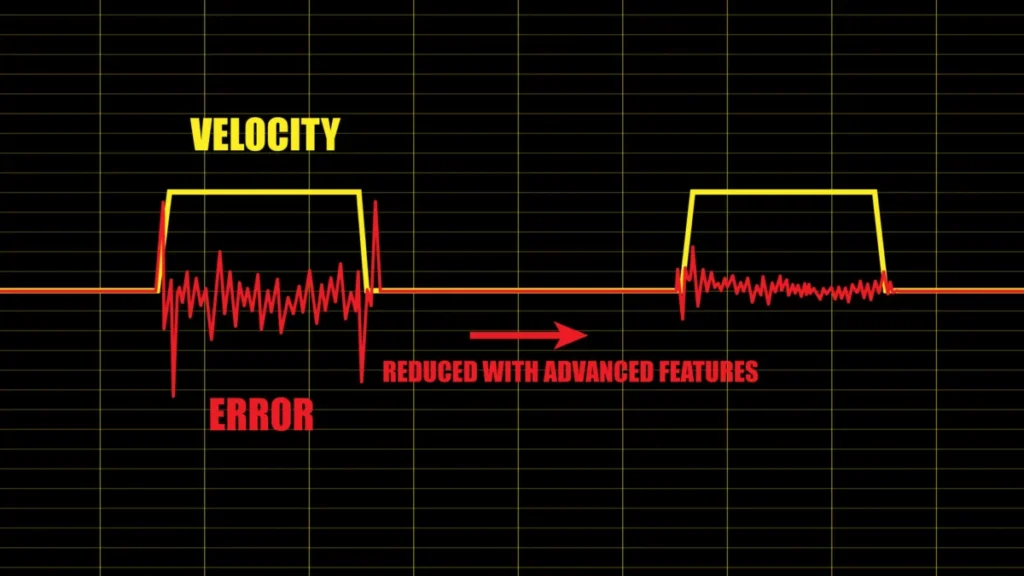
Advanced Tuning Features with Dynamic and Adaptable Gains: Unlike static PID gains, high-precision systems often require adaptive control algorithms that can dynamically adjust tuning parameters based on load changes, speed variations, or even environmental shifts. This ensures optimal performance across varying operating conditions, preventing oscillations or sluggish responses. Some controllers, such as the ECM series from ACS Motion Control, boast unique and powerful servo control algorithms, critical for achieving micron-level accuracy.
-
Multi-Axis Synchronization: For complex mechanical setups like gantries, Cartesian robots, or multi-axis manipulators, precise coordination across multiple motors is essential. Advanced controllers facilitate synchronous motion, ensuring that all axes move in harmony, preventing mechanical stresses, improving path accuracy, and enabling complex interpolated movements. This is vital for applications like 3D printing, laser cutting, or pick-and-place robotics where intricate tool paths are required.
-
Fast Servo Sampling/Update Rates: The speed at which a controller samples feedback from encoders and updates its control outputs (current and voltage commands to the drive) directly impacts responsiveness and accuracy. High-performance systems demand extremely fast update rates, often in the kilohertz range, to minimize latency and ensure that the motor precisely tracks the commanded trajectory. This rapid feedback loop is fundamental to maintaining stability and rejecting disturbances.
-
High-Speed Processors: To execute complex algorithms, manage multiple axes, and process real-time data from various sensors, controllers require powerful, fast processors. Insufficient processing power can lead to command lag, resulting in deviations from the desired motion profile and degraded performance. The ability to handle vast amounts of data quickly is a hallmark of controllers designed for high-end applications.

-
Environmental Adaptability and Robustness: Real-world industrial environments are rarely pristine. Electrical noise from arc welders, vibrations from nearby machinery, or fluctuating temperatures can significantly impact motion system performance. High-performance controllers incorporate features like notch filters to suppress specific resonant frequencies, anti-vibration algorithms, and robust electrical shielding to maintain stable operation. The anecdote of an OEM’s tool performing flawlessly in an isolated environment but failing in a noisy factory setting underscores the critical need for these adaptive tools.
-
Advanced Motion Profile Generation: Beyond simple trapezoidal or S-curve profiles, high-precision applications often require highly sophisticated motion profiles that minimize jerk (the rate of change of acceleration), reduce vibration, and optimize throughput. Controllers with advanced motion profile generation capabilities allow engineers to design custom trajectories that smoothly transition between different states, enhancing both precision and mechanical longevity.
-
Flexible Real-time Multi-threaded Programming: Modern high-performance controllers offer real-time operating systems (RTOS) and multi-threaded programming environments. This allows for the simultaneous execution of multiple tasks – such as motion control, I/O management, and communication – with deterministic timing. This flexibility is crucial for integrating complex processes and ensuring that critical motion tasks are executed without interruption.
-
Motion Optimization Tools: To simplify the complex task of system tuning and diagnostics, high-performance controllers often come with integrated software tools for analysis, simulation, and optimization. These tools can help identify resonances, predict performance, and fine-tune parameters, significantly reducing commissioning time and improving overall system quality.
-
Motion-to-Process Event Synchronization: In many high-precision applications, motion must be perfectly synchronized with external processes, such as laser firing, vision system triggering, or material dispensing. Controllers with advanced event synchronization capabilities can trigger these external actions with microsecond precision, ensuring seamless integration and optimal process outcomes.
Overlooked Details: Beyond the Datasheet’s Surface
Beyond the headline features, several nuanced aspects of drives and controls often prove to be decisive factors in high-precision applications:
-
"Auto-tuning" – A Starting Point, Not a Silver Bullet: While auto-tuning functions offer a convenient initial setup, they are rarely sufficient for truly optimizing high-performance systems. Auto-tuning algorithms typically aim for general stability and acceptable responsiveness, but they cannot account for specific mechanical resonances, complex load variations, or the subtle performance envelopes required for ultra-precision. Expert manual tuning, often involving frequency response analysis and iterative parameter adjustments, remains indispensable for pushing the boundaries of performance.
-
Encoder Resolution and Compatibility: The feedback loop is only as good as its weakest link. A high-resolution encoder provides abundant position data, but if the drive and controller cannot process this data at a sufficiently high rate or with adequate precision, the benefits are lost. The encoder’s resolution must not only match the application’s positional goal but also be fully supported by the electronics’ input capabilities, including interpolation and sampling rates. The choice between incremental, absolute, or serial encoders also has implications for noise immunity, startup procedures, and overall system architecture.
-
Fieldbus Communication Protocols: In multi-axis systems or integrated factory environments, the communication protocol between the master controller, individual drives, and other automation components is paramount. For high-performance, real-time applications, standard Ethernet is often insufficient due to its non-deterministic nature. Specialized industrial Ethernet protocols like EtherCAT, PROFINET IRT, or SERCOS III are designed for high-speed, deterministic data exchange, ensuring precise synchronization and minimal communication latency across the entire system. A robust fieldbus ensures that commands are delivered and feedback is received consistently and predictably, preventing communication bottlenecks that could degrade performance.
Industry Perspectives and Broader Implications
Industry experts consistently highlight the increasing reliance on sophisticated drives and controls for advancing manufacturing capabilities. "The global market for industrial motion control systems is projected to grow at a Compound Annual Growth Rate (CAGR) of over 6% through 2028," states Dr. Evelyn Reed, a lead analyst at TechInsights Research. "This growth is largely fueled by the demand for automation in high-precision sectors like semiconductor fabrication, medical device manufacturing, and advanced robotics, all of which are utterly dependent on intelligent drive and control technologies."
Application engineers from leading manufacturers echo this sentiment. "You can have the most robust mechanics and powerful motors, but without a finely tuned, intelligent controller, it’s like having a supercar with an unskilled driver," explains Mark Harrison, Director of Engineering at Valin Corporation. "The nuances of servo control algorithms, fast update rates, and environmental adaptation are what truly unlock the system’s potential, especially when dealing with sub-micron accuracies." Manufacturers like ACS Motion Control, with their ECM series control platforms, are continuously innovating, integrating powerful servo control algorithms and advanced power electronics techniques to meet these escalating demands.
The implications of advanced motion control extend across numerous sectors:
- Manufacturing: Precision motion control enables "lights-out" factories, vastly improving throughput, reducing waste, and enhancing product quality in industries ranging from automotive to consumer electronics.
- Robotics: It underpins the development of highly dexterous collaborative robots (cobots) and autonomous mobile robots (AMRs), allowing them to perform intricate tasks safely alongside humans or navigate complex environments.
- Medical Devices: From robotic surgery systems that demand unparalleled accuracy and safety to advanced diagnostic equipment and prosthetics, precision motion control is a critical enabler.
- Aerospace & Defense: It ensures the accuracy of flight simulators, missile guidance systems, and precision machining of critical components, where even minute errors can have catastrophic consequences.
- Semiconductor Industry: Perhaps the most demanding sector, requiring nanometer-level positioning for wafer fabrication, inspection, and packaging. Drives and controls are at the heart of achieving the yield rates necessary for modern microchip production.
Looking Ahead: The Future of Motion Control Intelligence
The trajectory of drives and controls points towards even greater intelligence, integration, and adaptability. Future trends include:
- Artificial Intelligence and Machine Learning: Integrating AI/ML algorithms into controllers will enable predictive maintenance, self-optimization, and adaptive control that can learn from operational data and adjust parameters in real-time for unprecedented performance and efficiency.
- Edge Computing: Decentralizing processing power to the "edge" – closer to the motors and sensors – will reduce latency, enable faster decision-making, and enhance system autonomy.
- Enhanced Connectivity (IIoT): Deeper integration with the Industrial Internet of Things (IIoT) will facilitate comprehensive data analytics, remote diagnostics, and seamless integration into broader smart factory ecosystems.
- Energy Efficiency: Continued innovation in power electronics will lead to even more energy-efficient drives, reducing operational costs and supporting sustainable manufacturing practices.
- Miniaturization and Integration: The trend towards smaller, more powerful, and highly integrated drive/controller units will enable more compact machine designs and simplify system architecture.
In conclusion, the journey to true precision in motion control is a multifaceted endeavor, a symphony where mechanics, motors, and electronics must perform in perfect harmony. While the physical components provide the muscle, it is the sophisticated drives and controls that provide the brains, orchestrating every movement with unparalleled accuracy and responsiveness. Disregarding the nuanced capabilities and limitations of these electronic components is a critical oversight that can undermine the performance expectations of an entire system. For engineers, designers, and system integrators, a holistic understanding of these layers of performance and specifications is not merely advantageous, but absolutely essential for constructing the high-precision motion systems of today and tomorrow.
This exploration of drives and controls forms a crucial part of our series on motion control performance. Readers are encouraged to revisit the foundational concepts in Part 1: Layers of performance and specifications in motion control, which examined the mechanics, and Part 2: Layers of performance and specifications in motion control, which delved into the motors. The series will continue with Part 4: Layers of performance and specifications in motion control, further exploring other critical elements of system design.






