In a landmark achievement for the field of condensed matter physics and quantum information science, researchers at Louisiana State University (LSU) have engineered a first-of-its-kind quantum material capable of operating at room temperature. This breakthrough, recently detailed in the journal Nature, addresses a fundamental bottleneck that has relegated quantum technologies to highly specialized, multi-million-dollar laboratory environments for decades. By demonstrating a material that can identify, sort, and transport distinct quantum states of light without the need for extreme cryogenic cooling, the LSU team has provided a blueprint for a new era of practical, scalable quantum devices.
For the better part of the 21st century, the primary obstacle to the "quantum revolution" has been the sensitivity of quantum states to thermal energy. Most known quantum materials—substances that exhibit macroscopic properties governed by quantum mechanics, such as superconductivity or quantum entanglement—require temperatures approaching absolute zero (-273.15 degrees Celsius or -459.67 degrees Fahrenheit). At these frigid depths, atomic vibrations, known as phonons, are minimized, allowing fragile quantum effects to persist. However, at room temperature, these vibrations become violent enough to disrupt quantum coherence, effectively "washing out" the information researchers seek to harness.
Overcoming the Cryogenic Barrier in Quantum Research
The necessity for cryogenic cooling has historically made quantum technologies both physically massive and prohibitively expensive. Standard quantum computers, such as those developed by IBM or Google, rely on large dilution refrigerators that consume vast amounts of energy and require specialized infrastructure. This limitation has made the transition from laboratory proof-of-concept to real-world consumer or industrial application nearly impossible.
The LSU study, led by Omar S. Magaña-Loaiza, an Associate Professor in the Department of Physics & Astronomy, marks a departure from the traditional search for naturally occurring room-temperature quantum materials. Instead of scouting for rare minerals or complex chemical compounds that might inherently possess these traits, the LSU Quantum Photonics Group turned to the field of "nanophotonics" to engineer a material from the ground up. This "bottom-up" approach allowed the team to dictate the material’s properties through geometric precision rather than relying on the luck of natural discovery.
The research team included key contributors such as Chenglong You, a former LSU postdoctoral researcher who now serves as a professor at the University of Electronic Science and Technology of China, and Riley B. Dawkins, who recently transitioned from LSU to a postdoctoral role at the National Institute of Standards and Technology (NIST). Their collaborative effort spanned the entire lifecycle of the project, from the initial mathematical theory to the complex nanofabrication of the material itself.
The Engineering of an Artificial Quantum Crystal
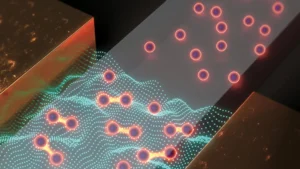
The LSU team’s creation is formally known as a "quantum statistical plasmonic metacrystal." The construction process began with a standard glass chip, onto which a microscopic layer of gold was deposited. Using focused ion beams—a high-precision tool used in semiconductor manufacturing—the researchers carved hundreds of nanometer-scale slits into the gold surface.
Each of these slits acts as a "meta-atom." While a natural crystal is composed of an ordered arrangement of atoms, this metacrystal is composed of an ordered arrangement of these engineered slits. Because these meta-atoms are larger than actual atoms but smaller than the wavelength of light, they can be manipulated to interact with light in ways that no natural substance can. The resulting structure is thinner than a human hair yet possesses the structural complexity required to manage quantum information.
When photons (particles of light) interact with the surface of the gold, they create "plasmons"—oscillations of electrons that move along the metal-dielectric interface. By carefully calibrating the size, shape, and spacing of the slits, the LSU physicists were able to control how these plasmons, and the light they represent, move through the material. This level of control allowed the team to create what they call "quantum statistical bands."
A New Mechanism: Quantum Statistical Bands and Robust Transport
The concept of "energy bands" is central to modern electronics; it is the reason semiconductors like silicon can be used to build transistors. In a semiconductor, these bands determine which electrons can flow and which cannot. The LSU team’s metacrystal applies a similar logic to the quantum statistics of light.
Light is not a monolithic entity. Different sources of light—such as the sun, a laser, or a fluorescent bulb—exhibit different statistical behaviors at the quantum level. Until now, distinguishing between these types of light required millions of measurements and complex, cryogenically cooled detectors. The LSU metacrystal, however, acts as a "statistical filter." It can automatically identify the quantum "fingerprint" of incoming light and sort different quantum states into separate pathways.
"We call this robust transport," Professor Magaña-Loaiza explained. This term refers to the material’s ability to move quantum information from one point to another without the information being degraded by the surrounding environment. Because the metacrystal is inherently sensitive to the "many-body" coherence of photons, it can maintain the integrity of the light’s quantum statistics even at room temperature. This is the first time a material has demonstrated the ability to preserve such delicate quantum properties without the assistance of a vacuum or extreme cold.
Implications for Computing, Communication, and Security
The ability to process quantum information at room temperature has profound implications for the future of high-performance computing. If quantum processors no longer require the bulky and expensive refrigeration systems currently in use, they could eventually be miniaturized for use in data centers or even portable devices. This would drastically reduce the "entry barrier" for companies and research institutions looking to utilize quantum algorithms for drug discovery, financial modeling, or climate simulation.
Furthermore, the metacrystal’s ability to sort quantum states of light is a major boon for secure communication. Quantum Key Distribution (QKD), a method of sending unhackable messages, relies on the ability to transmit and detect specific quantum states. A room-temperature material that can "filter" and "transport" these states reliably would make quantum-encrypted networks far more feasible for urban infrastructure.
In the field of sensing, the metacrystal’s sensitivity to subtle variations in light could lead to the development of advanced sensors capable of detecting biological markers or chemical traces at much higher resolutions than current optical sensors allow. Because the material is sensitive to the quantum statistics of light, it can "see" details that are invisible to classical detectors.
Potential Breakthroughs in Solar Energy Efficiency
Perhaps the most unexpected application of the LSU discovery lies in the field of renewable energy. The team is currently exploring how the metacrystal might be used to enhance the efficiency of solar cells.
Current solar technology faces a hard physical limit known as the Shockley-Queisser limit, which dictates the maximum theoretical efficiency of a single-junction solar cell. One of the primary reasons solar cells lose efficiency is "thermalization," where high-energy photons are absorbed, but their excess energy is lost as heat rather than being converted into electricity.
By integrating these metacrystals into solar panels, researchers believe they can guide light more effectively and prevent the "trapping" of light that leads to heat loss. "Our crystal can distinguish quantum states and move them in a robust way," Magaña-Loaiza noted. If this robust transport can be applied to the way photons are managed within a solar cell, it could allow for a higher percentage of sunlight to be converted into usable electrical energy. The team has already begun planning experiments to incorporate the metacrystal into experimental photovoltaic designs to test this hypothesis.
Chronology and Support
The development of the quantum statistical plasmonic metacrystal was a multi-year effort that began with theoretical modeling within the LSU Quantum Photonics Group. The team first established the mathematical framework for how a "meta-atom" lattice would interact with the quantum statistics of light. Following the theoretical validation, the group utilized advanced nanofabrication facilities to etch the patterns into gold chips.
The final phase involved rigorous experimental testing, where the team used various light sources—including lasers and thermal emitters—to prove that the material could indeed sort and transport quantum states at room temperature. The research was supported by the U.S. Department of Energy (DOE), specifically the Office of Basic Energy Sciences, Division of Materials Sciences and Engineering, under Award DE-SC0021069.
Conclusion and Future Outlook
The LSU team’s discovery represents a shift in the philosophy of quantum material science. By moving away from the discovery of natural materials and toward the engineering of artificial "metamaterials," physicists are no longer limited by the constraints of the periodic table.
"One of the most exciting parts of this project was realizing that we could build a material that does something nature doesn’t provide on its own," said Chenglong You. This sentiment highlights the broader impact of the study: it provides a general blueprint for building a whole family of room-temperature quantum materials.
As the global race for quantum supremacy intensifies, the ability to operate outside the confines of the "deep freeze" will likely be the deciding factor in which technologies become commercially viable. The LSU quantum statistical plasmonic metacrystal stands as a significant milestone on that path, offering a glimpse into a future where quantum technology is as accessible and ubiquitous as the silicon-based electronics of today. The team’s next steps will involve refining the fabrication process to make larger arrays of these crystals and beginning the first real-world tests in solar energy and telecommunication hardware.